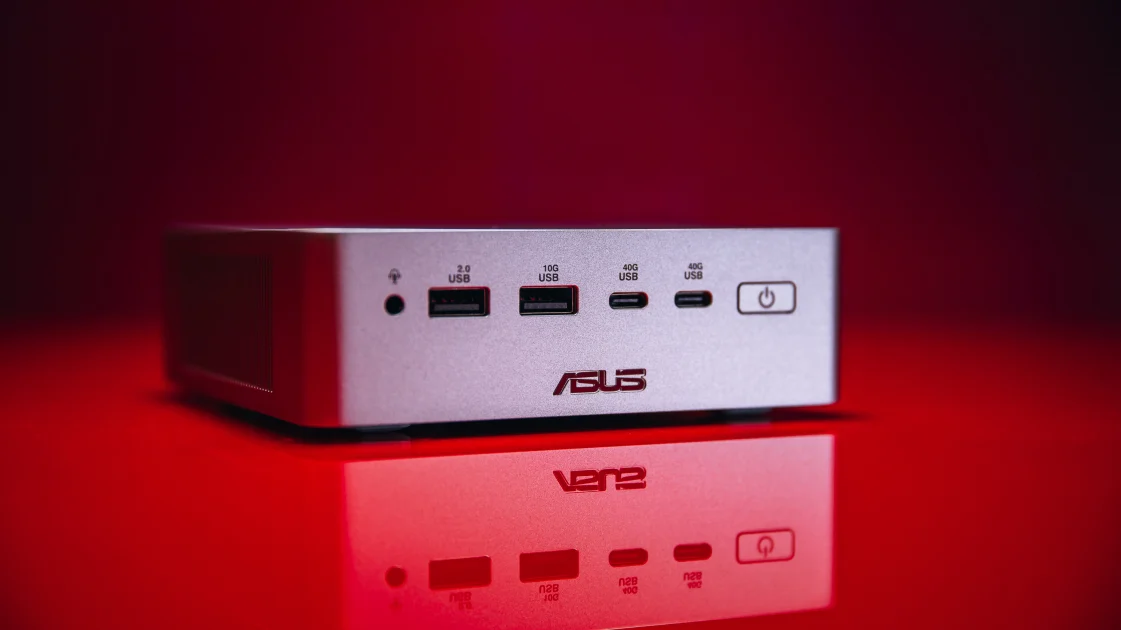
Qualcomm’s Snapdragon X2 Elite (X2E-88-100) is the driving force in the Asus Ascent QN10. It is from this chip that the system derives its processing power and most of its functions. Performance in most tasks depends on 18 third-generation Qualcomm Oryon CPU cores clocked up to 4.7GHz, while graphics performance is handled by a Qualcomm Adreno X2-90 GPU. We have few details about this graphics chip, but Asus notes that the GPU should be 1.5 times faster than the previous generation. Finally, the chip has a Qualcomm Hexagon NPU rated at 80 trillion operations per second (TOPS) for AI workloads. This last part has led Asus to claim that the Ascent QN10 has the fastest NPU in a mini PC.
(Credit: Joseph Maldonado)
Asus is technically correct here, but that doesn’t mean the Ascent QN10 is the mini PC with the most AI resources available. The fastest NPUs currently available from AMD and Intel are at 55 and 50 TOPS respectively. This does not take into account the AI performance of the graphics hardware built into competing AMD and Intel products. The AMD Ryzen AI Max+ Pro 495, which has AMD’s fastest NPU, includes a graphics processor capable of an additional 76 TOPS, giving the processor a total of 131 TOPS of AI horsepower.

(Credit: Joseph Maldonado)
Intel’s NPU in its Core Ultra X7 358H processor is the slowest of the three competitors, at just 50 TOPS. However, its graphics hardware is the fastest, and this contributes an additional 122 TOPS of AI processing power. With a combined 172 TOPS of AI computing muscle, the Intel option produces more than double the AI processing power of Qualcomm’s Snapdragon NPU.
Qualcomm doesn’t specify how much its Snapdragon X2 GPUs improve AI processing, if at all, instead only reporting the 80 TOPS NPU figure. If the Adreno GPU contributed significantly, Qualcomm would surely shout it from the rooftops.
Both the aforementioned AMD and Intel chips are available in mini PCs that compete with the Ascent QN10. If you really want the most AI computing you can get from a mini PC, measured in TOPS, you should look for one of these instead.

(Credit: Joseph Maldonado)
The Ascent QN10 may not have the most AI processing power among mini PCs, but it is still useful for developing AI tools. An important consideration in software development is whether the public will be able to access the apps or tools you are developing. If the software you create requires more processing power than most people have available, it will limit your user base.
This makes the QN10 a meaningful platform for developing AI applications that run well on similar devices. To develop more powerful AI apps or use them yourself, you’d be better off buying a desktop with a graphics card (or at least one with a system-on-chip that has more substantial GPU AI computing power).
In addition to the Snapdragon chip, our test sample of the QN10 is equipped with 32GB of LPDDR5X memory at 9,600MHz and a 512GB Sandisk PC SN51005 NVMe PCIe 5.0 solid-state drive. A second M.2 slot, which runs PCIe 4.0 lanes, is accessible under the bottom cover of the PC to add a second SSD.