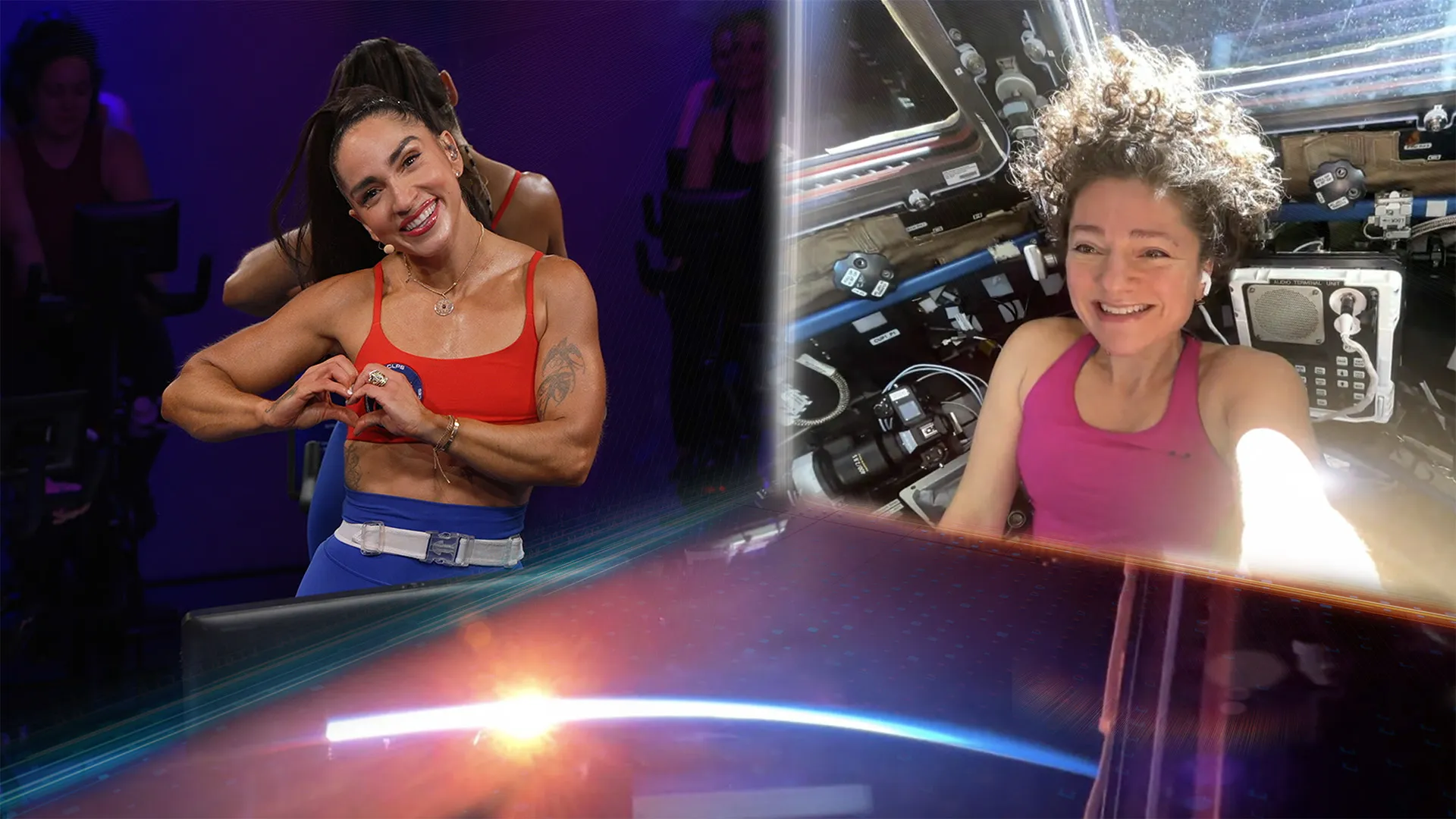
Peloton instructor Robin Arzón just took fitness out of this world and into space. Their new 20-minute class features astronaut Jessica Meir, who beamed directly from the International Space Station when the ride was recorded. The class is available for free on Peloton’s YouTube channel or through the Peloton app.
The ride begins with Arzón introducing Meir, who shows the rider her view of the Earth of the space station’s dome, the dome-like observatory that many astronauts use to take photographs Earth. Meir remarked during the ride that the view of our planet is magical and “never gets old.”
Meir goes to class on an exercise bike that resembles a minimalist, high-tech unicycle mechanism without a seat or handlebars, anchored to the wall, called the FERGO, or Flight Ergometer. In microgravity, pressing down on a pedal would launch an astronaut back to the ceiling. To stay in place, Meir wears a wide waist belt secured to stiff side straps with her cycling shoes and specialized pedals clamped with straps.
Meir talks about the importance of cardiovascular activity and “living happily in isolation” in a short video during her previous stint on the ISS in 2020, during the COVID-19 lockdown. There, she and fellow astronaut Drew Morgan showed off an earlier model of the bike, called CERVIS (Cycle Ergometer with Vibration Isolation and Stabilization System), as well as a T2 treadmill for running, which uses a belt and bungees to combat near-weightlessness.
A wild fitness ride through space
Even if you don’t travel, it’s worth watching the class to learn what it’s like aboard the ISS. Meir addresses questions that anyone interested in fitness or space (or both) will appreciate: the importance of strength training for astronauts and the changes the human body undergoes.
“We need the load on our muscles and our bones to keep our muscles and our bones healthy,” says Meir. “If we didn’t have that, we’d lose a significant amount of muscle mass as well as bone density. Up here, when you get into microgravity, your bones start to leak calcium, just because they’re not being loaded.”
Meir says astronauts commit 2.5 hours a day to exercise, spending a lot of time on the ARED, or advanced resistance exercise equipment, doing everything from squats and deadlifts to bench presses and sit-ups. The machine, which she describes as an “engineering marvel,” can go up to 600 pounds.
There were other fun moments in the video, including when Meir takes a drink of water by making a blob in the air from her water bag and gently tossing it in the air before catching it in her mouth, a moment that really delighted Arzón. Meir also talks about using a “space toilet” (which consists of a “big pump” that sucks everything down), and how the ISS recycles up to 98% of its water, including processing urine. She says that “today’s coffee is also tomorrow’s coffee,” or as astronauts like to say, “from toilet to tap.”
Exercise with astronauts
CNET Senior Editor Laura Michelle Davis, an avid Peloton member who often chooses Arzón as an instructor, found the ride both instructive and inspiring.
“The ride was full of information about the effects of microgravity and the importance of lifting weights when you’re just floating around,” Davis said. “It was also full of tech and engineering marvels, livestreaming a conversation from hundreds of miles above the Earth’s surface to a Peloton studio in NYC and eventually appearing on my bike monitor at home.”
Physical activity is a common talking point for astronauts. Sunita Williams was the first astronaut to run a full marathon in space, synchronizing it with the Boston Marathon in 2007 and completing the race in 4 hours and 24 minutes. Astronaut Tim Peake was the second astronaut to do so, running in the 2016 London Marathon, which he completed in 3 hours and 35 minutes.
For the people on Earth, the Peloton video was a chance to get in some reps while learning a little more about the ins and outs of life in space.
“It’s always easy to get lost in the experience when you’re doing a peloton ride,” Davis said. “This ride kept my brain active, pushed me to think about what it’s like to live (temporarily) in space and how astronauts’ bodies adapt. It felt like my own intergalactic journey.”

See full bio