Editor’s note: Requiring a seamless connection of the organization’s personnel, change management is closely tied to mobility. If you want to lead your company through change smoothly and quickly, consider developing an effective change management mobile app with ScienceSoft’s mobile experts.
Just by looking at the history of change management and more than 1,000 search results (as of this writing) for the vacancy “Change Manager” on monster.com, it is safe to make two assumptions.
First, change is important. More and more companies understand that Darwin’s theory of survival also applies to businesses. Second, change is hard. There are several models for going through an organizational change, but few of them can capture the challenge in all its aspects.
The combination of these models with each other as well as with state-of-the-art HRM technologies can significantly develop and improve change management. That’s exactly what this article aims to do.
How it all began: penguins and ice cubes
To reintroduce his 8-step change management model from the classic 1996′ Lead changeIn 2005 Dr. John P. Kotter published Our iceberg is melting – a fable about penguins who are forced to look for a new way of life when danger approaches their home. Intentional or not, Kotter’s “melting ice” theme echoes back to the starting point of it all – Kurt Lewin’s model created in the 1940s.
Lewin, a psychologist who seems to admire equations as much as good metaphors, compared business change to a process of reshaping an ice cube into an ice cone. Consisting of 3 stages that logically reflect the triad of a change process “then – now – in the future”, Lewin’s model has inspired many others that also include 3 steps. Similar models with 4-10 steps, not excluding Dr. Kotter’s 8 steps, elaborate on Lewin’s initial model.
What is missing from change management: democracy and flexibility
Fundamental change involves not only business reforms, but also complicated psychological transitions and “withdrawals”. For example, in the 1990s, in order to convert the mandatory tax payment into a customer service, the Revenue Service had to reshape the entire behavior pattern of its employees, which required a lot of work and a lot of time, because it is in human nature to resist changes.
Despite the theory leaving room for resistance, no model actually shows how to implement change in a way that is different from the ‘top down’ or unrealistic ‘command and control’ method. Furthermore, the tips of some experts can be counterproductive if taken to the extreme (like repeating the same vision statement over and over again). Such obtrusiveness can easily make employees withdraw from the idea.
Both Lewin’s and Kotter’s models talk about how communication is important during change, but some companies are not even office-based and have employees who work in shifts or in the field. These organizations may face problems with tuning their communication, but they still have the right to go through the change process successfully.
How to develop change management with mobile
People actively participating in the change process and being its driving force is what both models, Lewin’s and Kotter’s, propose. However, most HR managers would agree that reaching employees is one of the most difficult goals a company can aim for at the time of change.
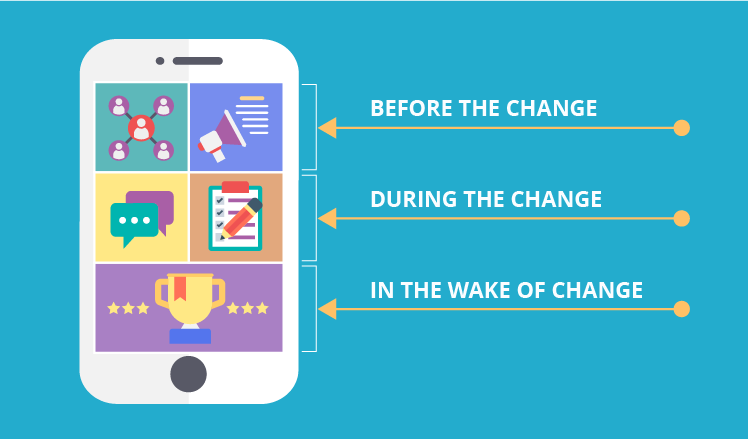
In other words, change would be faster, smoother and more efficient if everyone in the company was immersed in the process, playing their part in it and connected to each other. And that’s exactly what mobility with its extremely flexible nature can offer for all 3 steps of Lewin’s model.

1) Before the change
According to Lewin, it means that ‘sacrificing’ a square ice cube means destroying the status quo. Kotter would later expand on this first step and emphasize the need to announce upcoming changes and their assumptions in advance, decide on the vision the company should strive for and appoint those responsible for bringing the change to life.
How cell phones help:
Elaborating on Lewin’s model, Kotter makes it clear that there should be an “advisory body” to promote change in the company. To make this “coalition” (as Kotter addresses it) diverse, experts advise choosing representatives of 4 large groups of employees who combine both high and low power with high and low interest. However, should managers measure employee interest subjectively? Is ‘power’ only defined by a position? And more than that, are power and interest the only important criteria?
To help HR managers in the preliminary stages of change, a mobile app can display personalized tests that not only question employees’ attitudes to change, but also their personal characteristics such as rationality, charisma, conservatism, etc. With this, HR managers can make a much more reasonable choice of ‘coalition members’ based on the information they receive.
Daily notifications sent to employees’ mobile apps can be helpful in keeping them on the same page, regardless of their work type or schedule. Given a regular update on the change requirements (not in the form of pompous slogans, but as objective information about the market, company statistics or ratings), employees can form their own opinion and believe that the change is indispensable and inevitable in its own right.
2) During the change
In his second step, Lewin describes a complicated and almost unrealistic job of shaping the water from a melted square ice cube into a cone. Everything in business change is equally delicate, and every detail that slips through the fingers can turn into a serious mistake. Constant support, prompt regulations, clear communication and continuous commitment is what this step requires, and mobile software can bring it in.
How cell phones help:
Discussions and opinion polls
Communication is key to dealing with dissatisfaction and conflicts, and is essential to the change process. However, as mentioned above, not all companies can have regular face-to-face communication due to their workflows.
Installed on portable devices, mobile apps can keep everyone in touch and communication going. Special chat rooms with discussions on controversial topics can help employees stay on the same page, even if they are part-timers or work in the field. Furthermore, opening a survey to hear directly from employees will make them feel valued.
Task management and feedback
What makes employees feel even more important for the company is being entrusted to fulfill change-related tasks, such as special training, or cultural studies in the case of international mergers. Unfortunately, these often do not fit into a standard planning system or a schedule. What’s more, if they are simply listed together with common work procedures, these tasks can lose their specific nature in relation to change.
For staff to approach change-related tasks with all the attitude and perception they have formed so far, a mobile app can become an agile task management and feedback tool. With all the tasks listed separately on a mobile device, employees can receive instant notifications when a task has been added, update the progress and ask their line manager directly in the app. For management, such an application is a practical way to monitor performance and intervene when necessary.
3) In the course of change
It is almost impossible to mark the moment when the change is complete, so by Lewin’s “refreeze” one should not understand that success is consolidated.
Most companies ignore ‘short-term profits’ (Kotter’s term) for various reasons. Some think the employees don’t take them seriously; some can not come with the gratification form, since financial bonus is difficult on any company that makes drastic changes. This last step is about what should be done as soon as at least significant progress in change is noticed to engage people to keep the progress going.
How cell phones help:
Proven to be effective gamified elements, achievements and awards will keep the workforce interested in the app and change the process itself. A company can announce that awards are monetized when the company is facing hard times, but even virtual signs or awards are much better than nothing. Moreover, excelling at change-related tasks in order to get an achievement can become addictive, because such a scheme triggers a psychological ability to collect that lies dormant in all of us.

Keynotes
Like all theories, change management models offer logical but sometimes unrealistic solutions. In addition, employee engagement, which is the core of a successful change, can hardly be promoted with pushy ideas and principles. Mobile software can become an effective tool that keeps employees informed, connected, engaged and motivated.