
Originally published: March 11, 2025
Updated: September 4, 2026
I know I am a bit late to the party, but there isn’t exactly an abundance of proper networking hardware coverage these days, so I figured why not test the TP-Link EAP773 myself? And so, I got my hands on this slim half metal, half-plastic WiFi 7 access point that rivals Ubiquiti not only in terms of size, but in terms of price and features as well.
The EAP773 is a tri-band access point, so besides 2.4Ghz and 5GHz, it includes the 6GHz radio that can use up to 320MHz channel width. There’s also MLO support, Cloud and local management, mesh and AI roaming. It ticks pretty much all the boxes. But there is one other feature that made the EAP773 considerably more interesting to me: the 10GbE port. That’s something I only saw on the far more expensive WBE660S, while quite a few WiFi 7 APs settle for 2.5GbE.
Once the wireless throughput starts pushing beyond 2Gbps (and it does already), the wired uplink will become part of the conversation whether we like it or not. TP-Link avoided this problem altogether, so we should expect to see some impressive throughput, right? I think so considering that the WBE660S performed extremely well in my tests, which means that the EAP773 may pull something similar. So let’s see it in action.
The Design and Build Quality
I did a teardown video of the TP-Link EAP773 a few months back and even then I was surprised by how slim the access point was, especially when compared to the EAP670 or the EAP660HD. Plus, the device has metallic bottom for a better heat management.
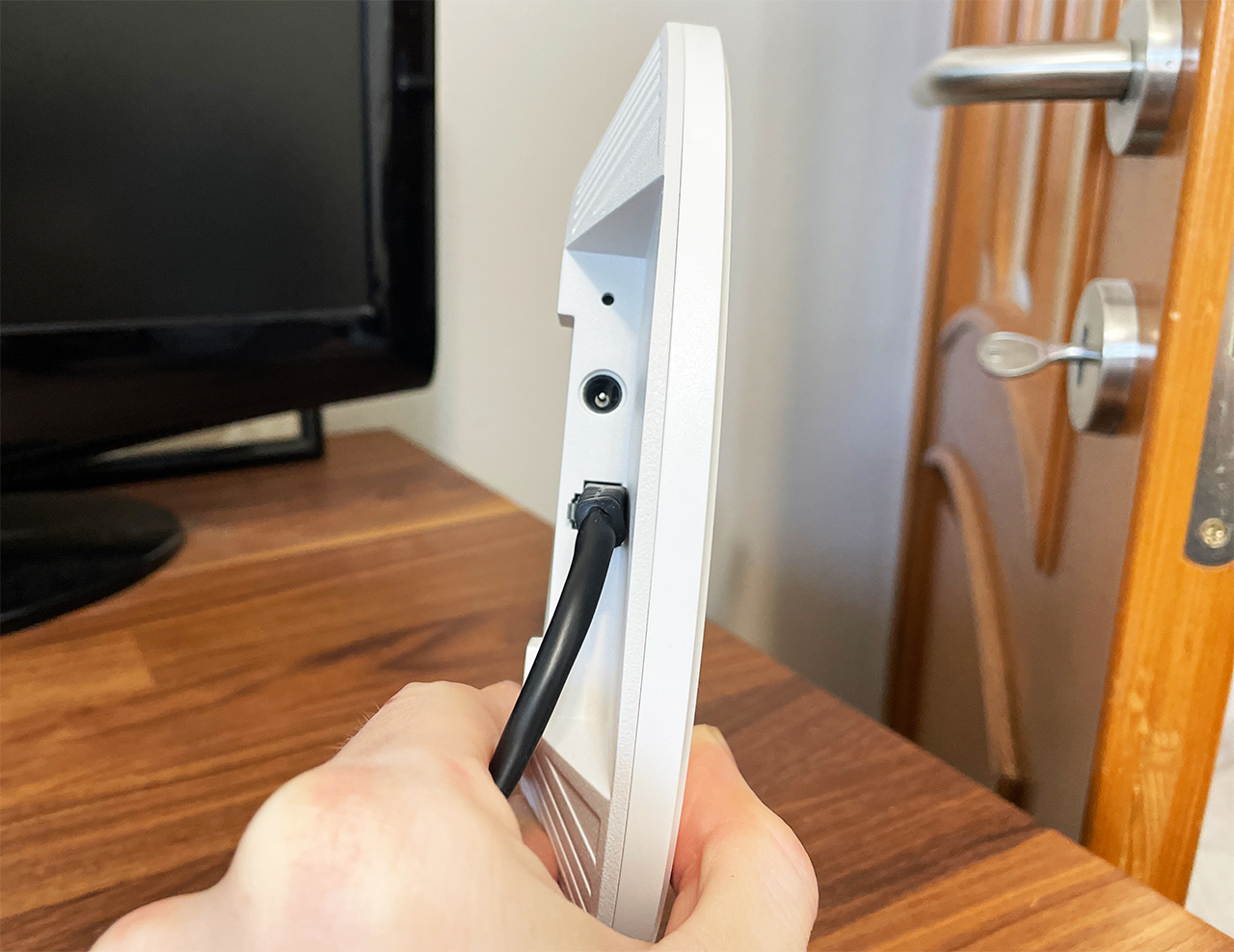
I didn’t see an obvious LED but it’s there, shinning through the plastic top, showing colors depending on the status of the network and of the access point. Flip the device back and we get to see a sunken area especially dedicated to the ports. And we can see one Ethernet port which we know, is capable of speeds up to 10Gbps. It’s also PoE, of course. Next to it, there’s a 12V DC In port and a small Reset button.
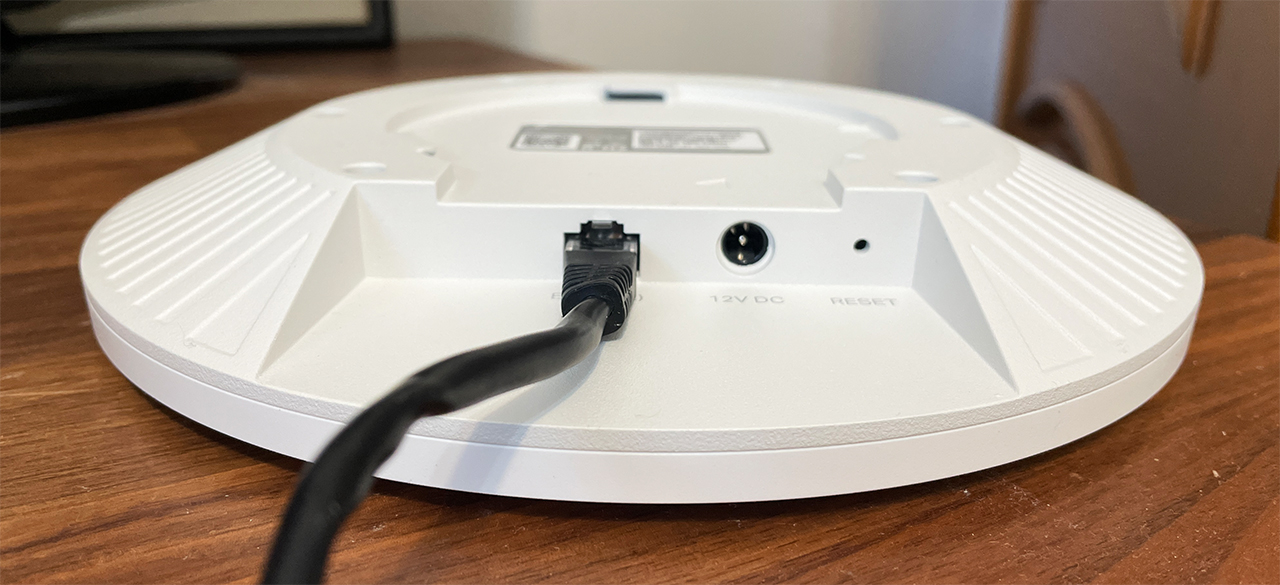
So yes, it’s a nice-looking device, but let’s check out its wireless performance in the Test Lab Tool.
Wireless Performance and Test Lab
MBReviews Lab: TP-Link EAP773 Tested in 2025 on firmware V1.6_1.0.14 Build 20240801. Tests available: MLO, single-client distance and signal-strength throughput, long-duration stability, multi-client application latency. Compatible devices can be compared here.
Test details
Test year: 2025. Firmware: V1.6_1.0.14 Build 20240801.
Charts use measurements stored in the MBReviews benchmark database. Stability charts are downsampled for display; the full one-second series remains in the database.
Read the full MBReviews Wi-Fi testing methodology.
Explorer version: 0.19.0.
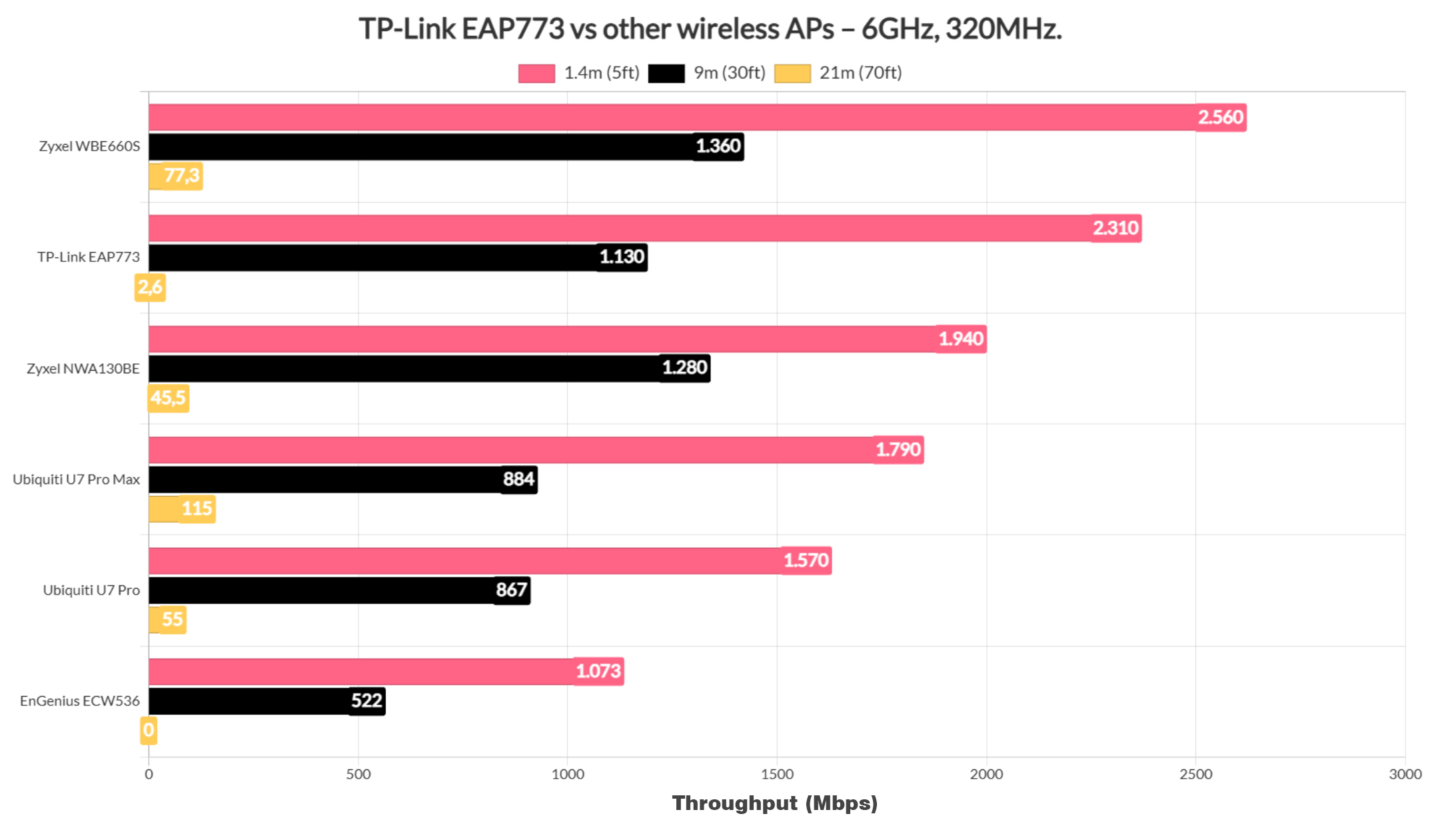
I admit that I was expecting the TP-Link EAP773 to offer a better throughput than the other WiFi 7 access points in the same price range and I was right. I did run a few single-client tests using WiFi 7, WiFi 6 and WiFi 5 client devices and we can see way over 2Gbps near the access point, but not as much of an impressive throughput at 70 feet or 21 meters. And this is true as long as I used the WiFi 7 adapter and, of course, the 6GHz radio.
Switching to the 5GHz made some significant improvements. And it does seem that the TP-Link EAP773 is one of the few access points to use the 240MHz channel bandwidth. And yes, the signal attenuation graphic does confirm that it’s better to use the 5GHz radio if you intend to cover more ground with WiFi.
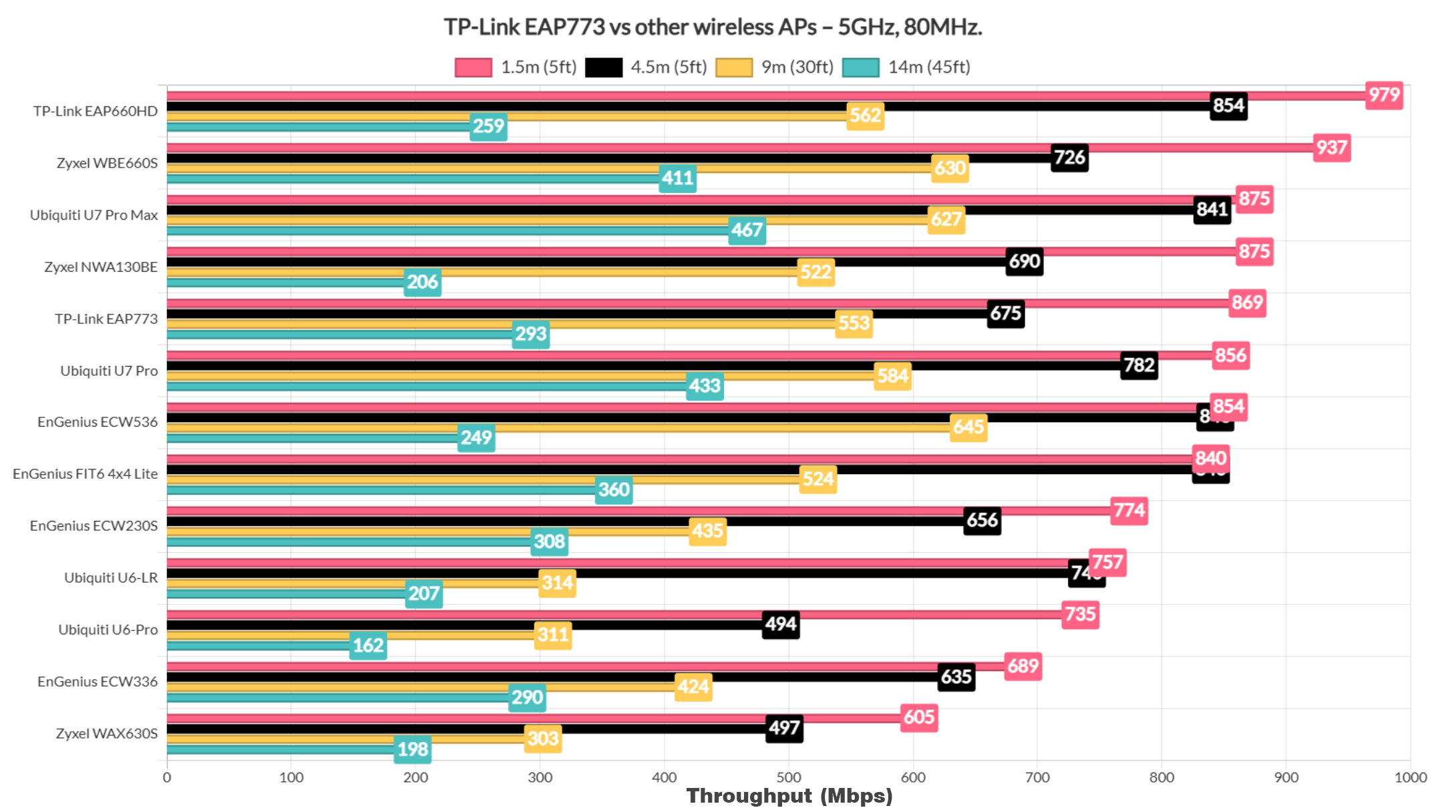
I did include a comparison with other access points that I tested over the years and, when using the 5GHz radio and the 80MHz channel width, the EAP773 sits in between the Zyxel NWA130BE and the U7 Pro.
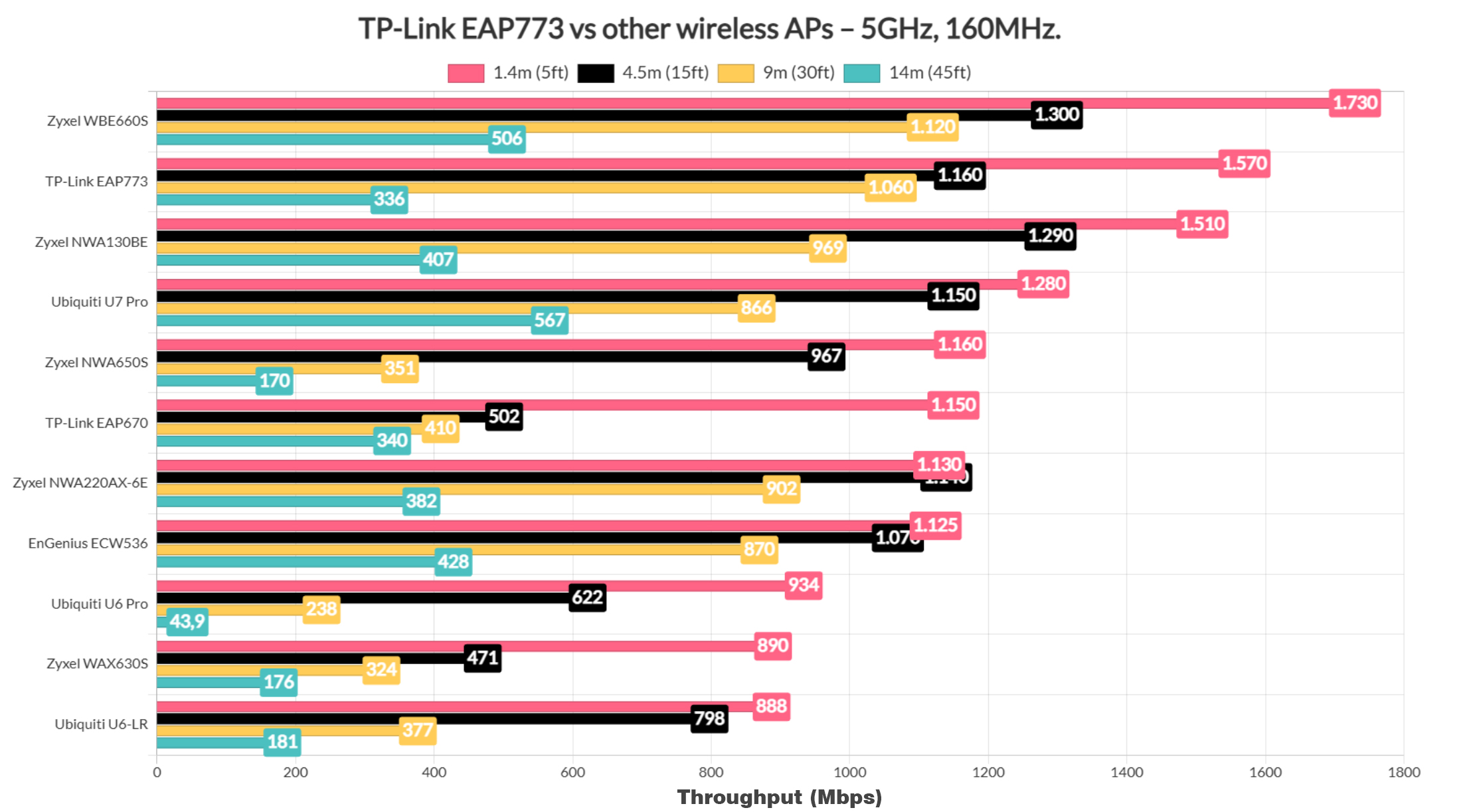
Switching to the 160MHz width, things do change and the EAP773 sits below the more expensive Zyxel WBE660S.
I was very curious how would it stand when using the 6GHz radio and the 320MHz channel bandwidth, and, as you can see, it does take the second place.
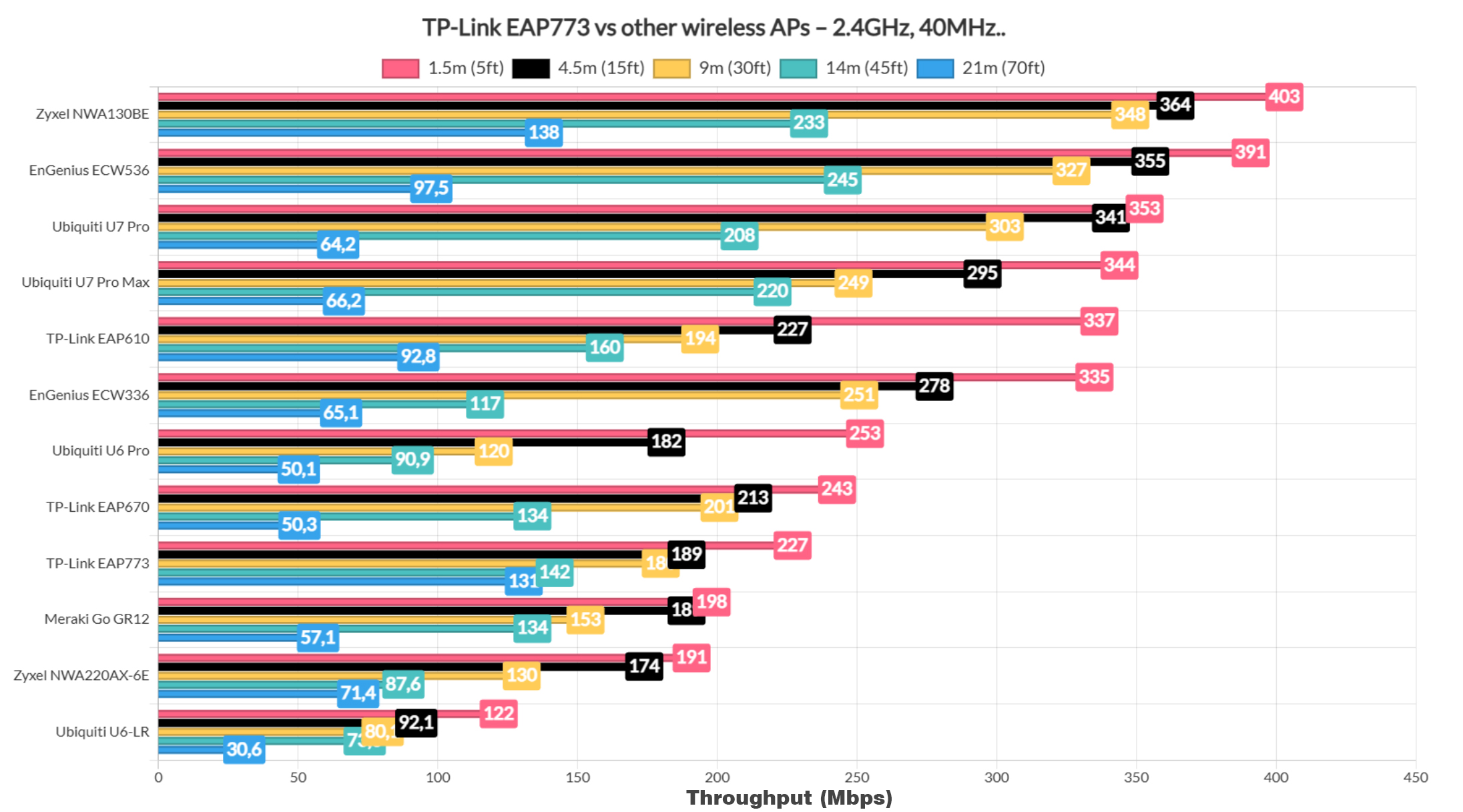
Using the 2.4GHz radio at 40MHz, U compared the EAP773 to other access points, and it is not really a top performer, sitting below the EAP670.
For the multi-client tests, I used net-hydra by Mr Jim Salter once again and, using a server PC, as well as five wireless client devices, I could simulate various types of traffic. The full client-by-client results are available in the Test Explorer, but if you would like a sort of summary, know that with 1080p streaming, the WiFi 7 client performed best, followed followed by the two WiFi 6 client devices which remained under 100ms for at least 95% of the time.
The two WiFi 5 clients struggled more. The performance is similar to the Zyxel WBE660S and the NWA130BE, and also a bit better than the U7 Pro. Things got more interesting once I combined the streaming with intense browsing. Running it alongside 1080p streaming traffic, the latency remained reasonably controlled, but the 4K streaming pushed most clients above 100ms.
The uncapped download traffic showed the EAP773 in a better light, With once client continuously downloading downloading a 10MB file alongside two intense browsing clients and two 4K streaming clients. the downloading client needed 572Mbps of throughput and it remained near 100ms for 95% of the time which is far better than expected. It was better than the WBE660S which was already superior to the U7 Pro and the NWA130BE.
Reducing the workload and switching to 1MB downloads brought the latency back below 100ms, with browsing and VoIP also remaining within reasonable limits.
MLO Performance
Since MLO is now functional on pretty much every WiFi 7 AP that I have tested, I had to also test it on the TP-Link EAP773. The full throughput results are available in the Test Explorer, so I won’t repeat every configuration here.
The standout result was the combination of 5Ghz at 240MHz and 6GHz at 320MHz which pushed the upstream throughput to almost 4Gbps near the access point. That’s the highest MLO throughput I have measured so far. Downstream followed the same general pattern, but at a lower throughput. One limitation is that the EAP773 did not allow me to include the 2.4GHz radio in MLO. That could have helped with range, where the 6GHz loses strength considerably faster.
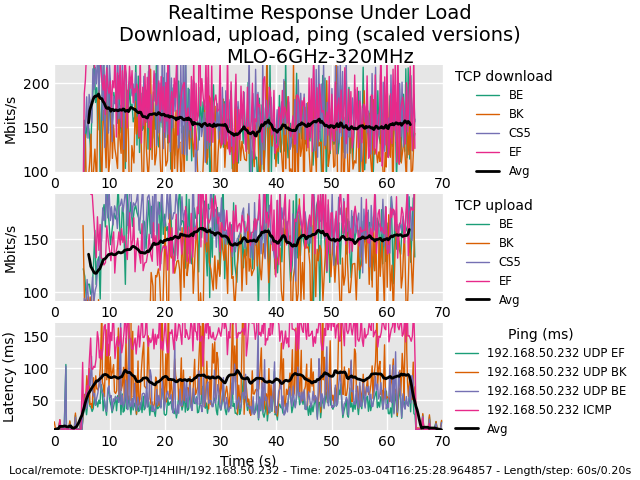
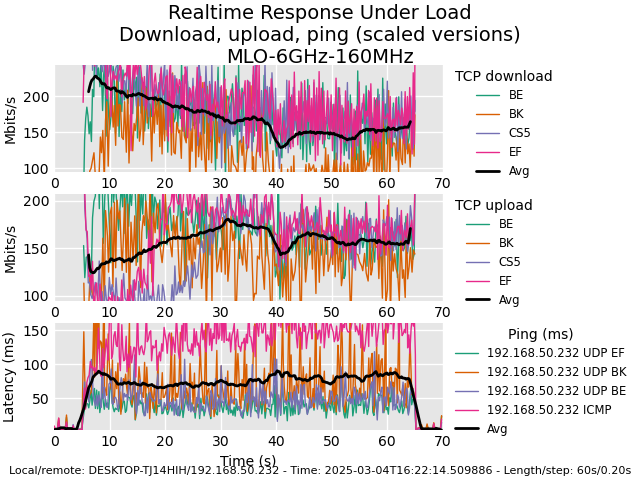
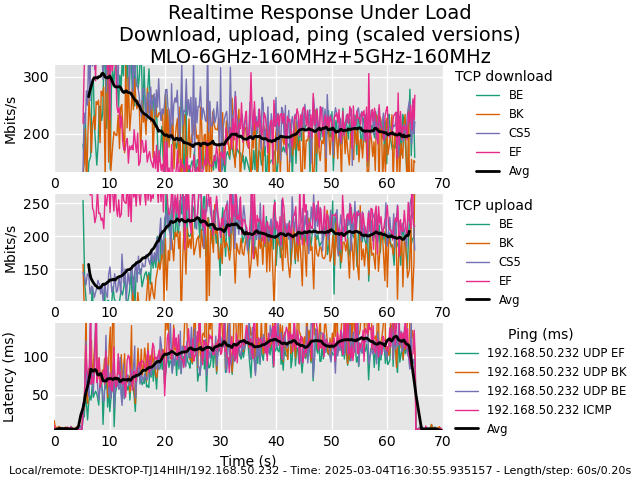
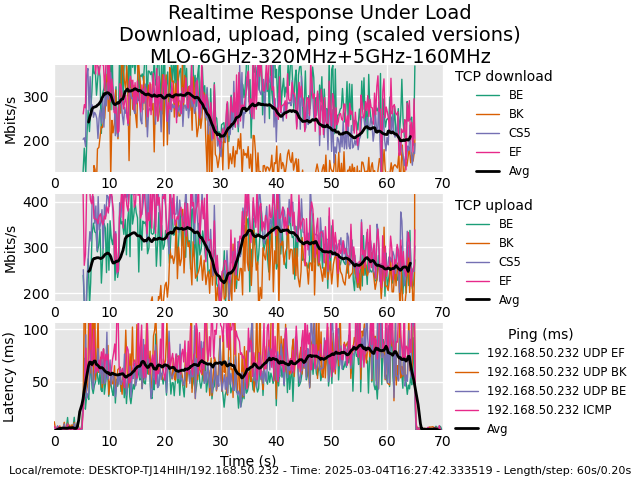
Raw throughput, however, tells only a part of the story. I also wanted to see what happens to latency while the MLO connection is under load, so I ran the EAP773 through my usual FLENT tests.
The Thermal Management
As I mentioned before, the TP-Link EAP773 relies on the bottom metallic part of the case to take away the heat from the main components and there is no actual ventilation hole, that’s the entire system. Does it work or would a fan be better, as in the case of the U7 Pro and U7 Pro Max?
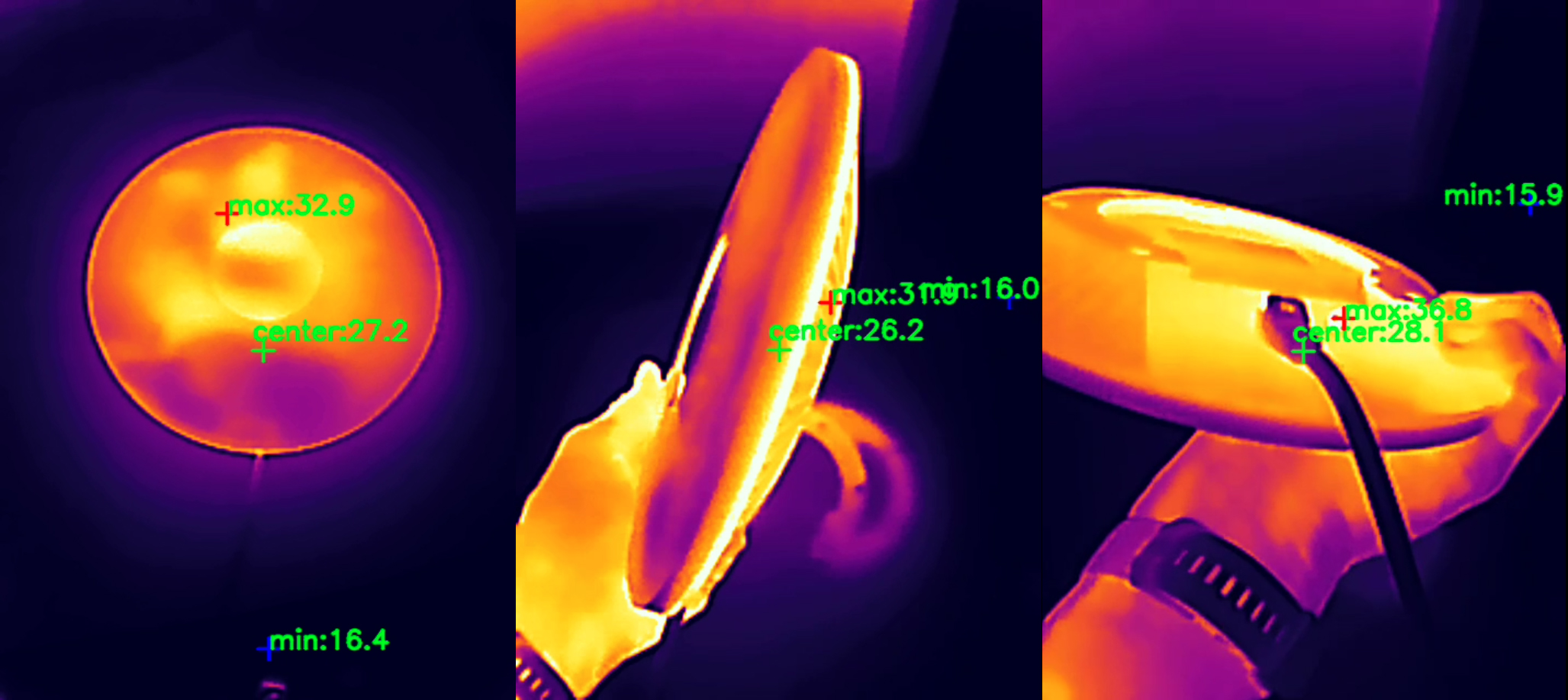
The thermal camera that I used here shows that it worked fairly well and the case does not overheat. So, despite being smaller and more compact, there is no need for a fan to keep things under control.
TP-Link EAP773 Teardown
Unlike other brands, TP-Link made opening up the case of the EAP773 a breeze. There are six screws that need to be removed and that’s about all, the top panel should easily pop out. Then, we get to see the PCB, but yes, the main components do rest on the other side. Not a big deal because it only takes the removal of a few screws. I quickly realized that there is no fancy antenna as on the WBE660S or even the cheaper NWA130BE, but we do get a good view of the main components. I also added a comparison table with other WiFi 7 access points.
Hardware Comparison
| TP-Link EAP773 | Ubiquiti U7 Pro Max | Zyxel NWA130BE | EnGenius ECW536 | |
| CPU | quad-core 1.5GHz Qualcomm IPQ9554 (A73) | quad-core 1.5GHz Qualcomm IPQ5322 | quad-core 1.5GHz Qualcomm IPQ5322 (Cortex-A53) | quad-core 2.2GHz Qualcomm IPQ9570 (A73) |
| RAM | 2GB DDR4 (2x 3KR75 D8BPK) | 1GB Samsung (SEC K4A8G16 SYC 8CTD) | 1GB Micron 3UR77 D8BPK (DDR4) | 2GB (2x Nanya NT5AD512M16C4-HRI) |
| Storage | 128MB NAND Winbond 24N01GWZEIG | 4GB Kingston EMMC04G-MT32 | 512MB (MXIC X233662 MX35UF46E4AD-241)/ 16MB NOR flash (MXIC MX25U12832F) | 512MB NAND (MXIC MX35UF4GE4AD) |
| Switch | Marvell AQrate AQR113C Gen4 PHY | Qualcomm QCA8081 Ethernet PHY | Qualcomm QCA8385 Ethernet PHY | 2x RealTek RTL8261N N2068H3 |
| 6GHz Radio | Qualcomm QCN6274 802.11be 4×4:4 | Qualcomm QCN6274 802.11be 2×2:2 | Qualcomm QCN6274 802.11be 2×2:2 | Qualcomm QCN6274 802.11be 4×4:4/td> |
| 5GHz Radio | Qualcomm QCN6274 802.11a/b/g/n/ac/ax 4×4:4 | Qualcomm QCN6274 802.11be 4×4:4 | Qualcomm QCN6274 802.11be 2×2:2 | Qualcomm QCN6224 802.11a/n/ac/ax 4×4 4×4:4 |
| 2.4GHz Radio | Qualcomm QCN5024 802.11b/g/n/ax 4×4:4 | Qualcomm QCN6274 802.11b/g/n/ax 2×2:2 | Qualcomm IPQ5322 802.11b/g/n/ax 2×2:2 | Qualcomm QCN6214 802.11b/g/n/ax 4×4:4 |
The Standalone Mode
Now let’s check out the software options. There is a standalone mode available and it does offer pretty much everything you need to configure and monitor the network. There are four main tabs, the first being the Status which shows info about the Device, the SSID and Radios, as well as about the Clients that are connected to the access point.
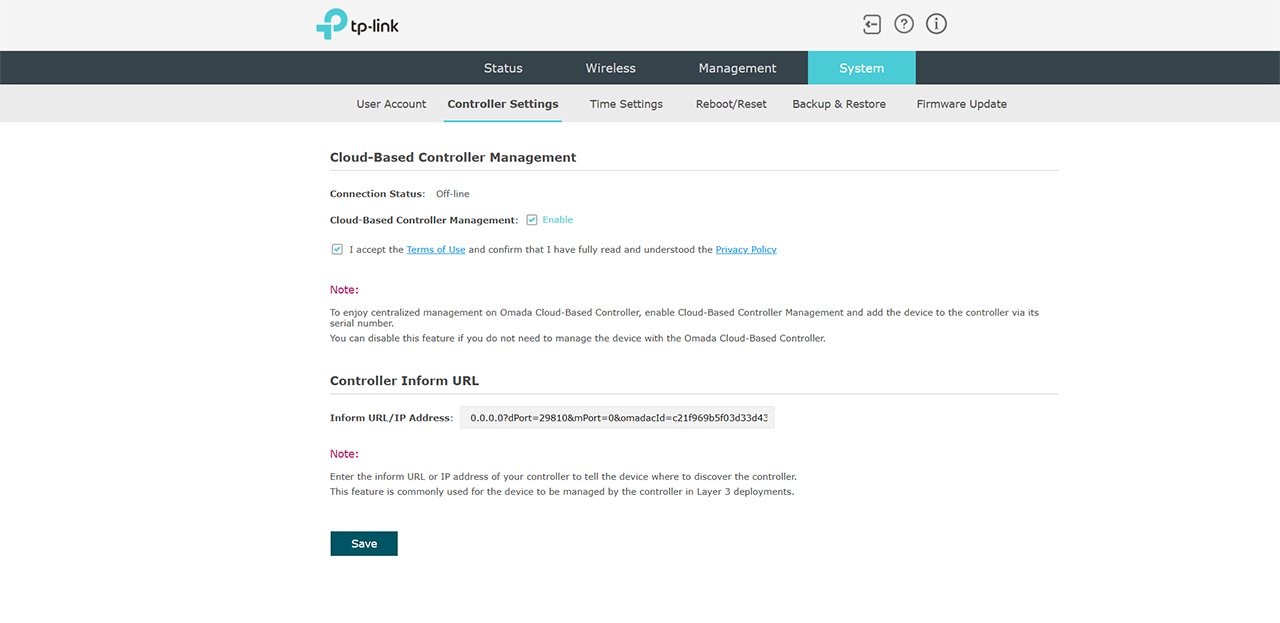
Then, we get the Wireless tab where we can set up the radios and the SSIDs, and yes, this is where you can also configure the MLO. Of course, we also get a captive Portal, VLAN support, QoS, Rogue AP Detection and more. The next tab is the Management where you can set up the IP, check the logs, configure the access ports, control the LEDs and some more options. Under System, we can update the account, update the firmware and enable the Cloud-Based Controller Management.
The Omada SDN
I did have available a hardware controller, the OC200 which made things easy for me, but you can also run locally on a PC. In my case, the EAP773 was detected automatically and I had to insert the username and password that I previously set up. Then, after some firmware upgrades, we can see the user interface. I did mention several times over the years that TP-Link was aiming at Ubiquiti, and I think it landed because the controller is much more mature and there is support for a lots of new types of devices.
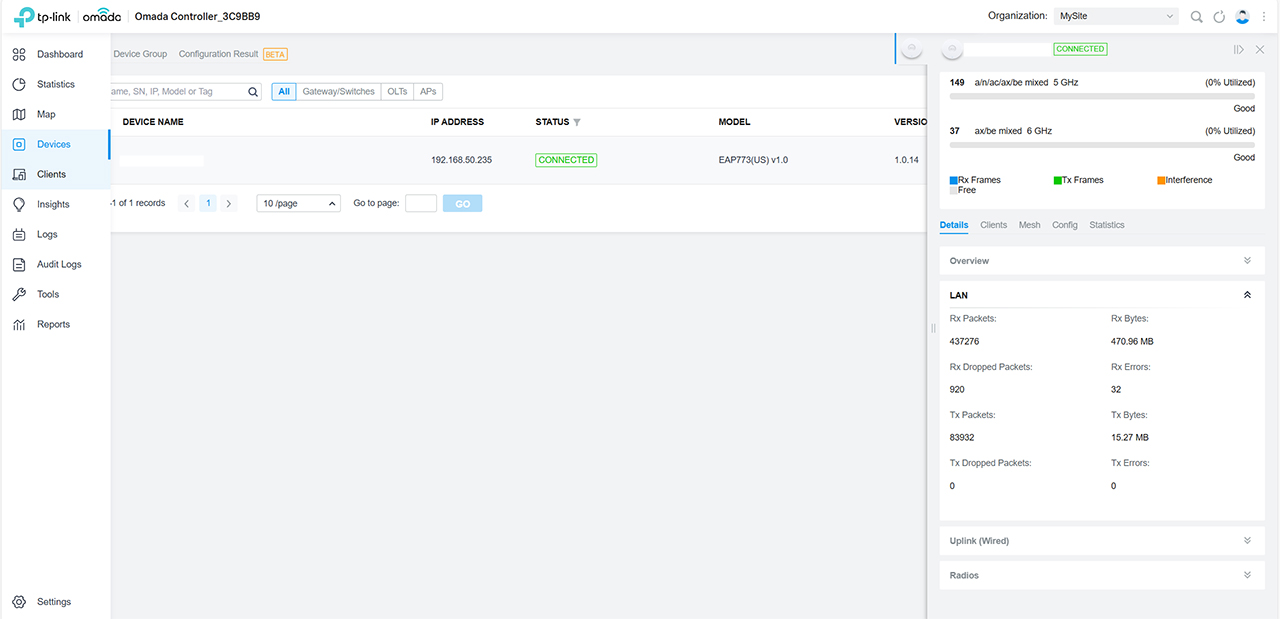
The UniFi familiarity is still strong, as we can see the access point dedicated section on the right side, while on the left, we can check the Dashboard for global status info, the Statistics area, and there is also a Map. Under Devices, we get to see out AP and there is a dedicated Clients section. I suppose I should mention the Insights and the Logs, both important sections to understand what’s going on with the network. But let’s not check out that dedicated section for the EAP773.
We have five main sections here starting with the Details which covers everything from Radios to the LAN and Uplink status info. Then, there’s the Clients section which does include a log History, followed by the Mesh section which will cover a potential mesh network which I don’t currently have configured. Next, we get to the Config section where we actually get to set up how things work, starting from Radios, SSIDs, VLANs and going to some Advanced options that include QoS and OFDMA. Lastly, we can check out the Statistics where we get some live monitoring tools available.
The Conclusion
It took me a bit longer than I would have liked to finally test the EAP773, but we got here eventually. And we discovered that the EAP773 offers a lot of value for the money and it’s perhaps one of the best WiFi 7 access points out there within the entry-to-mid-level hardware. In my tests it did better than the U7 Pro and it even went closer to the WBE660S in some aspects. The software got better over the years, so I see little reason why this access point won’t end up on your shortlist.
TP-Link EAP773
Pros
- 6GHz radio
- MLO and OFDMA
- 10GbE Ethernet port
- Proper standalone mode
- Cloud control
Cons
- Considering the price tag, none
Post Views: 100