Follow us
Add us as a preferred source on Google
Motorola switched gears with the Signature 27, its first true flagship phone in several years. Moving to offer flagship-grade camera credentials, adopting the most powerful chip, and increasing its software support, it puts the Signature 27 right in the firing line of the Samsung Galaxy S26 Ultra.
Exactly why Motorola chose this moment could just be down to the alignment of the stars. The company has seen growth while competitors, such as OnePlus, have exited the US and Europe. Also consider that the margins on flagship devices are much higher than the mid-range phones that Motorola has been known for in recent years.
So can the Signature 27 really take on the likes of Samsung? I got to test the phone in Tromsø, Norway before launch, and there’s a lot to like about it.
Lean on Motorola’s strengths
(Image credit: Future / Chris Hall)
Motorola has been talking for a few years about offering lifestyle devices that aren’t necessarily all about the highest specs. That was the message at the launch of the Razr 70 Ultra, where few specifications have changed from the previous year, but the luxurious finish still turned heads.
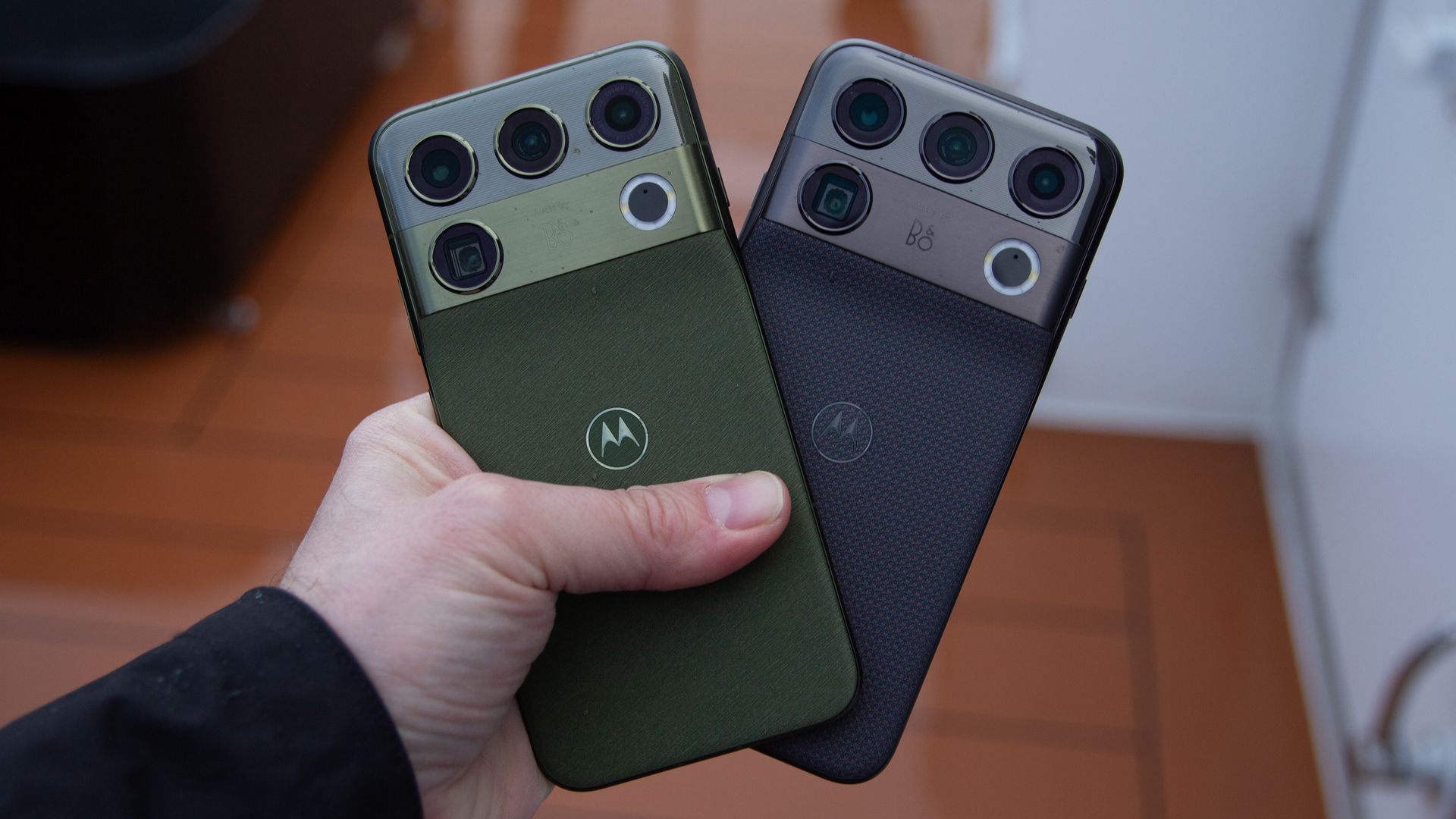
Coming in Pantone Coal Smoke (black) and Pantone Capulet Olive (green), that Pantone partnership continues to show, with unique textured finishes on these phones. They lend that sense of premium luxury, and they are distinctly different from any other flagship phone on the market.
They’re also different from other Motorola phones, with a design that shifts the cameras to the top on a raised bed where the phone is thicker. This is not an island, this is not Motorola copying Apple or Samsung, it is something else. It could also be a case of Marmite design, as the clustering of cameras is a bit busy.

(Image credit: Future / Chris Hall)
It also skews the weight at the top of the phone; although it’s only 227g (lighter than the iPhone 18 Pro Max, but heavier than the Galaxy S26 Ultra), it doesn’t feel very balanced in the hand.
Elsewhere, Motorola continues to push its devices towards the frame, and there is certainly no lack of grip – and no chance of fingerprints on the back of the phone either, thanks to the textured finish.
A change in user experience
Those familiar with Motorola’s recent phones know that the move from a clean Android build to Hello UI, with Moto AI, has raised many questions. That’s seen an increase in sponsored bloat around the device, awkward AI integration and changes to some fundamental parts of the Android experience – namely the apps tray.
I only used the signature 27 for a short time, but a lot of this is gone. There are still some pre-installed apps, but they are easily removed, and there is no sign of that irksome news feed in the apps tray.

(Image credit: Future / Chris Hall)
The Signature 27 also sees the shift to Qira, the new AI assistant that Motorola and Lenovo will use. That seems to have beefed up the AI experience (while still offering Gemini and all the standard Google AI features), making the user experience better.
In addition to this, the Signature 27 will come with 7 years of OS updates and 7 years of security updates, giving it parity with Samsung, Google and Honor – exactly what you need to compete in the flagship space.
Debuts the latest hardware from Snapdragon
Leading the hardware charge is the Snapdragon 8 Elite Extreme Gen 6, the latest flagship chip from Qualcomm. The Motorola Signature 27 will be one of the first phones available with this chip, months before the launch of the Samsung Galaxy S27 Ultra, which is expected to be powered by the same hardware.

(Image credit: Future / Chris Hall)
That’s a great position to be in for Motorola. I didn’t test the hardware in my hands-on time, but everything I encountered was fast and smooth. Interestingly, it’s backed by a 7,000mAh silicon-carbon battery, which I expect will see it through the day with relative ease. If not, there is 90W wireless and 50W wireless charging for quick charging.
That’s something Samsung doesn’t offer — and isn’t likely to offer on its next phone.
Go big on the camera
For many phone companies, the camera is the real battleground. Motorola was keen to point out that it worked with DxOMark to calibrate the cameras, while Qualcomm was also on hand to ensure it got the most out of the powerful new hardware.
My first impressions of the 50-megapixel main camera, with a Sony Lytia L910 sensor, are really positive. I’ve only tested it in limited situations, but so far it’s produced detailed images rich in color, although I tested it in November in Norway, I barely saw the sun, so I can’t make a final judgment yet.

(Image credit: Future / Chris Hall)
It is supported by a 200-megapixel telephoto camera, offering 3x optical and up to 100x digital zoom. When you get over 20x zoom, the phone’s AI system wants to help. That can clean up images, but it can also leave some of the longer shots looking a little unrealistic as AI fills in the details. I took a picture of some herons at 100x zoom, and the AI results look like a one-legged sparrow crossed with a kiwi. They are birds, but not the real ones.
Finally, the ultra-wide, on first impressions, seems a bit out of line with the other cameras. Most of the test pictures I took were a different shade from the main camera, so they didn’t quite match. That’s potentially fixable with a software tweak, but it’s a demonstration of how hard it is to get things right on a complex camera system like this.
I was impressed with the performance of the video I shot. With Dolby Vision capture included, it took advantage of one of my favorite features of the Signature 27 – the display.
A sublime display experience

(Image credit: Future / Chris Hall)
There are some firsts on the Motorola Signature 27, with a tandem OLED display, offering up to 12,000 nits. That’s ridiculously bright, but there’s no ridiculousness when using the display. It’s bright and vibrant, with a great pop to the colors, but exactly where you’ll see 12,000 nits used remains unknown.
Earlier phones with high brightness used this brightness for HDR content where there is a short peak – such as the center of a candle flame. But content is not mastered at 12,000 nits – professional mastering monitors only achieve 4,000 nits, while Dolby Vision’s theoretical peak brightness is 10,000 nits.
So, take the 12,000 nits figure with a pinch of salt and focus instead on the fact that this is a great display backed by very capable speakers.
These were developed in collaboration with Bang & Olufsen, support Dolby Atmos, as well as offering a number of presets to customize the sound to your liking. The speaker quality seems great, with noticeable immersion and stereo separation.
Is this enough to dethrone Samsung?

(Image credit: Future / Chris Hall)
There’s no doubt that Motorola offers a flagship experience in the Signature 27 and it’s great to have a true top-tier phone from the company. With that comes a high price, at £1,299. It’s cheaper than Samsung, while offering a packed spec sheet that will grab the attention of those shopping for a flagship Android phone.
But much depends on how well this camera performs in wider tests, which is the real challenge facing Motorola. Things are looking great so far, with the Signature 27 offering a great experience in a number of different areas.
The Motorola Signature 27 will be available to pre-order from November 16, starting at £1,299 in the UK.