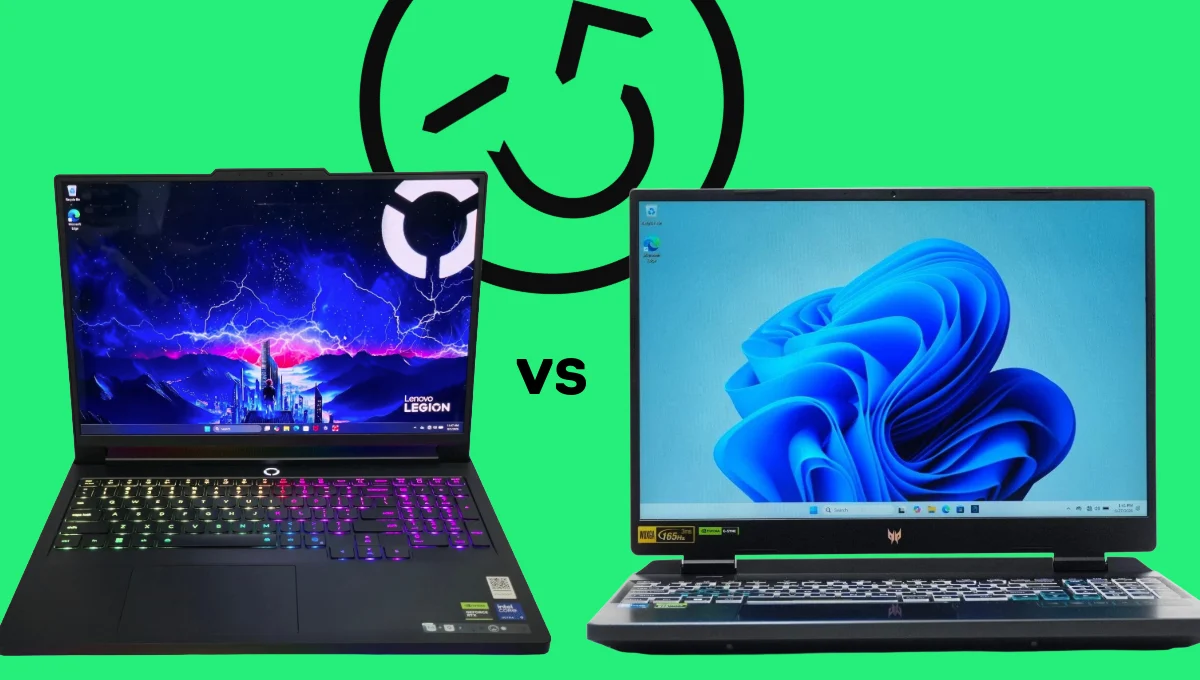
The Lenovo Legion line surpasses the Acer Predator Helios line overall, offering superior sustained performance, quiet thermal engineering, higher resale value, and exceptional long-term build durability. However, the Acer Predator Helios (especially the Helios Neo series) wins on raw price-to-performance, offering higher CPU and GPU hardware tiers at lower price points for budget-focused buyers.
Here, we Break down performance, thermals, pricing, and resale value across both lineups to find the smarter purchase.
Feature & Value Comparison Matrix
| criteria | Lenovo Legion (Legion 5 / Pro 5 / Pro 7) | Acer Predator Helios (Helios 16 / 18 / Neo) |
| Overall performance | Excellent sustained multi-core & GPU stability | High peak out-of-the-box FPS; aggressive power limits |
| Thermal system | Coldfront Vapor Chamber; quieter fans | Dual AeroBlade 3D fans; high cooling power, loud fans |
| Cost-effectiveness | Medium-High (Low cost to build) | High – excellent (Best spec-to-dollar ratio) |
| Resale value | High (Retains ~45%–55% after 2–3 years) | Moderate (retains ~30%–40% after 2–3 years) |
| Build & Keyboard | Stealth Aesthetic, TrueStrike Keyboard, Rear I/O | Striking RGB gamer design, solid chassis, plastic accents |
| Software control | Legion Vantage (Clean, low voltage) | PredatorSense (Basic customization, sometimes bugs) |
| Expected lifespan | 4-6 years | 3-5 years |
1. General performance & thermal management
Winner: Lenovo Legion
While both brands use high-wattage NVIDIA GeForce RTX graphics cards and Intel/AMD processors, Lenovo Legion wins on sustainable thermal performance and noise control.
Lenovo Legion: Use Lenovo’s Cold front thermal architecture (with liquid metal on higher Pro models and vapor chamber). It distributes the heat evenly without forcing the fans into dark decibel ranges. Legion BIOS settings allow accessible CPU undervolting and custom fan curves. Crucially, Lenovo rarely cuts corners on RAM configurations, shipping dual-channel setups out of the box to avoid CPU bottlenecks.
Acer Predator Helios: Focuses heavily on aggressive power delivery to crank out maximum peak frame rates in short bursts. The custom 5th thermal spikes are slightly more common on Helios models, and require aggressive fan profiles to avoid thermal throttling during multi-hour gaming sessions.
| Metric | Score (out of 10) |
|---|---|
| Peak GPU power | 9.2 |
| 9.0 | |
| Sustainable / thermal | 6.5 |
| 7.8 | |
| Display quality | 8.8 |
| 9.0 | |
| Portability | 5.5 |
| 7.5 | |
| Upgradeability | 8.8 |
| 7.8 | |
| Value for money | 7.0 |
| 8.5 | |
| Resale value | 7.0 |
| 7.3 |
Scores are Gadget Salvation editorial ratings out of 10, weighted for how each flagship line holds up over an ownership cycle. Ready to act? Get an instant quote for your gaming laptop.
2. Cost-effectiveness & value
Winner: Acer Predator Helios
If your primary goal is the fastest CPU and GPU possible for every dollar spent, the Acer Predator Helios line takes the lead.
Acer Predator Helios / Neo: Acer consistently undercuts Lenovo by $100 to $300 for equivalent hardware specs. It’s common to find a Helios Neo equipped with an RTX 4070 or RTX 5060-tier card for the price of a mid-tier Lenovo Legion with lower GPU specs. For buyers on a tight budget who prioritize FPS above all else, Acer delivers unmatched raw hardware value.
Lenovo Legion: Demands a slight price premium. While you pay extra for the underlying engineering—such as a better display panel, superior trackpad, quieter fans and cleaner chassis—it offers a lower raw component value per dollar on paper.
3. Resale value & secondary market demand
Winner: Lenovo Legion
Despite the widespread belief that gaming laptops depreciate faster than most other categories, we don’t find it to be true. After over a decade of all kinds of brands of notebooks, we see the same trend without fail: six- to eight-year-old gaming models still have value today, but a home-use computer from the same year typically loses salvageable value in that time span.
Of the two flagship lines we discuss in this post, Legion models hold their value significantly better secondhand Market.
Lenovo Legion: Enjoy an exceptional reputation among hardware enthusiasts. Used Legion laptops (on platforms like eBay, Swappa, and Reddit’s r/hardwareswap) regularly sell for 40% to 55% from their original MSRP after 2 to 3 years. Buyers seek them out second-hand for their reliable cooling and sleek, non-flat design that doubles as a professional workstation.
Acer Predator Helios: Experience steeper depreciation, maintain approx 30% to 40% from its original retail price after 2 to 3 years. The secondary market sees Acer as a budget brand, and aggressive gamer styling (blue accents, heavy branding) narrows the buyer pool compared to Legion’s understated aesthetic.
Upgrade to a new Predator or Legion this year? Gadget Salvation will give you an instant quote on your current gaming laptop – actual money you can put on the line you choose.
SEE MY QUOTE →
4. Build quality, ergonomics & longevity
Winner: Lenovo Legion
Laptop longevity depends heavily on chassis stiffness, hinge construction, component temperatures, and long-term driver support.
Lenovo Legion: Known for structural integrity. With aluminum covers and high-quality polymer bases, Legion laptops suffer minimal keyboard flex and zero hinge wobble. The rear port layout with LED indicators keeps desk setups clean and cluttered cable ports. Lenovo TrueStrike keyboard is widely regarded as one of the best laptop keyboards for both typing and gaming. In addition, open-source software alternatives such as LenovoLegionToolkit give users easy control without bloatware.
Acer Predator Helios: Build quality has improved significantly over the last generations, with robust metal display covers and tight assembly. However, Acer uses harder plastic around the palm rest and exhaust vents. Those PredatorSense Control software can sometimes change lighting profiles or fan settings after Windows update, requiring manual troubleshooting.
Which line should you buy?
Buy the Lenovo Legion when You want a quiet, durable, premium gaming laptop that stays cool under stress, doubles as a rugged work/school machine, and holds solid value if you decide to sell it in a few years.
Buy the Acer Predator Helios when You are on a strict budget, want the absolute highest FPS and screen refresh rate possible for your money, and don’t mind wearing headphones to block finger noise.
Frequently Asked Questions:
01Which is better for competitive or eSports gaming, Predator Helios or Legion Pro?
Both lines top out on the same RTX 5090 laptop GPU, which tops out at close to 175W, so peak power is essentially tied. Over long, sustained sessions, the gap comes down to cooling: the Legion Pro’s vapor chamber ColdFront system tends to maintain more consistently boosted clocks, while Predator Helios models have shown CPU throttling in Performance mode and higher GPU temperatures in Turbo mode in independent tests.
02Which runs cooler and quieter, Acer Predator or Lenovo Legion?
Lenovo’s Legion Pro line generally runs cooler and quieter thanks to its vapor chamber ColdFront cooling and liquid metal application. Independent reviews of the Predator Helios 18 AI have measured GPU hotspots approaching 105°C and notably loud finger noises once the laptop is pushed into Turbo mode.
03 Which gaming laptop line lasts longer: Predator Helios or Legion Pro?
It depends on what you value. Predator Helios 18 AI offers the largest upgrade headroom in the category, with four RAM slots (up to 256GB) and three M.2 slots (up to 6TB), which extends the useful life of a machine. Legion Pro 7i offers less upgrade ceiling (64GB RAM, two M.2 slots) but its cooler-running thermal design provides less sustained heat stress on internal components over years of use.
04Can you upgrade the RAM and storage on either line?
Yes, both lines offer user-upgradeable memory and storage on their higher configurations. The Predator Helios 18 AI has four SO-DIMM slots that support up to 256GB of DDR5 and three PCIe Gen5 M.2 slots that support up to 6TB of storage. The Legion Pro 7i offers two CSODIMM slots that support up to 64GB of DDR5 and dual M.2 slots that support up to about 2TB.