One of the biggest selling points of AI is its ability to build things quickly. AI models can help users sort through mountains of files, generate videos that have Hollywood studios worried, and create everything from websites and businesses to custom video games. With what’s called Vibe Coding, ordinary people can build playable video games in minutes using simple text prompts and popular AI tools like OpenAI’s ChatGPT and Google’s Gemini.
But AI company Anthropic seems to be drawing a line in the sand about what kinds of games their AI model Claude can make. If a Claude user tries to recreate someone else’s intellectual property, the AI tool will refuse to build it.
That’s according to Addy Osmani, an engineering leader at Anthropic, who runs the X. He’s responding to concerns that Anthropic modified Claude Opus 5.5 to prevent it from generating copies of existing games, which could violate the company’s copyright rules and usage policy.
“Original games, genre games, and games built from your own designs and assets are meant to continue working,” Osmani said. “We will continue to iterate to make sure we strike the right balance.”
He offered to review cases where amateur game developers believe that Claude wrongly rejected their requests.
A representative for Anthropic did not immediately respond to a request for comment.
Tribute versus injury
Anthropic’s stance, as expressed by Osmani, recognizes that using AI to try to clone a video game, even a simple one, constitutes an infringement of intellectual property, an issue that predated the rise of AI tools like Claude.
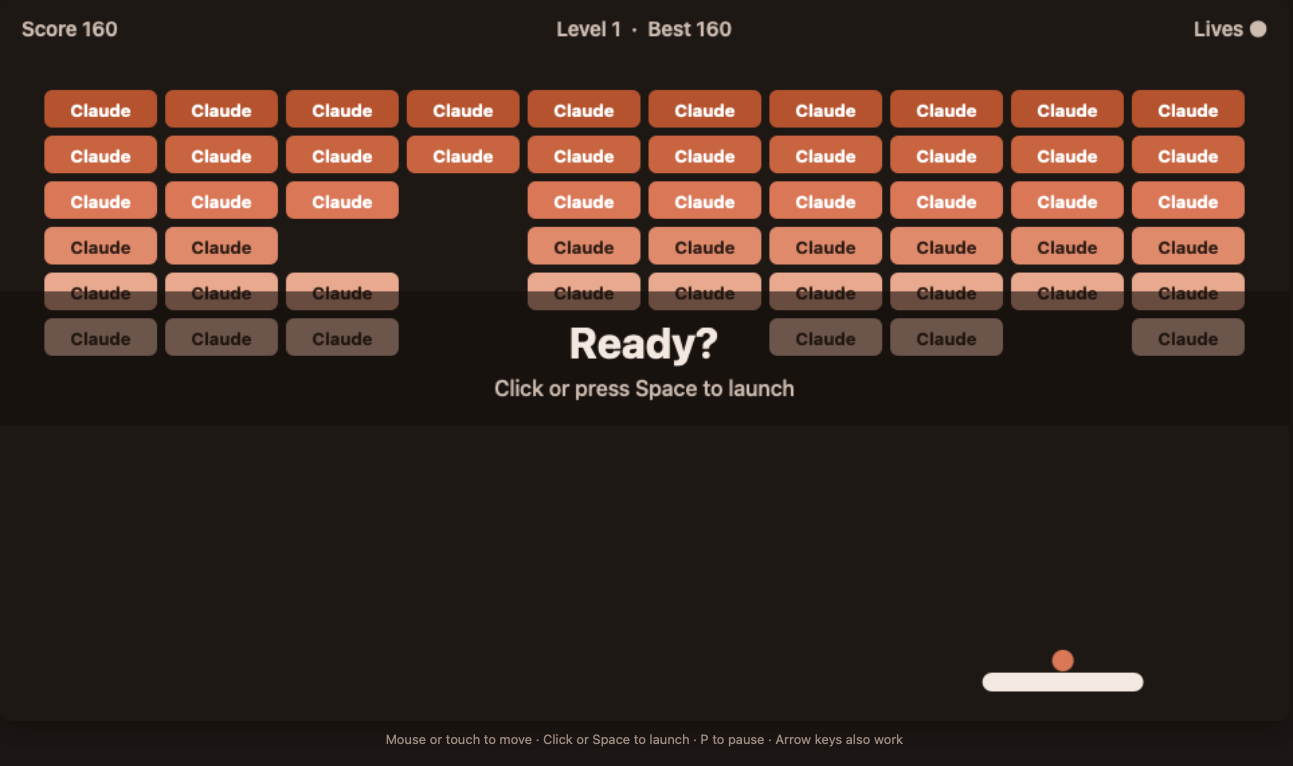
Even with the change, Claude will still generate video games that resemble popular hits from past decades. A CNET request to build a game “that looks like Breakout but with the word Claude on every brick” yielded a playable web version of the arcade classic, but not one that a video game fan would mistake for the original.
The same thing happened after Flappy Bird became a hit in 2014, spawning a wave of copycat games in app stores. Copyright infringement by games is complicated, said David Kocan, an intellectual property attorney at Nixon Peabody who co-leads the firm’s esports and gaming team.
“This is something the courts have been struggling with for a long time before AI came along,” Kocan said. “The basic distinction has always been that copyright protects the original creative expression of a game, but generally not its underlying data, rules, or game mechanics. Copyright protects the game you created, not the genre you helped popularize.”
You cannot copyright the concept of, say, a battle royal game or a side-scrolling platformer, which is why when a new type of game emerged as a hit, you will see many similar games.
“This distinction may sound simple in theory, but in practice the line between borrowing an idea and copying the creative expression can be blurry,” Kocan said. “That’s especially true in gaming, where so much of the experience combines functional mechanics with creative expression.”
RTB Ruhan, founder and CEO of Null Station, an animation and video game art studio, said AI made it “quick and cheap” to cross the line into infringement, allowing people without art or design skills to clone a popular game. But that doesn’t mean you can publish or sell a cloned game without getting into trouble.
“‘(Claiming) AI did it’ won’t protect them,” Ruhan said.
His studio uses a simple test.
“Remove the title and logo and ask if a player can still tell the two players apart,” Ruhan said. “If they can’t, you’ve crossed the line.”
Are AI companies responsible for game clones?
Legal experts CNET spoke with said there are no laws requiring AI companies to ban game clones on their tools. But adding those safeguards could prevent problems down the road, said Eric Blatt, a corporate, securities and intellectual property attorney at Scale and a former examiner at the U.S. Patent and Trademark Office.
“Anthropic is careful to hit the brakes here,” Blatt said. “If Claude – Anthropic-owned software running on Anthropic servers – receives an instruction to copy a game, and if Claude then copies the game, then there is a facially plausible argument that Anthropic did the copying.
Blatt said litigation hasn’t kept up with the growth of AI, but he thinks lawsuits could quickly follow if a revamped game with AI directly threatens a company’s business model.
But some of these attempts could be stopped before they start if AI models refuse to make exact copies.
“Ultimately, copyright law draws the legal boundaries,” Kocan said. “But AI companies have to decide where they’re comfortable drawing their own. And those won’t necessarily be the same thing.”

See full bio