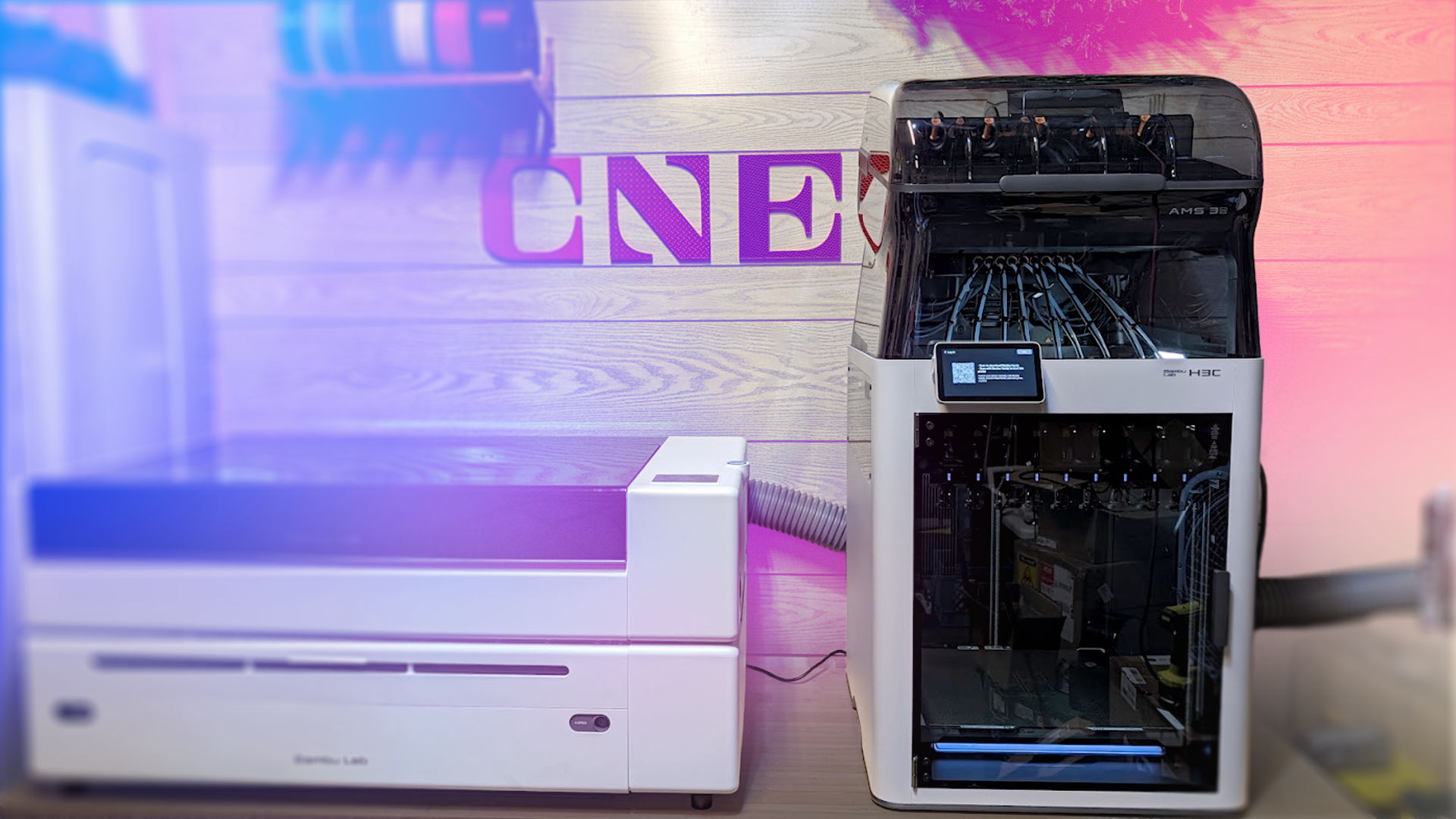
Bambu Lab H3C
Multi-nozzle printing to the max
Pros & Cons
-
Large build area allows you to maximize the nine tool heads
-
Being able to use different nozzles and filament sizes is amazing
-
The built-in material heater is excellent
-
The default acceleration often causes printing errors
-
This is a very complicated machine with many points of failure
Multicolor 3D printing has been around for many years. Like all technologies, manufacturers are constantly looking for ways to push it further than ever before. Bambu Lab today announced the H3C, a large format 3D printer that uses nine separate nozzles to print not only different colors or types, but also filaments of different sizes. It’s designed to allow you to mix and match as you see fit, expanding your creative options beyond the standard.
The Bambu Lab H3C starts at $2,500 and comes with the nine filament system and Automated Material System. I’ve been using it for the past few weeks, and while I haven’t finished my review yet, I already have quite a few thoughts.
Easy to set up
This is not a small machine by any measure. I originally had it on my workbench, but the H3C sits so tall that opening the lid and loading the filament was difficult, even for a 6-foot-1 person like myself. Bambu Lab also sent me a metal rolling cart, sold separately, that lowers the machine to a usable height. That said, it still says 63 inches tall on the cart, so yes, it’s a big’un.
Despite its size and complex design, it was easy to set up. I would recommend having a second person around to do it as it is cumbersome – but not difficult to plug in all the parts. The AMS 3 that sits on top of the machine is different from most of the best 3D printers because the H3C requires it. It is not a separate add-on but an integral part of the machine.
H3C 3D printer main specifications
| Construction volume | 330 x 320 x 335 mm |
| Printer dimensions | 493 x 571 x 587 mm |
| Hot end | All metal, x 9 |
| Nozzle | 0.4 mm (Optional 0.2, 0.6, 0.8) stainless steel x 9 |
| Hotend max temperature | 350 C |
| Print Bed Max Temperature | 120 C |
| Max speed | 1,400 mm/s toolhead speed |
| Supported material | PLA, PETG, ABS, ASA, Carbon Fiber infused, TPU, plus many more (1.75mm and 2.85mm available) |
| Build plate camera | Yes (top camera optional) |
| Color support | 9-nozzles AMS (allows mixed color) |
| storage | USB-A, internal memory |
| Slicer | Bambu Studio (Other slicers compatible) |
You can tell from every metric that the H3C is designed to be a Bambu Lab flagship. It has all the top-of-the-line hardware, including a heat bed that can reach 120C and an optional but very cool bird’s eye camera for monitoring prints from above. It’s also fast, with a top toolhead speed of 1,400 mm/s. Of course, that’s not the print speed, but it shows you the kind of speed it could achieve if you pushed it to the max.
However, printing at high speed has some disadvantages. I have had several print failures on tall prints where the supports or spar towers have fallen due to accidental touches or vibrations. The H3C moves fast, pushes fast and falls fast if you’re not careful. Most of these errors occurred at 125% speed, but that’s the default setting I use for large prints on other machines, and they handle it well.
Don’t call it an INDX (even though it’s almost exactly the same)

Bambu calls its nine-nozzle system, which heats by conductive heating, the Swaptek System. This is not to be confused with another nine-nozzle system you may have heard of: INDX, which uses conductive heating. INDX and Swaptek are extremely similar in execution but differ in some areas. INDX is purely mechanical, while Bambu says its Swaptek system delivers data and power to each tool, allowing the nozzles to heat up faster than those in a standard INDX system – in around 6 seconds per nozzle.
In practice, there is not much difference between what I see on the H3C and the Prusa Core One + INDX in terms of speed. The Core One has the advantage of being calibrated to avoid a purge tower, and it doesn’t make as much waste as the Swaptek system. However, the H3C has its own neat tricks: not only can it print with different nozzle sizes and materials, but it can also print with materials of different diameters.
More options than a dinner menu

One of the biggest roadblocks with printing TPU—the very soft, rubbery material from which 3D printed shoes are made—through an AMS is that it is too soft to print through the AMS feeder. To combat this, you need to use a harder TPU that isn’t nearly as flexible as you need for shoes or items that bounce. Adding toolheads capable of printing 2.85mm diameter materials allows Bambu to create TPU that is more flexible after melting but thicker and easier to feed in AMS. It works really well.
And it doesn’t stop at TPU either. You can use 2.85mm PLA with a 0.8mm nozzle to print the infill of a model, while using a 0.2mm nozzle and 1.7mm PLA to print the detailed exterior walls. It gives you so many options. The AMS even has two material locations with active heating chambers, so you can print materials that need to be warm and dry, along with other, more shelf-stable materials.
Print quality is excellent (as it should be)
Given the $2,500 price and the H3C’s flagship status, it would be shocking if the print quality was poor. All the models that didn’t fail due to the collapse of the purge tower look great, and the nine separate nozzles make light work of almost any paint project. I love pushing this machine to watch it switch over the nozzles at blistering speed.
Some of them failed though, and the H3C was good at catching the errors, pausing the print, and letting me know. I chose to keep one of them despite the failed tower, and it turned out fine, although a bit damaged. I had some fun 3D printing my scanned head at life size, using silver for my gray beard – and I love the way it came out.
The CNET test print wasn’t nearly as good as the one produced by the H2C, which maxed out pretty much every test, but it wasn’t the worst either. Accuracy was good, and despite the printer speed, ringing was kept to a minimum. It struggled on the 0.2mm tolerance test, but it did well on bridging and overhangs, showing that its temperature control is excellent. I still have more of these to do before I’m ready to give a full score, but so far I’m happy with the result.
The H3C is a high-end 3D printer designed for end-game users

In video games, there’s a concept called endgame content: the tougher challenges you take on after you’ve completed most of the story. It is not for the faint of heart. The H3C is endgame content. It is not difficult to use, but it is designed for someone who has gone as far as possible with machines like the P2S and A1 combos of the world. If you’re looking to go beyond what you thought you could do with a 3D printer, the H3C is the machine to get you there.
Swaptek, INDX and multi-toolhead printers are here to stay. And, like all 3D printers, they can come in many sizes and budgets. The Core One INDX is smaller but cheaper, but the H3C has plenty of options right out of the box to make some incredibly complex models. We live in interesting times and the landscape can only get better.

See full bio