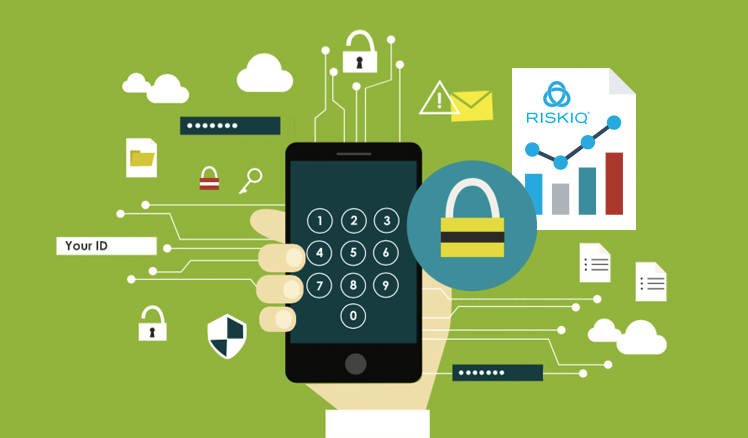
Editor’s note: This article shares key findings from the RiskIQ survey on how US and UK consumers approach mobile security, from installing apps via social media ads to jailbreaking their phones, and what app developers and businesses can do about it. Specializing in cybersecurity for demanding industries, including healthcare, insurance and investment, ScienceSoft helps companies build mobile apps and test security that protect user data even on poorly secured devices.
Expanding their winter report, Flurry released the data that says: US mobile users look at their mobile devices for a total of 5 hours every day, spending 8% of this time in the browser and 92% – in apps. With people clearly more and more addicted to their devices, and new Android viruses on the loose, RiskIQ wondered how security-conscious mobile users are.
At the request of RiskIQ, the Ginger Comms research group conducted a survey among 1,000 US and 1,000 UK residents of various age groups and published the statistics in April 2017. Despite US mobile phone users being more aware of security measures than those in the UK, the results are still very alarming.
Since security is not solely the responsibility of users, we share these findings and think about what mobile developers and app stores can offer to reduce the risks.
Both official and unofficial stores have malicious apps
According to statistics, untrusted sources are widely used to download and install new apps. About 44% of users install apps advertised through social media, while 55% and 48% have clicked on app-promoting ads and links at least once. What’s worse, 54% of these users don’t read the terms and conditions before installing an app. As a result, about 20% of users end up downloading fake and malicious mobile software.
Official stores ‘Top Apps’ category remains the most popular source for discovering and installing new apps. But even if the source is official, there is no 100% guarantee that the app is safe: RiskIQ revealed that 1 in 10 of over 5,000 Black Friday apps on global app stores are blacklisted.
It goes without saying that in this situation, mobile app stores – both official and not – should pay more attention to their content. By creating powerful filters and allocating more resources to maintain the uploaded apps, businesses should aim to block malicious software in front of it becomes available to the public.
More people root and jailbreak their phones
While only 7% of UK respondents have hacked their smartphones, in the US this practice is popular with 20% of surveyed users. All of them do so at their own peril. Along with gaining more options, owners of rooted/jailbroken devices are more exposed to malicious content as they deliberately bypass the security measures provided to them by the platform and device developers.
Mobile developers have always tried hard to penetrate their platforms, but no matter how hard they try, systems get hacked. What’s more, jailbreaking is still legal in 2000. Users are advised to install specific security scanners for rooted/jailbroken smartphones and tablets can be a way to keep these devices cleaner.
Businesses are also at risk
Of the 1,000 US users asked, 45% mentioned using their mobile devices for work outside or inside their business office. As the BYOD policy is now widely adopted, this means that the risk of digital infections in enterprises increases. A single employee’s disregard for mobile security guidelines can affect the company’s entire network and its digital data.
To avoid the threat, companies should have their security system professionally maintained and of course bring security issues to the attention of employees. Since most people are used to skipping long rules, terms and conditions, it can be more effective to make the regulations as precise and to the point as possible.
Calming trend
Despite the mostly worrying findings, RiskIQ also revealed that mobile users recognize the risks they are taking. The statistics say that 53% of all US respondents have installed security software on their mobile devices and 52% considered security as one of the main factors that influenced their mobile device choice. Hopefully, with more efforts on the part of mobile app developers and businesses, the trend will only continue to spread among users.