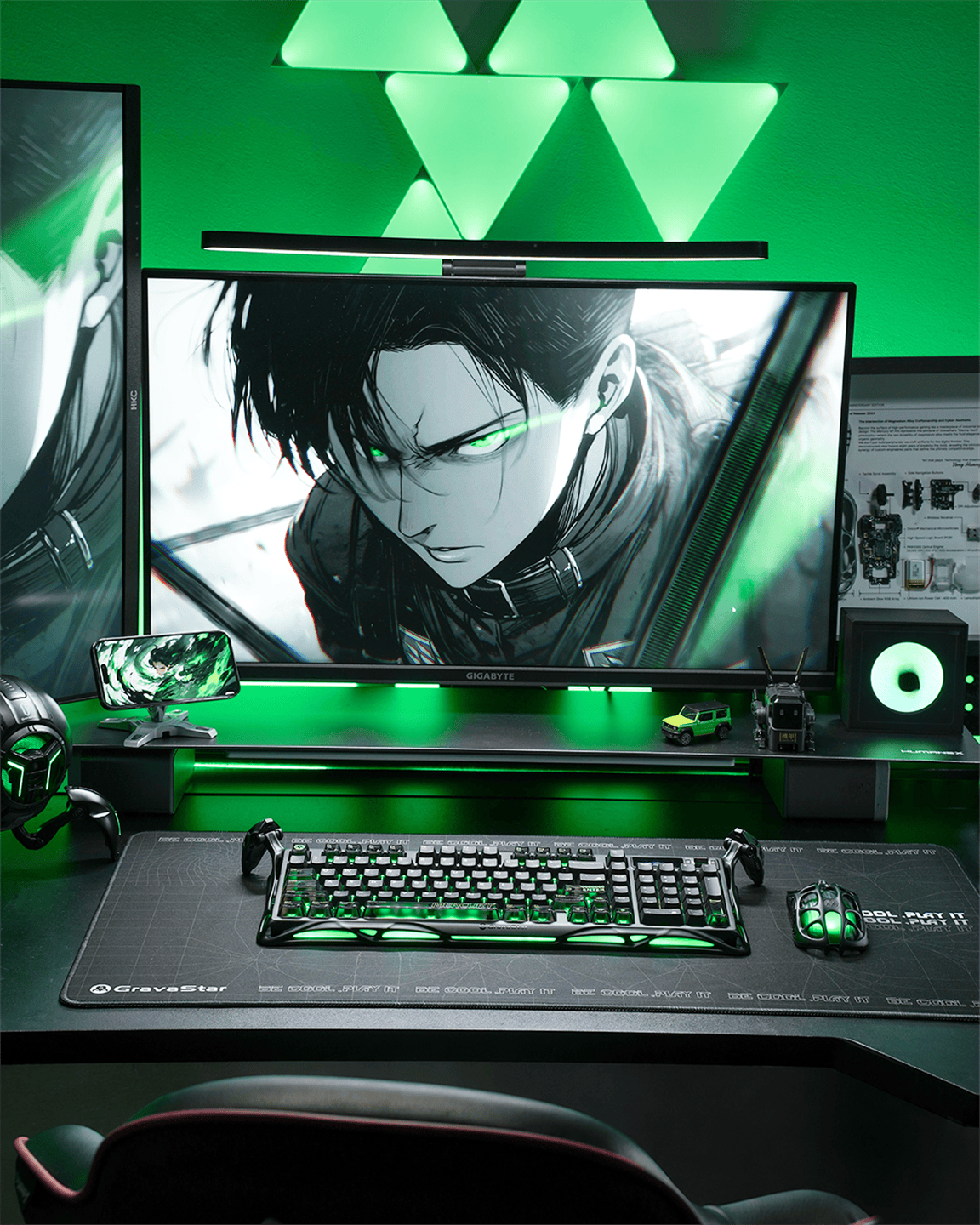
GravaStar has officially launched the Mercury K98 Pro mechanical keyboard in Australia, bringing its signature cyberpunk-inspired design to a larger 98-key layout. price at $499.99the wireless mechanical keyboard combines a CNC-machined aluminum chassis, an 8000Hz polling rate, a built-in color display and an 8000mAh battery.
GravaStar has always taken a different approach to product design. We reviewed their original GravaStar Bluetooth speaker in 2019, which looks more like something out of a science fiction movie than a traditional portable speaker. The Mercury K98 Pro follows the same design philosophy, this time aimed at gamers and mechanical keyboard enthusiasts.
The Mercury K98 Pro features a fully CNC-machined aluminum alloy chassis with an exposed, skeleton-like design. It’s certainly different from the more conventional mechanical keyboards we’re used to seeing on gaming desks. Despite its rather unusual appearance, the keyboard offers a practical 98% layout, retaining most of the keys you’d expect from a full-size keyboard, including a dedicated number pad, while keeping the overall footprint more compact.
Underneath the keycaps are GravaStar’s proprietary UFO Mechanical Linear Switches, rated for up to 70 million keystrokes. The keyboard uses a gasket-mount structure designed to provide a softer, slightly cushioned typing experience. There is also support for top-mount configurations.
GravaStar has incorporated five layers of sound dampening materials, including poron foam, IXPE switching pads, PET film and silicone filling. These are designed to reduce unwanted noise and produce a deeper, more consistent typing sound. Of course, what a mechanical keyboard actually feels and sounds like is something that specs alone cannot fully explain.
On the performance side, the Mercury K98 Pro supports an 8000Hz polling rate over both wireless USB-C and 2.4GHz wireless connections.
According to GravaStar, the keyboard can achieve response times of 0.1ms when wired and 0.4ms over its 2.4GHz wireless connection. An 8000Hz polling rate allows the keyboard to report inputs to the computer up to 8,000 times per second. While this is a welcome specification for competitive gaming, the actual difference compared to a good 1000Hz keyboard can be hard to notice during everyday use.
There are three connectivity options available: USB-C, 2.4GHz wireless, and Bluetooth 5.4. This makes the keyboard suitable for switching between gaming and productivity setups without relying entirely on cables.
One of the more interesting features of the Mercury K98 Pro is its 8000mAh rechargeable battery. GravaStar claims up to 228 hours of battery life with lighting turned off. However, enabling the keyboard’s full RGB and ambient lighting significantly reduces the estimated runtime, to around 19-21 hours.
The keyboard also includes a 1.65-inch TFT color display with a resolution of 142 × 428 pixels. It can display real-time information and customizable visual content, adding another element of personalization.
Settings for the display and other keyboard features can be adjusted through GravaStar’s web-based driver, eliminating the need to install a special application.
Lighting is another big part of the design. In addition to per-key RGB lighting with 19 preset effects and a music-reactive mode, the Mercury K98 Pro has three-sided underglow lighting and additional lighting around its feet. These lighting elements extend beyond the keyboard itself, creating ambient effects across the desk. Users can customize the lighting and save their preferred configurations in three onboard memory profiles.
Australian prices and availability
The GravaStar Mercury K98 Pro is priced at A$499.99 in Australia and is available through Silk Gear, with availability also planned at Scorptec, Center Com, and Amazon Australia.
At nearly A$500, this is certainly a premium mechanical keyboard. Its CNC-machined aluminum construction, large battery, built-in display, and extensive lighting system help explain the price, though typing comfort, build quality, and actual wireless performance ultimately determine whether it’s worth the investment.