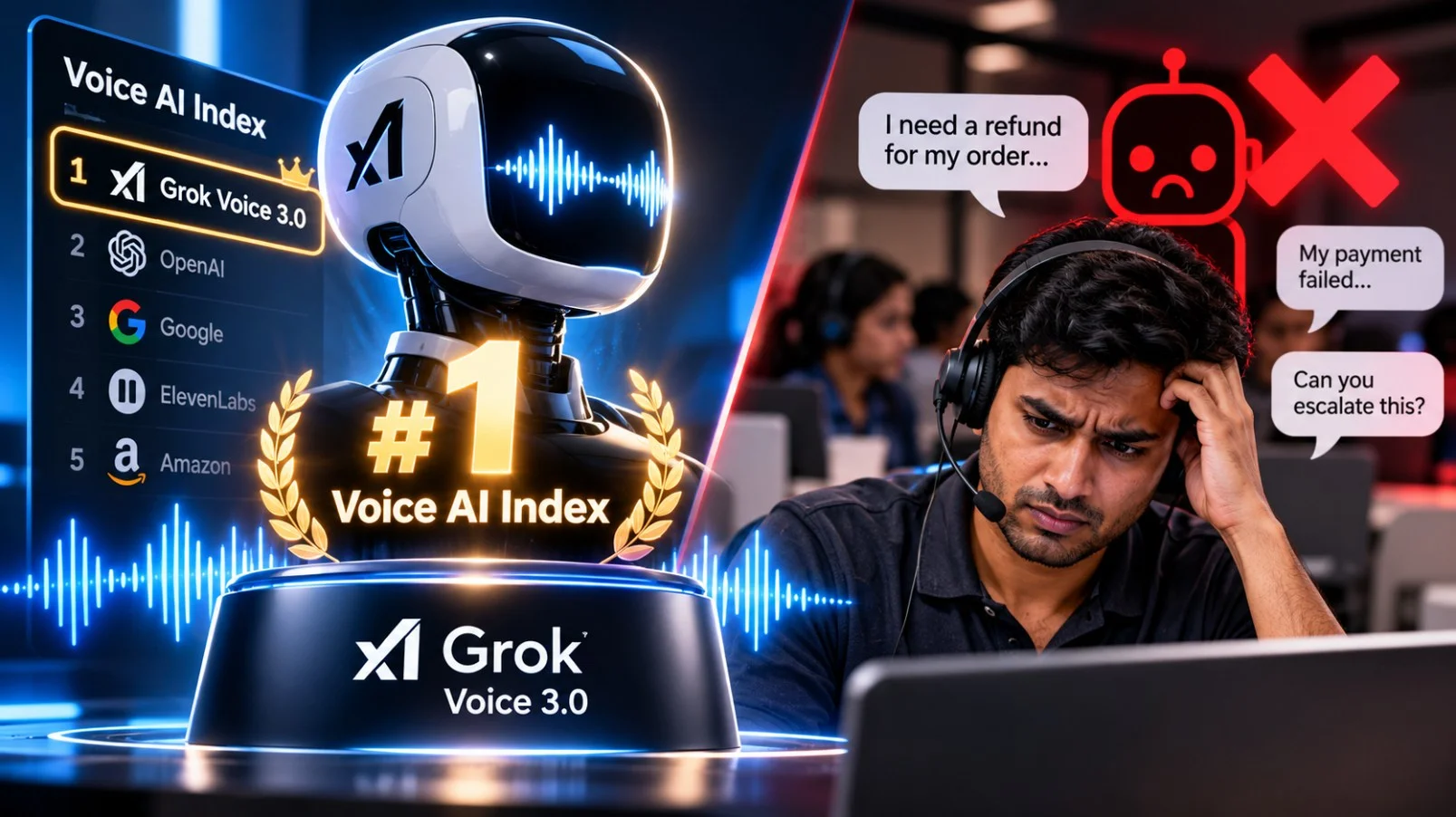
Musk’s AI division released Grok Voice 3.0 on October 14, 2026, and it takes the lead Artificial analysis’s speech-to-speech index with 86.9in front of OpenAI’s GPT-Live-1 on 83.2 and Google Gemini 3.8 live on 82.6. His own predecessor scored 81.3.
Read a line further on the same page, and the picture is complicated. On τ-Voice, the benchmark that simulates actual support calls with varying accents, background noise, and callers speaking over the agent, Grok Voice 3.0 scores 71.6%. GPT-Live-1 scores 74.5%.
The company described its result there as “comparable”. It is a loss in the test closest to the market in which this model is sold.
Where it wins
The composite index is built from several component tests, and Grok Voice 3.0 leads most of them.
| Benchmark | Grok voice 3.0 | GPT-Live-1 (Astra, Medium) | Gemini 3.8 Live (Ext. Thinking, High) |
|---|---|---|---|
| AA Speech-to-Speech Index | 86.9 | 83.2 | 82.6 |
| Big Bench Audio (Speech Reasoning) | 98.5% | 90.1% | 97.7% |
| task success rate | 94.8% | 87.4% | 89.1% |
| Full Duplex Bench (Turn-taking) | 97.0% | 94.9% | 91.9% |
| Speech Agent Arena (human preference) | 1070 lots | 1048 | 990 |
| τ-Voice (simulated support call) | 71.6% | 74.5% | 68.6% |
Note the configuration labels. GPT-Live-1 was run on its medium setting, while Gemini was run on its highest. Rival models evaluated at different effort levels are not a like-for-like comparison, in the published table there is no equivalent label for Grok voice 3.0 itself.
Two of those rows carry more weight than the rest. Full Duplex Bench measures whether the model handles the messy mechanics of real conversation: pauses, interruptions, both people starting at the same time. Grok Voice 3.0’s 97.0% versus 94.9% and 91.9% is the clearest lead in the set, and that gap is the difference between a voice agent that feels natural and one that talks over you.
Speech Agent Arena is the only measure here based on human judgment rather than automated scoring. Grok Voice 3.0 leads to 1070 Now, although 22 points over GPT-Live-1 is a modest margin in a preference ranking.
The Big Bench Audio gap is narrower than it looks against Google. 98.5% versus 97.7% is under one point.
Where it doesn’t
τ voice is the outlier, and it is worth understanding why it is more difficult than the others.
The remaining benchmarks test the ability under reasonable conditions. τ-Voice introduces the things that break voice systems in production: an accent the model wasn’t trained on, a TV in the background, a caller interrupting halfway through an answer. Drop from 94.8% task success to 71.6% under these conditions is a big fall, and it happens with every tested model. Gemini stands out 68.6%. Grok Voice 2.0 only manages 56.5%.
So the generational improvement is real, from 56.5% to 71.6%. It still trails OpenAI on the metric that most closely resembles a customer calling a helpline.
The company’s counterweight is speed. It says τ-Voice results in 40% lower latency than GPT-Live-1, and claims response times under one second. No absolute latency figures are published for each model, so 40% cannot be independently checked against a given baseline.
The company benchmark with no one to compare
Grok Voice 3.0 scores 74% on EVA-Bench, ServiceNow’s evaluation for enterprise voice agents, which the company calls the highest reported result.
No competitor scores are published alongside it. A single number without comparison is a claim rather than a ranking, and that distinction is important when the figure is used to sell in enterprise contact centers.
What the deployment numbers claim
This is the part that separates the release from a benchmark run, and also the part that depends entirely on the company’s own word.
The Starlink call centers handle approximately 20,000 customer calls per day in many languages. The company says around 70% are solved with no human involvedthe one four sales calls end in a purchase before the caller hangs up, and that a single agent checks in on customers, troubleshoots hardware, issues credit and ships replacement equipment.
In Tesla vehicles, it reports millions of conversations per day, with drivers checking calendars and emailing hands-free or handing off larger jobs to the Grok bot.
None of this is externally audited. A 70% content rate would be strong for a contact center, and it is offered as evidence that the τ-Voice number underpins real-world performance. Both things can be true, and neither can be verified from the outside.
One gap is important for readers in India. The announcement says Starlink calls span multiple languages but does not mention any of them, and does not publish a supported language list. Anyone evaluating this for an Indian deployment has no way of knowing what it does Hindi, Tamil or Indian-accented English.
Price, and what the price covers
The Voice Agent API runs on $0.08 per minute, or $4.80 per hour, unchanged from Grok Voice 2.0.
A separate cost figure sits next to it: $0.025 per task, vs $0.030 for GPT-Live-1 and $0.055 for GPT-Echttime-2.1. That comparison is only drawn from the Big Bench Audio run. There is no cost per task across any benchmark, and it doesn’t say anything about what a real support call costs.
Existing applications that point to the model string grok-voice-latest were switched to 3.0 automatically without code changes. The exact spelling is important, because a near miss will not solve.
Should you build on it?
If your use case is a voice agent that handles clean audio with a cooperative user, the benchmarks support it, the turn-taking is the best measured, and the price has not moved.
If you replace human agents on a support line, the number to plan against is 71.6%, not 86.9. About three inches ten of those calls will not resolvethis means that the escalation path is the part of the build that needs the most attention rather than the least.
And if latency is your binding constraint, the 40% claim is the reason to do your own test. It is the most commercially useful number in the announcement and the one published without an absolute figure behind it.