ZDNET’s key takeaways
- AI-related job losses will affect local community economies.
- The CAIS Tracker puts these losses in dollars and cents.
- Understanding how AI will change the economy is still a matter of guesswork.
Fears of how AI will affect the economy and the availability of jobs are running high after several years of steady layoffs at large companies. Much of that fear can be attributed to labs and CEOs juicing their own relevance, but some job cuts have been explicitly tied to the rapid acceleration of AI.
The Center for AI Safety (CAIS) maintains a tracker that keeps tabs on how these changes affect family wages.
Also: Why replace staff with AI
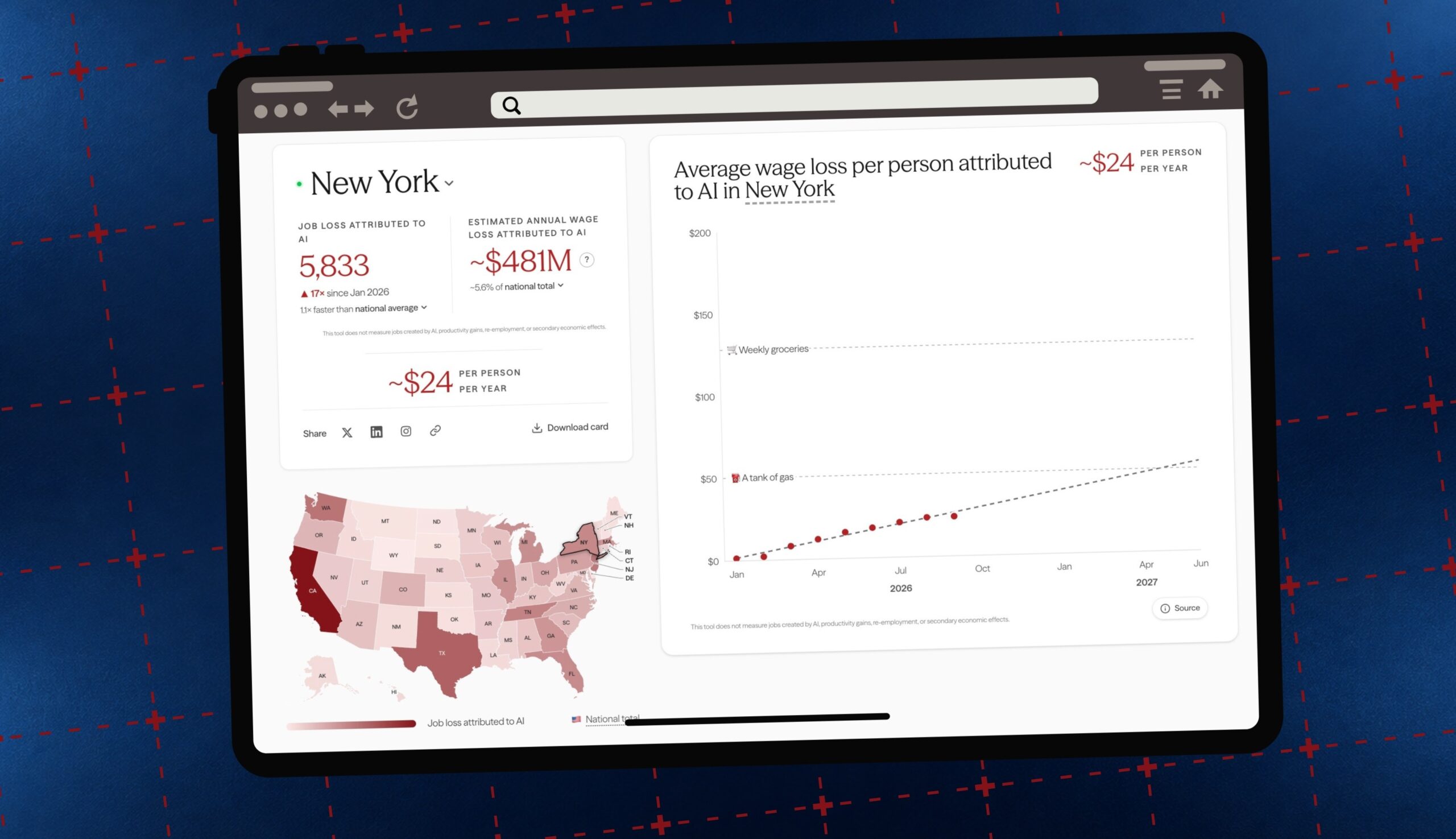
The wage loss dashboard includes a map of where layoffs have occurred since January 2026 (it was just updated this month to include September data) and a dropdown that shows data for the entire country or an individual state. As of now, the dashboard finds just over 117,000 job cuts attributed to AI nationally this year — $8.5 billion in estimated annual wage losses.
The wage loss dashboard multiplies the number of AI-attributed job cuts by the average annual salary to estimate annual wage loss. According to the dashboard, wage estimates are beginning to “show what these cuts could mean for households and local economies.”
The dashboard also shows the estimated average wage loss per person based on this layoff data, presented in relation to daily expenses, such as a tank of gas. For the country as a whole it is $25 per person per year. Not much, but the numbers vary by state: In California, for example, it’s $56. That’s thanks to a much higher concentration of job cuts (just over 27,000 layoffs attributed to AI). Alaska, on the other hand, claimed only 138 job losses ($14 per person).
However, these are not the exact number of people fired for AI in California and Alaska this year. As CAIS explains, “The dashboard estimates AI-attributed cuts for each state, converts them to estimated annual wage loss, then divides by state population to estimate the average loss per person. State estimates do not include observed AI layoffs.”
From layoffs to dollars and cents
The dashboard uses several data sources: monthly reporting by Challenger, Gray, and Christmas, which compiles layoff announcements from the United States by state, as well as national job cuts credited to AI, and data from the Bureau of Labor Statistics on each state’s annual median wage. CAIS also refers to population estimates from the US Census Bureau.
Also: 3 ways AI can help you ace your next job interview
In 2025, the Challenger, Gray, and Christian reports identified over 54,000 job cuts that companies publicly linked to AI. That translates to one out of 20 layoffs last year. But tracking job losses alone is a more abstract metric than what those layoffs mean in monetary terms to the people experiencing them.
“There has been significant news about job losses from AI, but it can be difficult to quantify how these cuts will affect the average person’s finances,” CAIS wrote about the project. “This dashboard aims to highlight the monetary costs of AI on American families and communities.”
As CAIS points out, the impact of layoffs shows ripples across grocery stores, small businesses, rent and other local costs.
“Laying off one person means less income for every business they support. Multiply this effect over thousands of workers in several industries, and you start to see the real economic weight of AI displacement,” wrote the researchers behind the project. “Additionally, AI-attributed job cuts are not evenly spread. States with large tech and media sectors will experience greater impacts.”
A few caveats: CAIS noted that this dashboard does not “include jobs created by AI, productivity gains, reemployment or secondary economic effects.” That’s partly because experts don’t have a consensus on whether or how much AI will stimulate the economy or outpace job displacement. AI-attributed layoffs are themselves dark: The data here are job cuts companies have said themselves are tied to AI. Without a single definition for what that means or complete transparency from companies, it’s not always 100% provable that a layoff was the direct result of obsolescence or replacement spurred by AI.
Also: Companies that embrace AI the most hire more people
“We don’t need an executive to say ‘we’ve replaced a team with AI.’ This is a moderate standard, mind you: it captures the broad pattern of AI-justified workforce reductions, while clearly excluding unrelated cuts,” the Alliance for Secure AI wrote about its methodology.
Other trackers like Jobloss.ai, which is run by the Alliance for Secure AI, also catalog job loss data by company, date, and how explicitly companies cited AI around those layoffs. Because of how amorphous tracking this data can be, Jobloss.ai only logs layoffs that meet certain criteria: at least 100 jobs in one fell swoop, accompanied by some mention of AI (or proxy terms, like “automation” and “productivity”).
The dashboard aims to make the data we have more accessible – not to shame any particular industry or company for its AI adoption choices.
“AI is a technology that is being embraced by companies for many reasons,” CAIS wrote. “Our goal is to make the costs of that adoption visible so that workers, communities and politicians can respond with real information instead of guesswork.”
Automated remote work
The Wage Loss Dashboard also includes a section on how well AI is completing remote freelance tasks. Using data from the Remote Labor Index (RLI) benchmark CAIS co-developed, which tests agents on real-world freelance tasks such as web development and video production, CAIS shows how quickly agents are evolving.
Also: The top AI fear for 6,000 tech professionals is not losing their jobs
“When RLI launched, the best AI agent completed just 2.5% of projects at professional quality. Eight months later, this number increased to 15.8%,” the researchers wrote. As of now, AI can fully automate nearly 16% of remote tasks, a percentage that doubles every 3.7 months. Claude Fable 5 comes out on top, followed by OpenAI’s GPT-5.5.
But that doesn’t mean AI will take over these projects from human freelancers. RLI measures what AI models are capable of doing, not what they actively assume. That said, CAIS remains alert to what it sees as a trend: the convergence of AI-attributed job cuts with more and more workable agents.
While the legislation cannot explicitly prevent companies from allowing AI systems to decide over hiring humans in certain cases, recent laws in several states, including the tech-sector-heavy state of California, aim to ensure that firing and other disciplinary decisions are not completely automated by AI systems.

See full bio