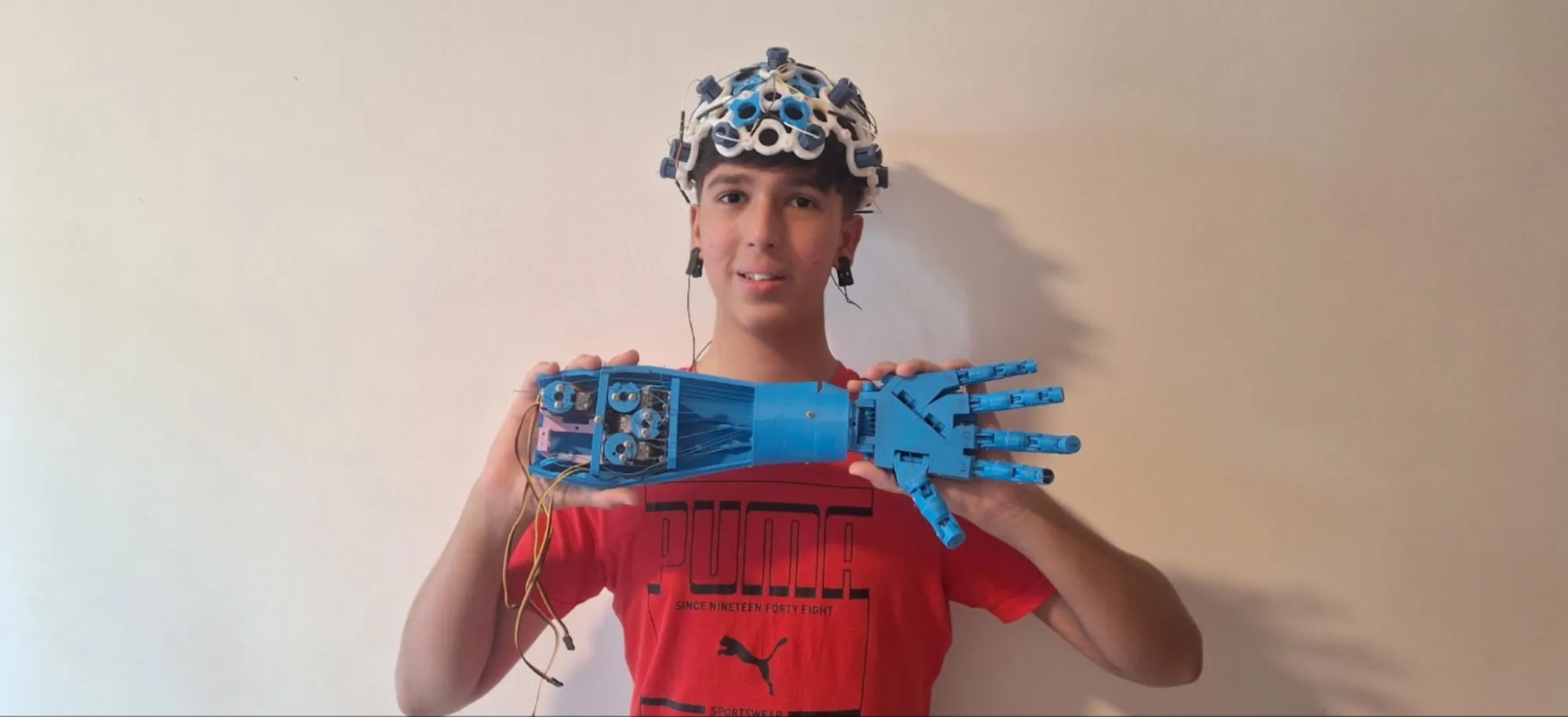
Aarav Sharma is still at work.
If you subscribe to the Make: Substack in July, you’ll read about Aarav Sharma and the 3D-printed, brain-controlled robotic arm he started building when he was 14.
Well it turns out Sharma hasn’t stopped working yet. Since then, he has been busy expanding control over the arm into a wider communication system.
Enabled by a sponsorship from OpenBCI, he built a six-command Steady State Visually Evoked Potential (SSVEP) system. Think of it as eye tracking from the inside, or as Sharma explains, “SSVEP is a kind of brain-computer interface where different targets flash at different frequencies. When the user focuses on one target, the EEG headset detects the appropriate response in the brain and converts it into a command.
Speed is aided with word suggestions from an OpenAI language model, while the user retains control over the final output. In his tests, people could respond to full sentences in under five seconds.
“For offline EEG data collection, the user completes about 60 trials where the system tells them which of six flashing targets to focus on. I then test how accuracy changes when using different amounts of EEG data, and use TFR graphs to check the detected frequencies and a confusion matrix to see which targets get confused.
He plans to eventually move the UI from a computer screen to AR glasses, for a more portable and practical experience.

Read more about his BCI projects at aaravinnovate.com/bci-neurova.