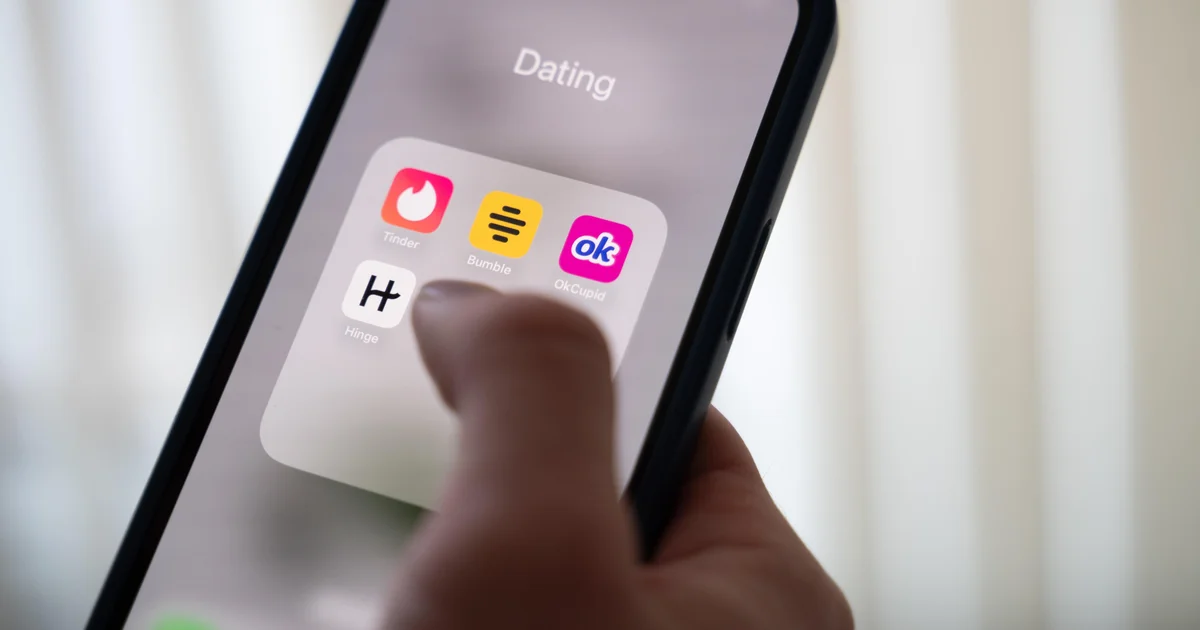
Marissa, a 31-year-old Boston resident, downloaded dating apps because she was looking for love. But more and more she finds herself looking for something else: AI-free photos.
The marketing professional said she regularly comes across dating app profiles that are digitally altered. Usually the changes are small and can be easily done with tools like Photoshop, just like editing a photo. Sometimes, though, the photo appears completely AI-generated, she told CBS News, citing a photo she came across on Bumble of a man dressed in a suit tiling a bathroom wall.
“AI aside, I’m not sure what the appeal is,” she said (Marissa asked to withhold her last name for privacy reasons).
Many women on TikTok also report seeing photos of men on dating apps that appear to be AI-generated. Their accounts show how AI is blurring the line between what’s real and what’s fake in the already fake arena of online dating. They also raise ethical questions about how far is too far when it comes to manipulating your online persona.
“People want authentic connections and conversations,” Kathryn Coduto, an assistant professor at Boston University who studies dating apps, told CBS News in an email. “I think AI has made people more cautious and skeptical of others, especially people they don’t know.”
Of course, dating app users have long relied on filters and other editing tools to polish their photos. But AI tools are upping the ante, allowing people to create high-quality images within seconds, and in some cases, fabricate fake scenes.
“A dater has to think about how they’re going to catch someone’s attention in a few seconds or less,” Coduto told CBS News. “This could mean your photo looks a little better than it might have before.”
To be sure, this practice is not exclusive to men. However, they seem more likely to use AI to build their dating profiles than women, Coduto added.
“So far, men are more interested in AI in the dating space, which is not surprising,” Coduto said. “Women tend to get more matches and messages, so men have a harder time standing out.”
The “digital stylist” that helps men AI their photos
AI can create obvious distortions when it generates photos, such as omitting a finger from the hand. For Marissa, a telltale sign is the person’s face, which sometimes looks “waxy” in AI-generated photos, she said.
However, as technology improves, it becomes increasingly difficult to distinguish a real photo from one created by AI models.
Lana Li, a Brooklyn, New York, dating consultant who runs the substack “Love Me Like a Robot,” calls herself a “digital stylist.” She uses AI to help men revamp their dating app photos, and advocates using the technology as long as the photos still truly represent who they are.
“I can take a picture of someone and then put them in a different outfit or change their hair a little bit, or put different shoes on them,” she told CBS News. “Or if I think her body language doesn’t look confident in the photo, I will have [ChatGPT] change that.”
The 37-year-old also uses FaceApp to change men’s facial expressions. She said the changes are subtle, such as lifting the corners of someone’s mouth slightly to make them look “friendly”.
Despite her liberal approach to using AI, there are lines that Li does not want to cross. For example, one client asked her to digitally alter a photo so that his head was on the body of a marathon runner—a request she refused.
“I told him, ‘I can’t work with you if you don’t want to represent yourself accurately,'” she said.
Two men, who spoke to CBS News on condition of anonymity to protect their privacy, told CBS News They have used AI in their online dating photos, but in ways they don’t feel like being misleading and stay true to who they are.
A ban on hinges
One man, a 30-year-old tech employee and client of Li’s, said she used ChatGPT to digitally dress him in more professional attire and tame his frizzy hair.
“It’s very subtle,” said the New York City resident, saying he still looks like himself, even with the changes. He emphasized that he does not want to “catfish” anyone – a concern for singles even in the absence of AI.
Another man retreats after one of his AI photos backfires. The 50-year-old New York resident said he fed photos of himself into Aragon.ai, an AI headshot generator, which produced an image of him on a Manhattan rooftop with a sunset in the background. It immediately drew hits on his Hinge profile.
“This picture got the most likes overall,” he told CBS News. “Now that might just be because it was the first thing they saw. But regardless, it proved to be effective, and the women seemed to like it.”
That was until Hinge banned him. He managed to get his account back, but eventually decided to delete the sunset photo, suspecting that it was the reason for his removal from the app.
“How much AI am I OK with?”
Most popular dating apps have policies that limit the use of AI-generated images in people’s profiles. Hinge emphasizes the importance of authenticity on his website, noting that people are able to distinguish “fact from fiction.”
“If you decide to include generative AI images, audio or video in your profile, it should not be used to misrepresent yourself or your intentions,” the company says on its AI policy page.
Hinge also uses automated tools and human reviews to detect and remove “prohibited material,” according to the company’s terms of service. If users see suspicious AI material, they can report it confidentially through the app or online.
A spokesperson for Match Group, which owns Hinge, Tinder and a handful of other dating apps, told CBS that as generative AI develops, the company is “watching and listening to daters who tell us they want more transparency, more authenticity, and more confidence that a real person is on the other end.”
Bumble also uses tools to detect and remove AI-generated content, and lets users report profiles that display such images. A spokesperson said the company prohibits inauthentic profiles, and Bumble’s community guidelines prohibit the use of “artificially generated photos or enhanced photos to deceive others.”
“We implement this through a combination of AI-powered tools, human moderation, verification features and member reporting, and we take action based on the severity of a violation, up to and including permanently banning accounts,” the spokesperson said.
Marissa, the 31-year-old who lives in Boston, said that when she sees a profile of a person whose photos bear the AI’s trademark, she chooses to join.
“The data pool is already challenging, and this is just another thing we have to contend with,” she said. “How much AI am I OK with?”