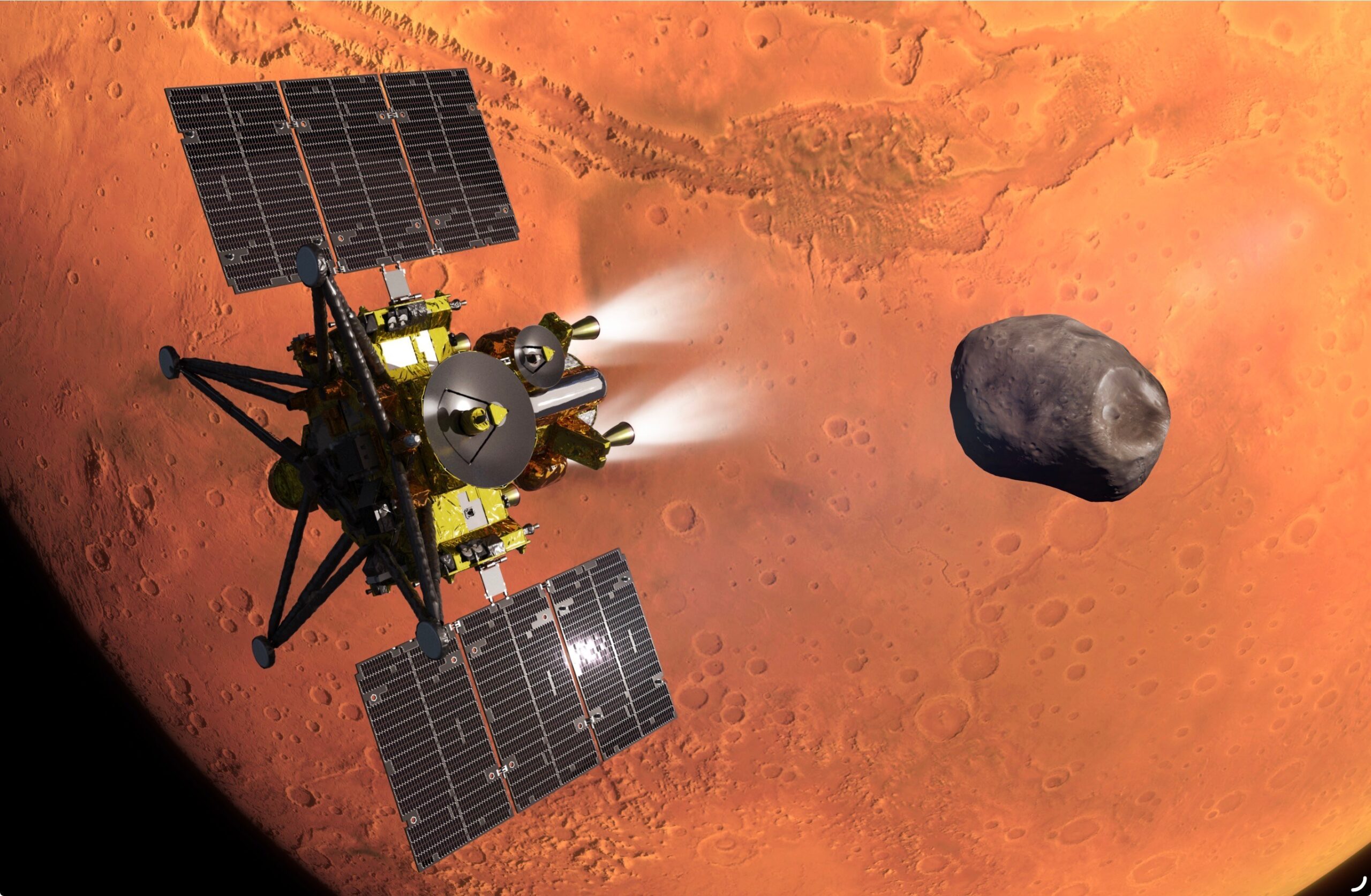
An ambitious Mars mission is scheduled to launch on Monday afternoon from the Tanegashima Space Center in Japan. Led by the Japan Aerospace Exploration Agency, with contributions from NASA, the Martian Moons Exploration Mission may be the first to travel all the way to Mars and back.
Not only will the mission send a spacecraft to study the Martian moons Deimos and Phobos, JAXA and NASA aim to carry samples from the surface of the Phobos home. JAXA has set up a live stream for you to watch the historic launch, set for 3:41 PM ET.
“The samples from MMX will bring paradigm-shifting science about the Mars system for generations, especially as NASA prepares to send the first humans to Mars,” said Nicky Fox, associate administrator for NASA’s Science Mission Directorate, in an announcement.
By studying these Martian moons, scientists can learn more about how our own world came to be and why the solar system looks the way it does today.
The Mystery of Mars’ Moons
Many scientists believe that the Earth’s moon was created a long time ago after one or more fast-moving objects from space collided with our planet, causing pieces to break off. This debris was captured from our planet’s orbit. Gravity gathered it together over time and turned it into the rounded moon we know today.
But it is still a theory. Similar theories surround the origins of Deimos and Phobos. Scientists think that Mars’ asteroid-sized moons may have been formed by collisions, the way we think our moon was formed, or the Martian moons could be asteroids that have been captured in Mars’ gravity.
By studying the moons closely, and then bringing home samples, scientists think they may be able to figure out how Deimos and Phobos formed.
“Having the answer will help illuminate the early era when Earth and the other inner planets acquired much of their water and organic compounds,” Tom Statler, MMX program executive and program scientist at NASA Headquarters, said in the announcement.
Essentially, if we have more data about other moons, we will have a better understanding of how celestial bodies formed when our solar system was young. Studying the moons will also advance our knowledge of the surface of Mars and how the planet’s environment has changed over eons.
NASA’s contributions to the mission include the Mars Moon Exploration with Gamma Ray and Neutron (Megane) spectrograph instrument to study the surface of Phobos, as well as the pneumatic sampler (p-sampler) technology demonstration that collects the Phobos sample. NASA will also lend communications and navigation support with the agency’s Deep Space Network.
A long way home
The mission will also test technology that could help humans one day travel to Mars. Getting a spacecraft to Mars and back, using robotics to reach and collect samples from the surface of Phobos, and all the while relying on deep space communications, should teach NASA and JAXA quite a bit of what it takes to make a successful round trip to Mars.
If all goes well, the mission will last five years. JAXA has scheduled the MMX spacecraft for an August 2027 arrival on Mars. The craft will depart in November 2030, and then return home in July 2031.
However, even if the MMX mission is a success, there is no guarantee that it will be the first mission to Mars and back. China’s Tianwen-3, tasked with returning samples from Mars to Earth, is scheduled for a 2028 launch, with a return date also set for 2031.
In 2020, NASA’s Osiris-Rex spacecraft grabbed samples from asteroid Bennu and returned them to Earth in 2023.

See full bio