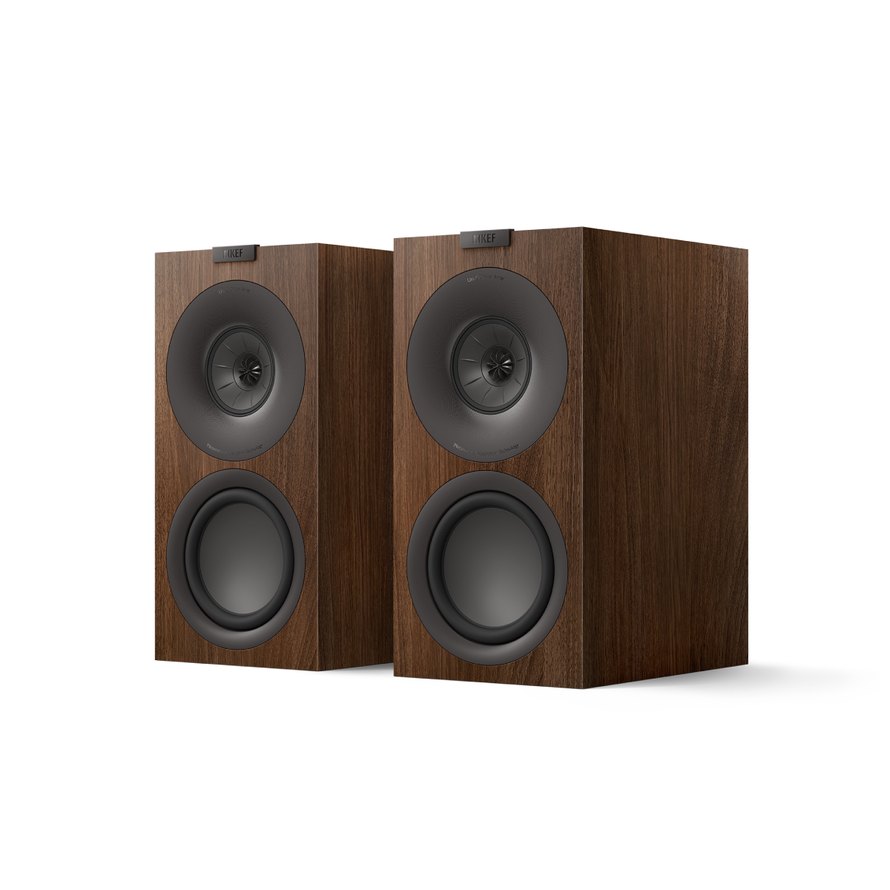
KEF gives the Q Concerto Meta and Q3 Meta a common technology foundation: a 12th generation Uni-Q Array and Metamaterial Absorption Technology. Their driver arrangements are different though. The Concerto separates bass duties into a different driver, while the Q3 combines bass and midrange in its Uni-Q assembly. Choosing between them also involves cabinet dimensions, external amplification, and where the speakers can sit in the room.
Understand driver arrangement before comparing bass

Q Concerto Meta is a three-way bass reflex design. Its Uni-Q array combines a 19mm tweeter with a 100mm midrange driver, while a separate 165mm driver handles the bass. Q3 Meta uses a two-way layout with a 25mm tweeter and a 165mm bass/midrange cone. Sharing the Uni-Q name therefore does not mean that the two cabinets contain identical driver assemblies.
KEF lists a frequency response of 48Hz–20kHz within ±3dB for Concerto and 49Hz–20kHz for Q3. The small difference should discourage choosing entirely from the lower number. The numbers describe a response limit; they do not capture every aspect of output, dispersion or how a particular space changes the outcome.
The separate typical in-room bass figures are 36Hz and 39Hz at -6dB. Keep this qualification next to the numbers. MAT addresses the energy behind the tweeter, rather than controlling reflections throughout a listening room. The position and surrounding surfaces remain part of the setup of either speaker.
Allow the cabinet and its support

Concerto measures 415mm high, 210mm wide and 315mm deep, including clamps. Q3 is 357mm high with the same width and a 305mm depth. The larger model is mainly superior in this comparison. Check the space above a shelf as well as the depth available for cables and the rear port.
The quoted weights are 9.5 kg and 8.2 kg per cabinet. These figures are important when choosing stands, furniture or mounting materials. KEF lists SQ1 stands for both models and a B2 wall mount option for Q3. Follow the appropriate installation instructions and check the support structure before choosing a wall position.
Matching a stand to the speaker is only one decision. The listener’s height, the distance between the pair, and the distance from the boundaries of the surrounding area also need attention. Leave room to adjust placement during setup rather than treating the first available shelf as the final listening position.
Adjust the amplifier to the specified load

Both speakers have a nominal impedance of four ohms, with a stated minimum of 3.2 ohms. Check the suitability of an amplifier for this load alongside its power specification. A wattage rating alone does not describe how an amplifier behaves as the electrical load changes during playback.
KEF recommends amplifier power of 15–180W for Concerto and 15–150W for Q3. These are areas to choose for external reinforcement. Neither cabinet contains the amplifier needed to support its drivers, so a source device with only a line-level output won’t complete the system.
Sensitivity is quoted as 85dB for Concerto and 87dB for Q3, both at 2.83V/1m. Keep the test conditions attached when comparing these values. Speaker choice, listener distance, and the level you intend to use should inform the available amplifier storage space. An audition at appropriate levels can help evaluate the overall result.
KEF also quotes maximum output on one meter as 108dB for Concerto and 109dB for Q3. These spec numbers provide another reason to evaluate more than cabinet size. When arranging a demonstration, compare the pair at a similar listening distance, using the same source material and an amplifier suitable for both models, with music you know well.
Plan the complete stereo system

Both packages include a pair of speakers, magnetic grids, rubber feet, and portbungs. The rest of the system depends on the source: a network player, TV connection or record player presents its own connection requirements. These passive cabinets provide speaker terminals, so that wireless streaming and source switching belong elsewhere in the system.
For a vinyl setup, our Technics Turntable comparison covers another part of that chain. Account for suitable phono processing and amplification when assembling the complete setup. Comparing the speakers alongside equipment you already own can make the decision more useful than considering each cabinet in isolation.
Up to date UK pair prices are £1,099 for Q Concerto Meta and £649 for Q3 Meta. Walnut Concert and Satin Black Q3 were available to order when tested. KEF announced the series on September 26, 2024. Current specifications and purchase options are available from KEF.
| specification | Q Concert Meta | Q3 Meta |
|---|---|---|
| Design | Triple bass reflex | Two-way bass reflex |
| Uni-Q Tweeter | 19mm aluminum dome with MAT | 25mm aluminum dome with MAT |
| Midrange/bass arrangement | 100 mm center field; separate 165mm bass driver | 165mm combined bass/midrange |
| Frequency response ± 3dB | 48Hz-20kHz | 49Hz-20kHz |
| Frequency range -6dB | 40Hz-20kHz | 42Hz-20kHz |
| Typically in the room bass -6dB | 36 Hz | 39hz |
| Sensitivity at 2.83V/1m | 85 db | 87 db |
| impedance | 4 ohms nominal; Minimum 3.2 ohms | 4 ohms nominal; Minimum 3.2 ohms |
| Recommended external amplifier | 15-180 watts | 15-150 watts |
| crossover frequencies | 430 Hz; 2.9 kHz | 2.0 kHz |
| Dimensions per cabinet, H × W × D | 415 × 210 × 315 mm, including clamps | 357 × 210 × 305 mm, including clamps |
| Weight per cabinet | 9.5 kg | 8.2 kg |
| Listed support options | SQ1 stands | SQ1 stands; B2 wall holder |
| completion | Satin Black; Satin white; walnut | Satin Black; Satin white; walnut |
| Series start announcement | 26 September 2024 | 26 September 2024 |
| Where to buy | Buy Q Concerto Meta at KEF UK | Buy Q3 Meta at KEF UK |