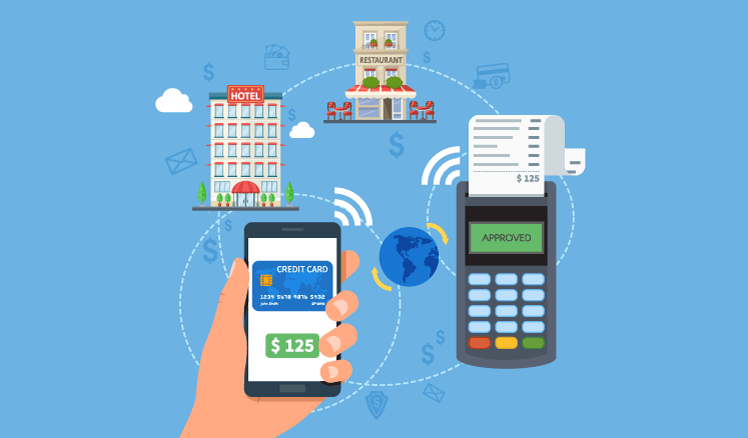
With the advancement of mobile app development technologies has come the practical opportunity to literally turn a smartphone into a credit card. No wonder that hotels and restaurants, which are more about comfort and convenience than other businesses, were the first in line to take the initiative. Let’s see how these two industries have welcomed mobile payments and how they have benefited from this technology.
How it all began
Popular brands, such as Hilton and Marriott, Starbucks and Wendy’s, started offering hotel and restaurant mobile payment to their customers a few years ago. This step helped them strengthen their public images, attract new audiences and create high industry standards in customer service.
Currently, these brands are busy expanding the range of their mobile payment services, while other businesses in the hospitality and restaurant industry are quickly adopting the technology to meet the set standards.
Use mobile wallet
Mobile wallets make it easier for hotels and restaurants to introduce mobile payment customers. By taking advantage of the already existing popular systems, such as Apple Pay and Android Pay, businesses do not have to develop their own apps. All they have to do is simply implement a solution that allows them to make mobile payments.
This solution is, in most cases, an NFC reader. However, different mobile wallets have different features and give both businesses and customers the right to choose the most suitable option. As mentioned here, for example, JP Morgan’s Chase Pay offers QR code scanning instead of NFC data exchange.
Loyalty integration
A major disadvantage of mobile wallets is their incompatibility with loyalty programs. After all, mobile wallets are universal and mostly adapted to the needs of the customer. So, to make the most of mobile payments, far-reaching brands are opting to go for the development of their own payment apps.
The fact is, integrating loyalty programs with hotel or restaurant mobile payment systems and stand-alone apps can not only increase customer engagement and retention, but also give business owners a lot of useful information about customers’ buying patterns. This information is crucial to creating special offers that connect with the audience and bring real benefit.
Possible challenges
Certainly, the introduction of mobile payments is not an easy step for any business: as much as it brings positive changes, it can also bring difficulties. A vivid example of an unexpected challenge is the issue with Starbucks restaurant mobile payment, where the company failed to properly manage the lines of walk-in customers and customers with a mobile pre-paid order. To avoid customer frustration, businesses should be prepared to provide high-quality service to all customers, regardless of their payment choice. Deploying self-service kiosks in restaurants and hotel lobbies can also be a helpful option.
On a final note
Once a luxury option, mobile payment is now becoming a customer’s basic expectation, if not a demand. More and more customers make their choice of a hotel or a restaurant based on the available mobile services. As such, companies that do not offer mobile payment are at a disadvantage, and if they do not adopt new technologies, they may lose their position in the market.