Sales and service gains are reshaping competition between car brands, a new study finds
Filipino vehicle owners report better purchase and ownership experiences, according to Differential Singapore’s second annual Philippines Customer eXperience Index (CXI) study℠.
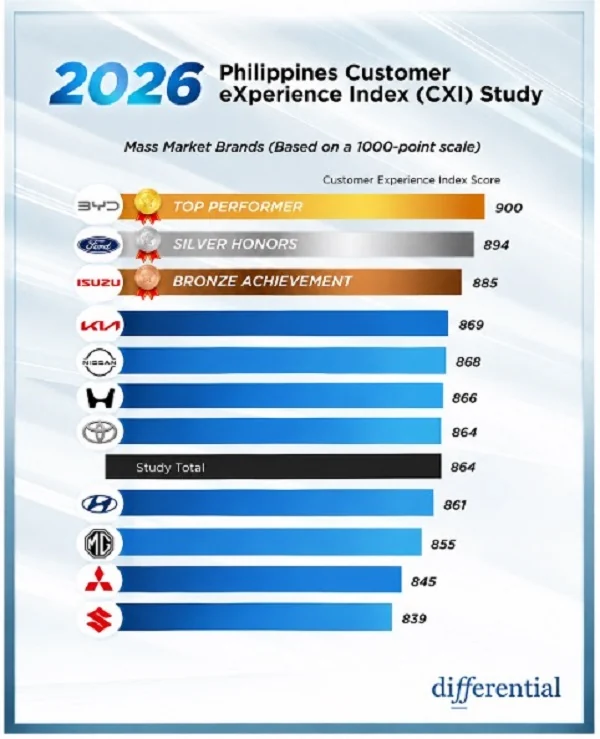
The industry’s Total Customer Experience Index rose eight points, from 856 in 2025 to 864 in 2026. Behind the increase is a more striking story: sales and after-sales service are improving significantly faster than satisfaction with the vehicles themselves.
The majority of the 11 car brands assessed in both years recorded higher sales and service index scores. Across the industry, the Sales Experience Index increased by 24 points and the Service Experience Index by 21 points, underscoring the growing importance of dealer interactions in shaping customer perceptions.
WHAT the study measures
The independent study evaluates the customer experience across three pillars: vehicle sales, after-sales service, and product satisfaction. It examines the touchpoints that matter throughout the vehicle purchase and ownership journey:
- Sales and purchase experience covers the customer journey from initial inquiry to vehicle delivery, including pre-sales consultation, dealer facilities, salesperson interaction, vehicle selection, price negotiation, and post-sales follow-up.
- After-sales service quality evaluate the reliability of the service, communication and transparency, convenience, price fairness and professionalism of the dealer staff.
- Product satisfaction examine vehicle styling, driving performance, interior comfort, ergonomics and user interface, storage practicality, entertainment systems, and safety features.
Together, these dimensions provide a broader view of the automotive customer experience, helping consumers look beyond specifications and giving manufacturers actionable insights into where customer expectations are changing.
“The encouraging news is that the customer experience in the Philippine automotive industry is improving, especially where customers interact directly with dealers,” said Sigfred M. Doloroso, country manager at Differential Singapore.
“As competition intensifies, manufacturers and dealer networks raise the bar for sales and service. That’s good news for Filipino motorists who benefit from better support before and after purchasing a vehicle.”
KEY INDUSTRY INSIGHTS
Retailer experience drives gains, while product satisfaction remains largely steady
The biggest industry-wide improvements came from sales (+24 points) and after-sales service (+21 points), compared to just two points for product satisfaction.
- Sale: Pre-sales information and consultation (+33 points), seller interaction (+32 points), and dealer facilities (+27 points) posted notable gains.
- Service: Both service quality and personnel and facilities improved by 25 points, while convenience and accessibility increased by 22 points.
- Product: The results were more mixed. Interior design and comfort improved by seven points, while safety and security features dropped by five points and Vehicle Sound Systems by two points.
For OEMs, the message is clear: stronger dealer execution is driving customer appreciation, but product experience remains a critical area for differentiation.
Chinese brands are narrowing the gap as customer experience competition intensifies
Chinese car brands rated the biggest year-on-year gain among the four country-of-origin groups, improving 50 points from 839 in 2025 to 889 in 2026. That moved them from fourth to second place, ahead of Japanese and Korean brands on numerical points.
American brands remained ahead at 894, but their lead over Chinese brands narrowed from 29 points to just five. Korean brands improved by 24 points and Japanese brands by three. The changing scores suggest that competition between car brands is increasingly about the complete purchase and ownership journey, not just vehicle features or price.
BYD surpassed rivals in year-on-year profits
BYD published the greatest improvement in the overall CXI among the 11 brands evaluated in two years, rising 52 points from 848 in 2025 to 900 in 2026. Its gains exceeded those of Kia (+38 points), Isuzu (+31 points) and Ford (+26 points).
BYD also made substantial progress across the three pillars: after-sales service (+63 points), sales (+61 points), and product satisfaction (+48 points). Beyond its top overall score, the breadth of BYD’s improvement is a signal to OEMs that competitive positions can change quickly if the customer experience continues across multiple touchpoints.
Communication and service processes show tangible progress
Retailers are also strengthening how they communicate with customers and manage after-sales visits. While the proportion of buyers using the Internet before purchasing a vehicle decreased to 83 percent, the use of e-mail in salesperson-to-customer communication increased by 37 percentage points. It was followed by SMS (+12 points), messaging applications (+9 points), and face-to-face contact (+3 points).
Service processes also showed measurable gains, including walkaround inspections (+14 percentage points), service advisor familiarity with vehicle service history (+14 points), and service notifications (+12 points). For OEMs and retailers, these findings underscore the importance of proactive communication, service transparency, and consistent execution at key customer touchpoints.
GENERAL EXPERIENCE RANKINGS
The three highest overall customer experience index scores in 2026 were:
- BYD: 900 index points
- Ford: 894 index points
- Isuzu: 885 index points
BYD also recorded the highest numerical scores across the three individual pillars: sales and purchase experience, after-sales service quality, and product satisfaction.
Beyond the overall ranking, the study provides brand-level benchmarking and detailed customer feedback on individual touchpoints, helping manufacturers identify where to defend strengths and where to prioritize improvement.
“The most important finding is not simply which brand leads the ranking. It is that every brand evaluated in both years improved in sales and service, pointing to a broader industry effort to deliver better customer experiences,” Doloroso added.
“For consumers, the ownership experience deserves as much attention as the vehicle itself. For OEMs and dealers, the opportunity is to turn these insights into consistent, meaningful improvements at every stage of the customer journey.”
ABOUT THE STUDY
Conducted from April to July 2026, the Philippines Customer eXperience Index (CXI) Study℠ independently assesses customer satisfaction with authorized car dealer networks in the Philippines.
The study covers 11 mass market car brands and 1,200 respondents nationwide who purchased vehicles between January and December 2025 and serviced them during the same period. It measures experiences on vehicle sales, after-sales service, and product satisfaction, providing manufacturers with a structured view of customer expectations and competitive performance.
The complete study includes brand-level results, benchmarking across key customer touchpoints, and detailed findings to support improvements in customer engagement and owner experience.