As the Philippines and its ASEAN neighbors face compounding climate risks, regional research points to a shift from extractive industries to a restorative economy as a path to long-term prosperity, protected watersheds and safer frontline communities.
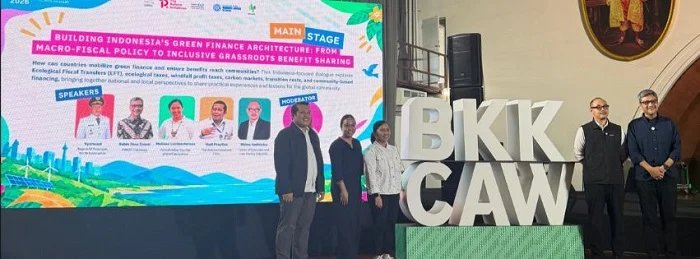
At Bangkok Climate Action Week (BKKCAW) 2026, Indonesian research institutes, organizations and local leaders unveiled a practical framework for a restorative economy. This model gives Southeast Asia an opportunity to build economic systems that actively replenish ecosystems rather than just extracting value from natural resources.
The agenda is modeled around regional potential and supported by new research from CELIOS (The Center of Economic and Law Studies) which shows that restorative economic practices in neighboring Indonesia alone could generate IDR2,208 trillion (about PHP8 trillion / USD140+ billion) in national economic output over 25 years, while reducing income inequality by 15 percent.
A BLUEPRINT FOR THE PHILIPPINES
For the Philippines, the model provides an important blueprint. The country is ranked as one of the most vulnerable nations in the world to climate-induced disasters. National government climate spending exceeds PHP1.16 trillion annually, and adaptation financing needs approach USD100 billion by 2040.
Against this backdrop, the Indonesian sessions demonstrated how community-led nature restoration across 23,470 villages is moving beyond isolated projects into mainstream, scalable economic models across Southeast Asia. Convened under the BKKCAW theme “Economy We Shape, Climate We Share”, the program showed how economic activity itself can build natural systems and strengthen local livelihoods.
The CELIOS study comes as the Philippines faces an urgent need to address extreme weather hazards across the country. As seen in recent months, the climate crisis has greatly affected Southeast Asia. News of extreme flooding and typhoon damage across Metro Manila, Luzon, and Visayas, and urban flooding in Bangkok and Johor Bahru, in addition to devastating forest fires in Sumatra, Kalimantan, and Papua, filled everyone’s TV sets and social media feeds.
FROM EXTRACTION VALUE TO RECOVERY VALUE
For CELIOS, the transition requires changes in the way the economy collects, allocates and distributes capital. On October 5, CELIOS joined with PINUS Indonesia, The Reform Initiatives, and published What You Pay Indonesia to “Build Indonesia’s Green Finance Architecture: From Macro-Fiscal Policy to Inclusive Grassroots Benefit Sharing.”
The session examined how instruments such as Ecological Fiscal Transfers (EFT), ecological and windfall profit taxes can be developed to direct resources to ecological priorities and local economies.
Indonesia’s experience with ecological fiscal transfers across 43 subnational governments provides an example of how fiscal policy links national revenues to environmental performance and local development. The discussion also considered how green finance can support community-led initiatives and improve benefit sharing at the grassroots level.
“We need to elevate the nature-based economy beyond basic conservation and position it at the center of the national economic strategy,” said Bhima Yudhistira, executive director of CELIOS. “Through fair fiscal mechanisms and transparent benefit sharing, we can attract capital, while transitional dividends directly enrich local communities on the frontline.”
RESTORATION AS AN ECONOMIC ACTIVITY
At the landscape level, Cendekia Iklim Indonesia (CII) explored what a restorative economy looks like when it is built around the ecosystems that sustain the local economy. His program, “Wealth That Flows: Building Prosperity Through Watershed Regeneration in Southeast Asia,” focuses on the relationship between healthy watersheds, livelihoods and local economic activity. A feature session on “Restoring Watersheds through Agroforestry” explored how agroforestry and landscape restoration support both ecological recovery and rural livelihoods.
The discussion includes examples such as coffee and macadamia agroforestry in Doi Tung, where agricultural production is part of a broader approach to landscape restoration and community development.
CII emphasizes that restoring nature is a value-generating investment rather than an ongoing expense. The organization emphasized that regenerating water through sustainable agroforestry secures critical water systems, builds rural livelihoods, and constructs a scalable economic playbook for the wider Mekong and ASEAN region.
A PAVILION FOR GLOBAL SOUTH SOLIDARITY AND PRACTICAL BIOECONOMY
Organized by Koalisi Ekonomi Membumi (KEM), the Nature-Based Economy Pavilion at Lumpini Park (October 5 to 7) served as a collaborative hub bringing together social entrepreneurs, impact investors, civil society, researchers and politicians from across the Global South.
Rather than seeing climate action in isolation, the pavilion demonstrated how responsible bioeconomy models can connect local producers directly with absorbers, capital and policy design.
“Climate action strategies cannot operate in isolation; they require active, cross-sector collaboration,” said Fito Rahdianto, executive director of KEM. “If the dreams of a better world feel too abstract, we can at least offer a new perspective to imagine life beyond the extraction systems we have inherited, to build a responsible bioeconomy that creates value from biodiversity while ensuring social and ecological well-being.”
FROM NATURE-BASED SOLUTIONS TO A RESTORATIVE ECONOMY
Across these discussions, the message was simple: restoration can be part of how the economy creates value, not just a cost of doing business. From green finance and tax reform to agroforestry and water restoration, participating Indonesian organizations explored what it takes to build economic models that strengthen both local livelihoods and the natural systems they depend on.
This exploration aims to build regional awareness of how restorative economic practices, applied not only at the grassroots level, but also at the national and Southeast Asian level, create positive impacts for society and the environment.