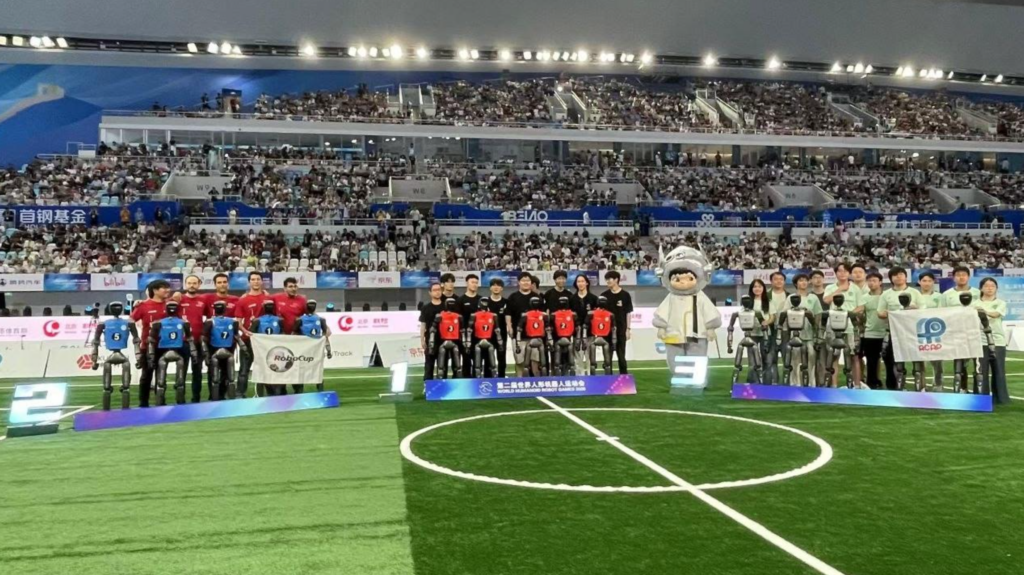
RoboCup’s humanoids played their first 11-a-side match. This October, some of the same problems – balance, vision, autonomy and a lot of debugging – are coming to Maker Faire Rome.
This summer, twenty-two humanoid robots took to a soccer field in Incheon, South Korea. Eleven against eleven. No remote controls. On July 5, 2026, B-Human from Bremen and HTWK Robots from Leipzig played the first 11-a-side humanoid robot soccer match in RoboCup history. It was an exhibition that was played after the official competition, on a bigger field, and lasted for a half. B-Human won 4-0. The score was interesting. The fact that the match could be played at all was more interesting.
When the RoboCup introduced its first humanoid competition in Fukuoka in 2002, the robots still managed limited challenges rather than playing a full football match. Twenty-four years later, two teams managed an 11-a-side game. That’s quite a lot of engineering in between. A robot playing soccer maps the kinematic vectors, wheel velocities, and directional forces required for an autonomous mobile robot to navigate, track a ball, and execute kicks on the field.
Why make a robot play football?
The RoboCup began in 1997 with an unusually clear long-term goal: by the middle of this century, a team of fully autonomous humanoid robots should be able to beat the reigning human World Cup under FIFA rules. It still sounds unlikely and that is rather the point. Soccer is a useful robot problem because almost nothing remains. The ball is moving. The other players move. The robot itself balances on two legs while trying to figure out where it is and what to do next. There is no fixed sequence of moves that will get you through a match.

A robot must locate the ball, understand its position on the field, recognize other players, choose an action, move without falling and react when someone else gets there first. And all those systems have to agree with each other. Good vision isn’t much help if the robot can’t turn fast enough. A beautifully trained kick is useless if the robot has misjudged the position of the ball. Improve the walking system and you can create a new problem for localization. Changing a component in software that worked yesterday may require tuning again. For a manufacturer, this is where robot soccer gets good. You can see the whole system being tested at the same time – same robot, different footballs. But things are changing fast.
The 2026 season also brought a significant change for RoboCup. The former Standard Platform League and Humanoid League were brought together in the new Humanoid Soccer League. In the middle division, teams including B-Human and HTWK Robots competed with Booster Robotics’ K1 humanoid platform. Having the same base robot does not mean having the same robot on the field. B-Human developed its own movement systems for the K1, including running, shooting and getting back on its feet. The team used deep reinforcement learning to train these behaviors instead of relying entirely on the manufacturer’s standard movement routines. This is worth paying attention to. Buying a humanoid platform removes a huge engineering job: you no longer have to design every joint, gearbox and structural part yourself. It doesn’t give you a football player. That still involves software, training, control, testing, tuning and a lot of time spent discovering that a behavior that looks good in simulation behaves rather differently when motors, batteries, friction and gravity are involved. B-Human went on to win the RoboCup 2026 Middle Division title, beating HTWK Robots 6-0 in the official final. The two teams then returned for the experimental 11-a-side match.
The hardware can always come off the shelf. What you do is another matter. Watch what happens before kicking robot football becomes much more interesting when you stop watching only for goals. Watch the few seconds before a robot reaches the ball. How did you find it? How does it know where its own feet are in relation to it? Why did it come from that angle? How fast can it change direction? What happens when another robot crosses the path he had planned? And when it falls — which robots still do — how does it decide how to get up and get back in the game?
RoboCup comes to Maker Faire Rome
A match bundles problems in computer vision, localization, motion planning, bipedal locomotion, machine learning, control and coordination between different autonomous machines. It also exposes something that every hardware manufacturer eventually learns: the physical world has opinions. A simulator does not have a connector that is working. Its batteries don’t fade halfway through a run. His foot does not slip because the surface is slightly different from the one you tested on. Real machines do all those things. That’s why watching them fail can be every bit as useful as watching them.

From October 23 to 25, Maker Faire Rome will host the first Italian Open RoboCup Humanoid Soccer Tournament, an official RoboCup regional event, at Gazometro Ostiense. The Roma event will feature the Medium and Large divisions, with 3-v-3 and 5-v-5 matches depending on the teams and robot platforms participating. There will also be technical tests, public demonstrations and a RoboCup Humanoid Soccer workshop. That makes it rather different from watching a polished humanoid demonstration video. The robots have something to do. They have to find the ball, move into position, stay upright, make decisions, cooperate with teammates and with what the other side does next. Sometimes that will work. Sometimes one will reach for a laptop. Both are part of history.
It is just as important to talk to the people behind the robots. At a Maker Faire, the machine is only half of the exhibit. The other half is usually the person standing next to them, happy to explain why version 3 failed and why version 4 has a completely different knee joint. RoboCup teams bring together students, researchers and engineers working across mechanics, electronics, AI, computer vision and control systems. What looks like a simple movement on the ground can be the result of weeks of changing a gear, changing a behavior or trying to understand why the real robot refuses to behave like the model.
That’s what makes the RoboCup such a natural fit for Maker Faire Rome. There is a competition, for sure. But underneath is the familiar cycle: Build it. Test it. Find out what is wrong. Change it. Try again. RoboCup’s World Cup goal is still twenty-four years away. No one knows if a robot team will be ready to face the human champion in 2050. For now, there’s a better reason to watch. You can see how they build their way there. Maker Faire Rome – The European Edition 23-25 October 2026 Gazometro Ostiense, Rome
