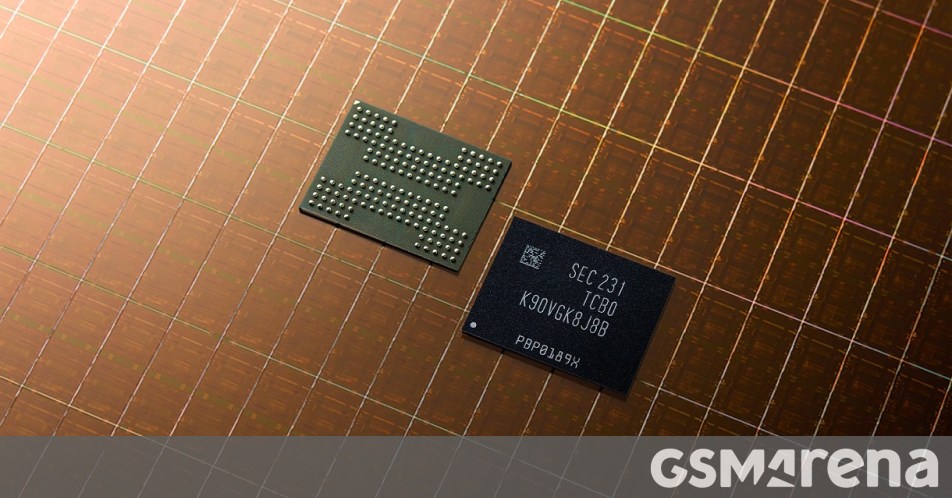
Chinese memory maker YMTC became China’s largest producer of NAND flash chips this year with a market share of 38.5%, up from 28% last year. This allowed it to overtake Samsung, which is #2 with 33.5% share (from 36%) and SK Hynix, which is #3 with 17% (from 20%). So, now the two Korean companies are working on upgrading their production capacity in China.
Samsung’s facility in Xian, China accounts for approximately 40% of its global NAND production capacity. However, it only makes relatively old chips with about 200 layers (more layers = more storage per chip).
There is an ongoing project to upgrade the facility to make NAND V9 chips with 286 layers, writes Reuters. This will start slowly with a planned output of 5,000 wafers by the end of this year and then increase massively to 40,000 wafers by the end of 2027.
Samsung NAND production timeline up to v9
V9 is however previous generation technology. Earlier this year, Samsung unveiled the NAND V10 with more than 400 layers. V10 has other improvements over V9, including higher speed and better power efficiency.
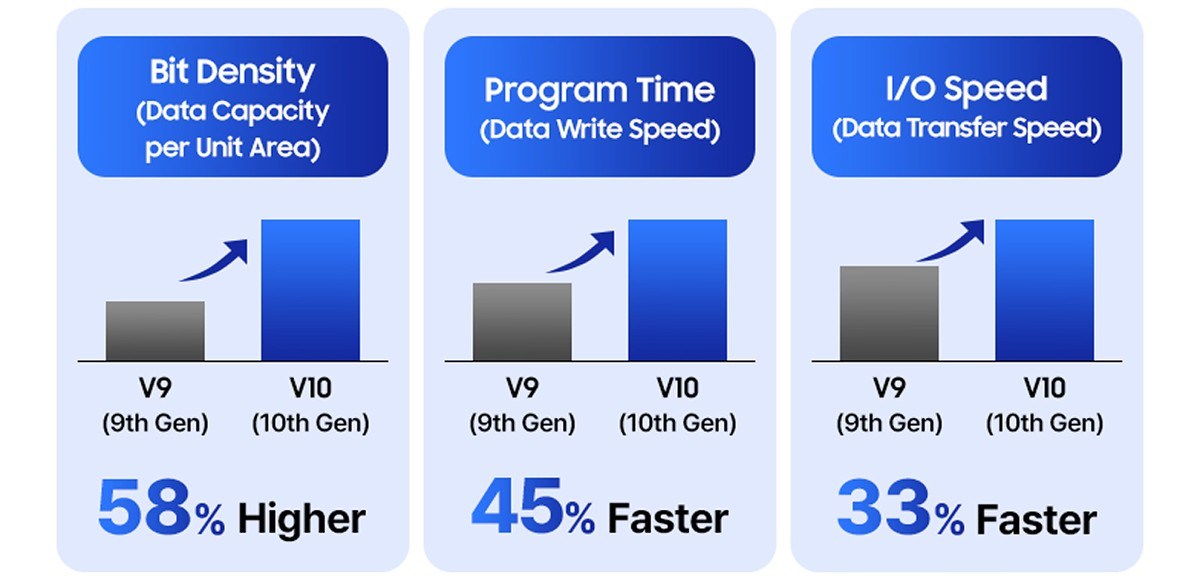
Samsung NAND V10 upgrades over V9
SK Hynix has a plant in Dalian, China – this plant used to be owned by Intel before it was spun off and sold under the name Solidigm. Solidigm has plans to be listed on NASDAQ, but it is facing pushback from shareholders and regulators.
Speaking of regulators, companies that want to install US-made semiconductor equipment in China need a license from the Bureau of Industry and Security, which is part of the US Commerce Department. In 2025, the bureau said it will not issue licenses to expand or upgrade factories in China owned by foreign chip makers.
Anyway, SK Hynix’s plant in Dalian currently produces 192-layer chips, but insiders say the company has received the go-ahead from US authorities to upgrade to 240-layer chips and has plans to work on 300+ layer chips if given permission. SK Hynix is also in talks about setting up NAND production in the US (with the help of Intel), which may help tip the scales.
Source