Price: $130
Manufacturer: Sunlu
link: store.sunlu.com/products/sunlu-ams-lite-heater-upgraded-your-bambu-lab-ams-lite
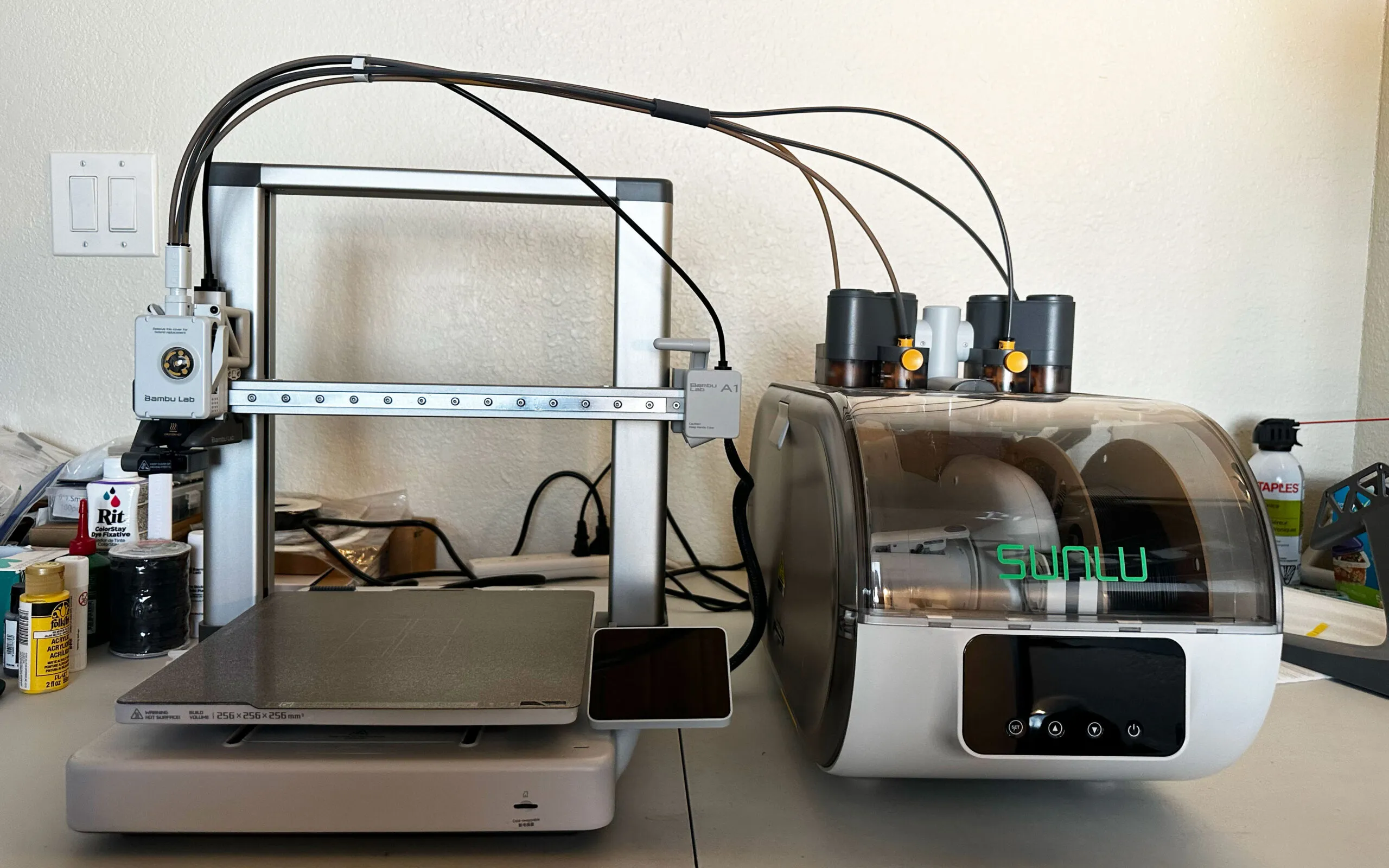
Dry filament for 3D printing wasn’t on my radar until recently, so as a happy user of my Bambu Lab A1 and AMS Lite I was excited to get my hands on Sunlu’s AMS Lite Heater. It’s easy to assemble, easy to use and keeps your filament dry while you print, but it only works with Bambu’s AMS Lite.
Unlike the standalone heating cabinets, Sunlu’s AMS Lite heater integrates with the bamboo’s hardware, so you have a fully enclosed AMS Lite that can dry filament before and during printing. Assembly looked easy at first and became a bit daunting when I realized I basically had to take the AMS apart and destroy a Sunlu unit in the middle. In reality, it only changed a few screws and stripped two wires. The AMS is still powered by the printer, so you can print without a heater and use the heater with the printer turned off. Apart from a few screw holes that don’t quite match up (and a clunky plastic cover to replace), it’s an elegant integration.
The unit has six preset temperature and humidity settings for PLA, PETG, TPU, ABS, PA (Nylon) and PC (Polycarbonate), plus the ability to manually set the temperature between 35°C – 70°C and set the humidity between 25%-50%. A timer can be set and defaults to 6 hours of heating, but then switches to 50% humidity to bring it back to your target value. The unit was hot to the touch during operation, but not enough to burn. And importantly, there is no heat in my office. It was also quite quiet.
Quality-wise, I haven’t seen a huge improvement in my prints, but I also typically don’t have a huge problem with the humidity where I live in the San Francisco Bay Area. However, in more humid areas you may see more of an advantage, especially as the heater continues to dry the filament as you print.
You want to leave some space on the side of the machine for loading and unloading filament. The heater doors need room to fold and with the relatively short bamboo PTFE tubes I found myself turning the entire unit to get to the side facing the printer.

Since the filament spools are closed and heated together, it may not be ideal if you keep different types of filament loaded in the AMS, as I usually do. Different materials require different temperatures, so heating a spool of PETG to its recommended temperature can cause a spool of PLA to melt if you load both at the same time.
Overall it’s a clever unit that’s easy to use, works well and generally keeps the same footprint on my desktop as my A1 and AMS Lite combo did before.
