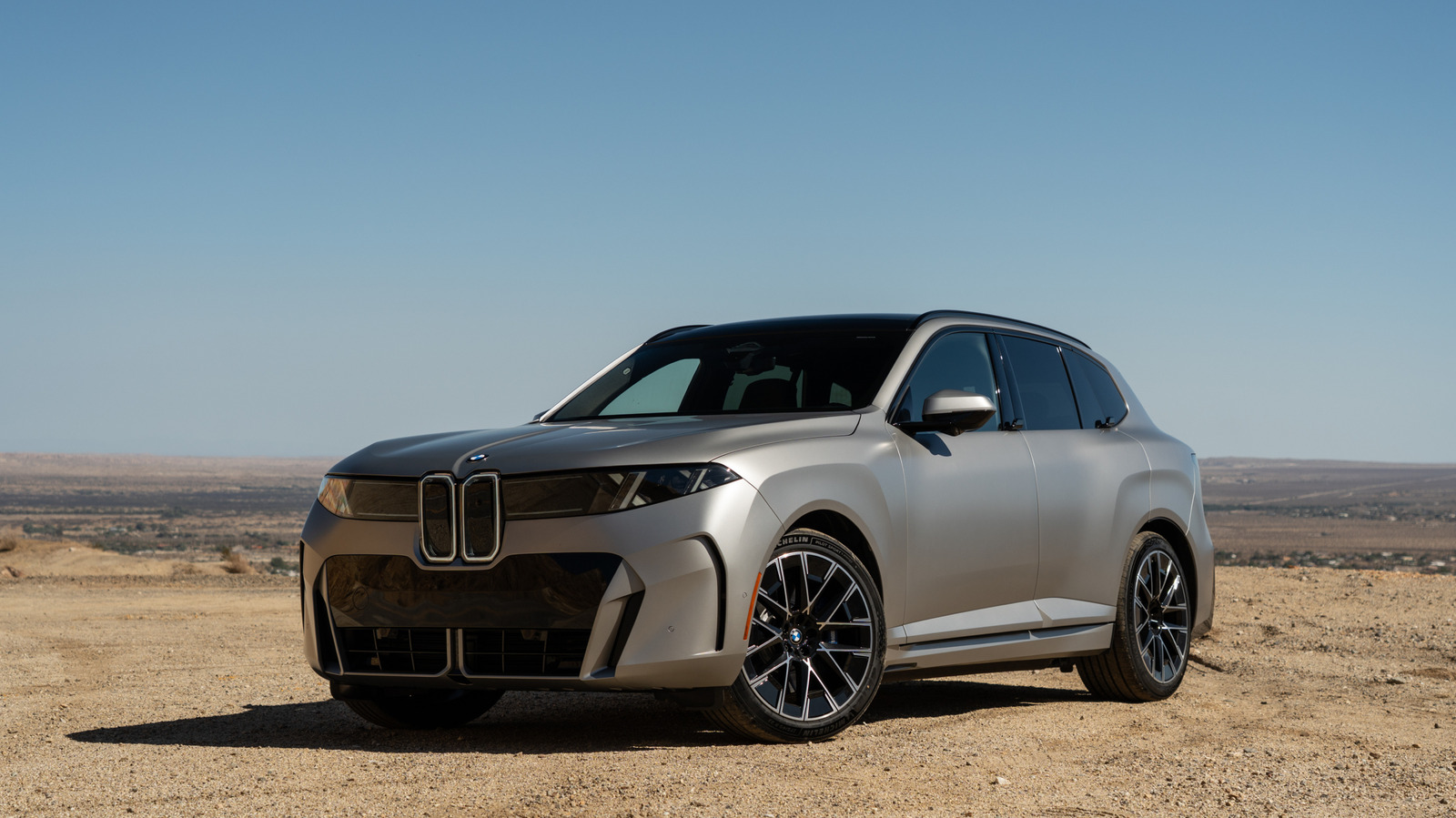
BMW’s latest EV will go over 450 miles on a charge and even close its own doors.
Too many manufacturers are getting too clever lately to reinvent the humble door handle, sometimes with fatal consequences. BMW is sure to join that crowd with the upcoming electric SUV, the iX5. It is the effective replacement for the iX, the next step up the model line from the recently released iX3, and a battery-powered alternative to the two-row X5.
The iX5 has small wings atop the front and rear doors that contain strain gauges that detect a subtle pull without actually flexing. It’s an immensely complex system that enables something surprisingly cool: power doors that actually work.
Reinventing the door handle
Pull the little wing and the door swings open as far as it will go, relying on built-in sensors to avoid bumping into the car you parked next to. Get inside, step on the brake pedal and the door closes quickly. This is by no means a new technology. Quite a few cars (mostly expensive ones) have offered this in the past, but I tend to find them extremely annoying.
Most are so slow that I never wait for them, so bad that they are hard to close manually or so unreliable that I couldn’t trust them not to create a power-assisted ding into the next car. In the iX5, they actually work, adding a little more luxury to the electric version of BMW’s second-best-selling machine in the United States.
It is far from the only luxurious touch. The SUV I drove was the 570-horsepower, 593-pound-foot iX5 60 xDrive model, equipped with plush, massaging seats. The matte silver finish on the exterior has given it a premium look, even if the styling is polarizing to say the least.
A shared security experience
The driver assistance system also has some decidedly premium touches. BMW evocatively calls it “Symbiotic Drive,” and while that sounds vaguely alien and ominous, it just means the system works with you. On the highway it will steer itself, and you can take your hands off the wheel. But when you want to change lanes, you can either tap the turn stick, or simply grab the wheel and perform the change, then let it go again.
You can quickly accelerate and even manually decelerate without the system disabling, something that definitely takes some getting used to. This isn’t like an old-school cruise control system that turns off when you touch the brake pedal or launches into full speed as soon as it’s engaged. You can apply the brakes to bring yourself to a complete stop for a light, then back off and the car will go smoothly again.
It works excellently, as does the infotainment system, which runs on a curiously inclined 17.9-inch touchscreen in the center of the dashboard. Everything is fast and responsive, and even if the integrated AI assistant was a little too comprehensive to report when someone in the car said “BMW”, it was at least able to find restaurants and answers to all the unnecessary requests that we expect from our agents future overlords.
Panoramic vision
Above that touchscreen, far back on the dashboard, is the BMW Panoramic Vision Display. It runs from pillar to pillar, with six segments that you can customize to show everything from current weather to arbitrary pictures of vintage BMWs. It looks a bit much at first, but it’s actually quite nice to have, and is much easier to see than your average gauge cluster hidden behind the steering wheel.
It’s certainly more useful than the last display in the iX5, the optional 14.6-inch passenger display. It is located to the right and slightly behind the central display, to hide it from the driver’s view. That’s because BMW opted not to use the same kind of perspective-limiting display technology that many other premium SUVs have used.
Instead, the system relies on the driver’s surveillance camera to detect when the driver’s gaze wanders to the passenger display. When it does, the screen goes blank and whatever video the passenger is watching pauses. The screen reappears when the driver looks away, but the passenger must continue the video manually. In terms of user experiences, it is not ideal.
Range-topper
The iX5’s most luxurious feature might be the range. The iX5 carries a magnificent 144-kilowatt-hour battery under the passenger compartment. It charges at a remarkable 460kW via NACS port, enough to get from 10 to 80 percent in 22 minutes if you find a charger with enough juice.
BMW hasn’t completed its EPA testing, but says to expect more than 450 miles on a charge. To prove that this is achievable, one of BMW’s engineers drove over 500 miles from San Francisco to LA without stopping and still had 50 miles to spare.
My road trip was a little shorter, but I spent about six hours behind the wheel of a pair of BMW’s new SUVs. The first half I was in the X5 40 xDrive, the combustion engine version. The second half was in the electric, and it was my clear preference.
Although the petrol-burning X5 had good power at higher speeds and made a lovely sound when I hit it, throttle response on the iX5 was infinitely sharper. It’s certainly heavier, but the lower center of gravity made it feel much more engaging in corners, and it can do the same stop trick as the iX3, relying on the electric motors to stop so smoothly that if you close your eyes, you literally can’t tell when the wheels stop rolling.
Graduation
But there’s honestly not much between the gas-powered X5 and battery-powered iX5. That’s a big change in positioning compared to the even more polarizing iX and the previous generation X5. Although similar in many areas, the two looked and drove nothing alike.
For this generation, BMW is bringing the family together, so the combustion and battery-electric versions look almost identical. They even price them similarly, with the plug-in X5 50e starting at $77,500, and the iX5 starting at $79,800.
Perhaps this, combined with the generous range, will finally help break some of the EV stigma that still poisons the American automotive landscape. If not, maybe the cool, automatic doors will outlast people. Yes, you can get them on the gas-powered X5, too, but they cost extra there.