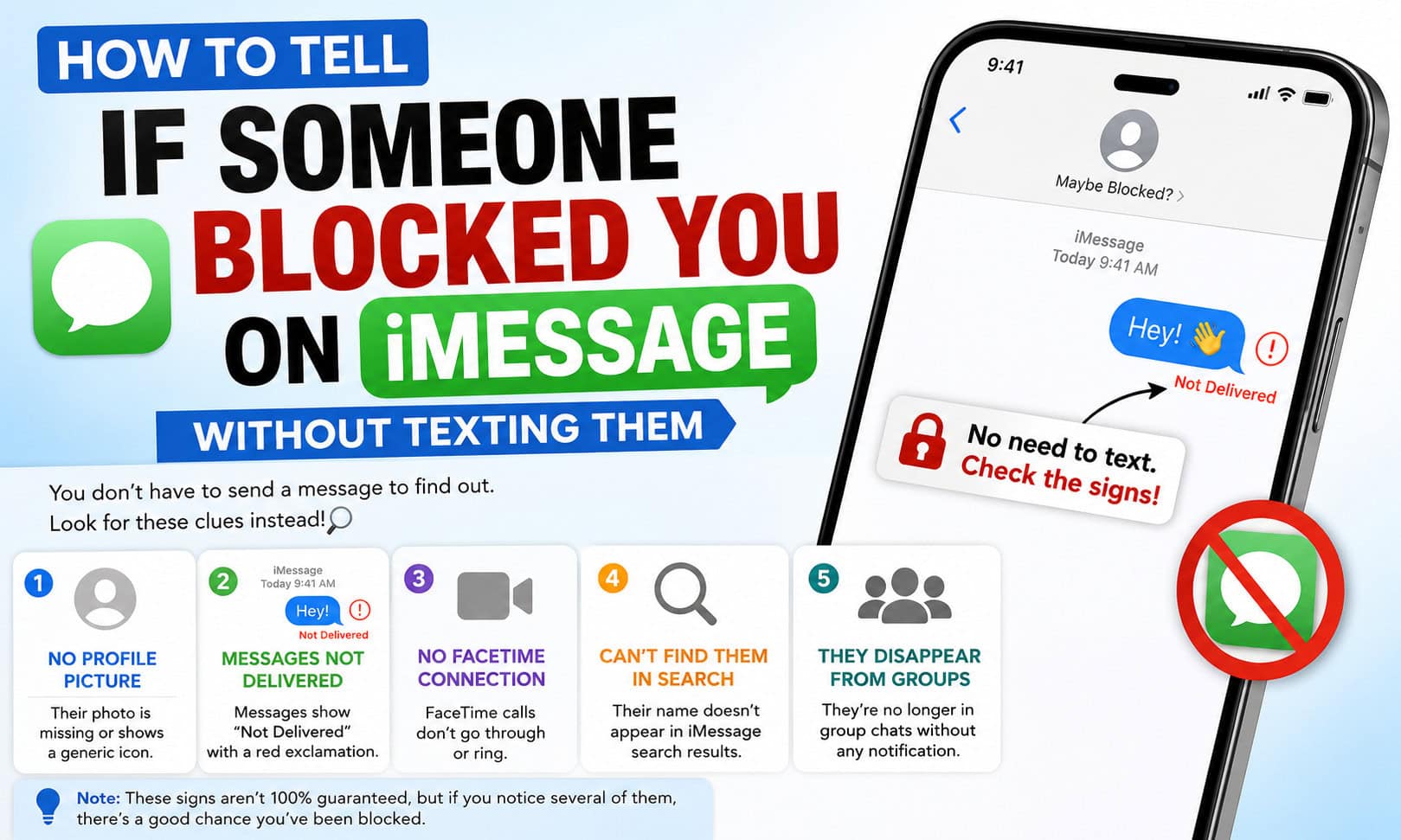
If you send someone a message on iMessage and it just sits there under “Delivered” never showing up, that ring once and goes straight to voicemail, and a contact photo that hasn’t changed in months, there’s a strong chance you’re blocked. None of these signs are proof on their own, as network issues, Do Not Disturb, and disabled iMessage can look identical. But if two or three line up at the same time, it’s about as close to confirmation as you can get without sending a message and asking directly.
The tricky part about iMessage is that Apple never tells the blocked person, and it never tells you either. There is no banner, no error, no “this user has blocked you” message. Instead, blocking silently changes how your phone behaves around that contact, and those small behavioral shifts are really the only evidence you have to work with. Below is a recap of what to check, what each sign actually means and what it doesn’t.
Can you know for sure if someone has blocked you on iMessage?
The short answer is No.
Apple consciously protects user privacy. If someone blocks your number, Apple will not notify you or show a message that you are blocked.
Because of this privacy design, the only way to make an educated guess is to observe changes in communication patterns about Apple services.
Keep in mind that many of these signs can also happen if the other person:
- Her phone turned off
- Switched to Android
- Disable iMessage
- Changed her phone number
- Activate focus mode
- Internet connection lost
- Is simply ignore messages
For this reason, never rely on just one clue.
1. Your message never shows “delivered”
Normally, when you send an iMessage (the bubble is blue), the word “Delivered” appears in small gray text below it within a few seconds, confirming that the message has reached the other person’s device. If you send a message and that word never appears, even after confirming you have a solid signal, that’s one of the clearest signals of a block. Apple’s servers still accept the message on your end, but it’s never actually routed to the recipient, so there’s nothing to trigger a delivery confirmation.
Attention: this happens even if the other person has turned off iMessage entirely, switched to an Android phone, has no signal, or simply has their phone turned off. It is also normal to sometimes see “not delivered” even on unblocked contacts if they have disabled read/delivery charges for everyone. Treat this as a hint, not a judgment.
2. Calls go directly to voicemail (often after one ring)
This is probably the most talked about “tell” in blocking folklore, and there is some truth to it. When a number is blocked on iOS, calls to that contact are typically routed directly to voicemail, sometimes with a single half-ring before it happens. Because the call barely rings before it goes to voicemail, it can feel significantly different than a normal missed call, which usually rings a few times first.
Attention: Do Not Disturb, Airplane Mode, a dead battery, or the person simply rejecting the call can all produce the same one-ring-then-voicemail pattern. This sign is more convincing when paired with the delivery above than when it stands alone.
3. Freeze or Disappear Her Profile Photo and Name Info
If the person has Name & Photo Sharing turned on, their profile photo and display name will usually update automatically through your Messages app when they change them. If you previously see that their photo has changed over time and it suddenly stops updating, or the photo and name completely disappear from the conversation and return to just a phone number, this is a sign that your access to their shared contact information has been cut off, which happens when you are locked out.
Attention: this only works as a signal if the person had Name & Photo Sharing enabled with you in the first place. Many people never turn this feature on, so its absence doesn’t tell you anything.
4. FaceTime requests don’t go through
Try a FaceTime call instead of a normal call. On an unblocked contact, you’ll usually see the call ring, then either connect or show as “Rejected.” If you are locked out, the call usually just ends abruptly with no ring and no status update at all, almost like the request evaporates. Since FaceTime uses a separate connection process from standard cellular calls, it can sometimes reveal a block even if a regular phone call is ambiguous.
5. “Send as a text message” Never appears as an option
Under normal circumstances, if an iMessage fails to send, your iPhone offers a fallback option to “send as a text message” via SMS instead. If you’re locked out, this fallback option often never appears at all, because the error isn’t a delivery problem your phone is aware of, it’s a silent block that your phone doesn’t recognize. The message just sits there, neither delivered nor marked as failed.
6. Shared content quietly stops updating
If you’ve previously shared something through Apple’s ecosystem, a Find My Location, a shared album, or a group chat, a block can break those connections as well. Look for a Find My Location that freezes in an old location and never refreshes, a shared album that stops accepting your new photos, or silently dropped out of a group chat where your messages no longer seem to reach anyone else. These are more indirect, but they are evidence you can gather without contacting the person at all.
7. Ask a mutual friend to check on you
This is a solution rather than a technical sign: have a friend who is also in contact with the person send them a message and mention your name randomly, or simply ask them to check if the person has mentioned that you are blocked. It’s not something you do yourself, so it suits the mind to confirm the block without reaching out directly, and a trusted third party is often the fastest way to get a real answer.
How to view recently deleted apps on iPhone and Android
Not a single sign above is conclusive, because almost all of them have an innocent explanation. The most reliable approach is to stack two or three signs together and see how they line up. A stuck “delivered” status combined with calls going straight to voicemail is a much stronger indicator than either alone. Use the table below to gauge how much confidence each sign should actually give you.
| Sign | Could also mean | How confident this makes you |
| No “delivered” status. | iMessage disabled, no signal, phone off | Moderate on his own; strong when paired with another sign |
| One ring then voicemail | Do not disturb, dead battery, rejected call | Weak alone; moderate when combined with a stuck delivery status |
| Frozen profile photo/name | Photo sharing was never enabled | Moderated, only if sharing was previously active |
| FaceTime ends without a ring | Bad connection, FaceTime disabled | Medium |
| No “Send as text message” option. | Rare, but possible with certain carrier issues | Strong |
| Shared content stops updating | They manually turned off sharing | Medium |
- It does not inform the blocked person in any way. There is no alert, no pop-up, and no message telling them they have been blocked.
- It does not delete your old message history. Past conversations with that contact typically remain visible in your Messages app exactly as they were.
- It does not affect other apps or platforms. Being blocked on iMessage doesn’t affect WhatsApp, Instagram, email, or any other way you can reach that person, unless they’ve blocked you there separately as well.
What does a canceled call mean? A detailed guide!
Does a blocked message still say “delivered”?
No. When you’re locked, your message is typically sent but never marked as delivered because it never reaches the recipient’s device. The status area below the message usually remains blank indefinitely.
Can you tell if someone has blocked you by calling them?
It’s a decent clue but not definitive. Calls to a blocked number usually go straight to voicemail after a single ring, but the same pattern can happen with Do Not Disturb enabled, a dead phone, or a call that the person simply declined.
Does iMessage Say “Not Delivered” When You’re Locked?
Usually not. A block tends to produce silence rather than an explicit error message. A direct “Not Delivered” error is more often a sign of a real network problem than a block.
Can your number change come around a block?
Messages from a new number that is not blocked would normally go through because the block is tied to the specific number or Apple ID that was blocked. That said, using a workaround to reach someone who has deliberately blocked you is worth thinking twice about, as the block was a clear signal that they didn’t want to be contacted.
Did you know?
Blocking someone on iMessage is device-wide rather than app-specific. It simultaneously blocks their texts, iMessages, calls, and FaceTime requests from this number or Apple ID, unlike apps like Instagram or WhatsApp, where the blocking only affects the single platform.
None of these signs come with a warranty, because Apple designed blocking to be silent by nature. The strongest approach is to look for two or three overlapping signs instead of betting everything on one. And if the evidence really points to a block, it’s worth remembering that it was a conscious choice on the other person’s end, so respecting that boundary, rather than working around it, is usually the better way.