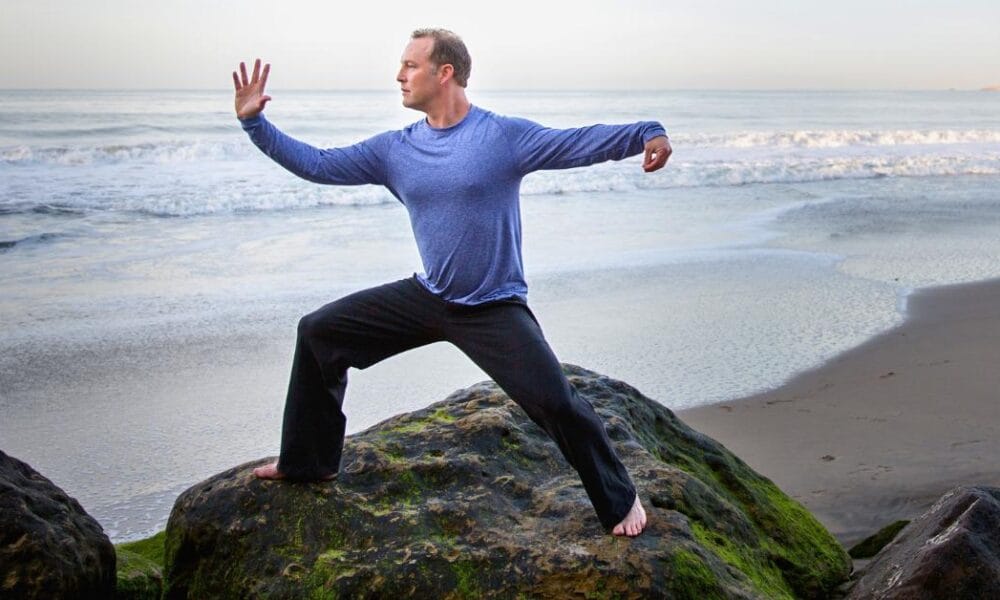
One of the defining characteristics of Chen-style Taijiquan is its emphasis on connected spiral movement. Rather than training the arms, legs and torso as separate parts, the practice teaches the body to gradually move as an integrated system. One of the primary methods used to develop this quality is silk reeling, commonly known as Chan Si Gong or Chan Si Jin.
The term “silk reeling” describes the continuous reeling and reeling quality found throughout Chen Taijiquan. The movements may look like simple circles from the outside, but the deeper training is about coordinating the whole body so that movement in one area is supported by changes elsewhere. Traditional descriptions of Chen Taijiquan place particular importance on the relationship between the waist, the torso, the limbs and the connection of the body to the ground.
More than moving the hands in circles
A common misconception is that silk reeling simply means rotating the hands or forearms. Making circular movements with the arms alone does not develop the whole body connection that the exercise is designed to teach.
In a properly coordinated movement, the feet make contact with the ground, the legs support the weight shift, and the kua and waist help organize the rotation of the body. This movement then continues through the torso, shoulder, elbow, wrist and hand.
Therefore, silk reeling exercises are often described as a method to connect all parts of the body. When one part moves, the rest of the body should join in instead of remaining disconnected.
To start a practice such as Bali Tai ChiThis distinction is particularly useful. The goal is not simply to reproduce a visually appealing sequence. The more important question is whether the movement will become more and more coordinated and internally connected.
The waist as the center of movement
Chen-style training often emphasizes the waist and core as important organizers of movement. Instead of each limb initiating independent movement, practitioners learn to coordinate the limbs with changes in the body center.
Imagine rotating the torso while the arm remains connected to that rotation. As the center changes, the shoulder, elbow and wrist naturally adjust. The resulting movement appears continuous rather than segmented.
This relationship is one of the reasons silk reeling can be challenging. A practitioner can understand the movement intellectually, while still moving primarily from the shoulders or arms. Developing a true connection requires repeated practice and attention to how the movement travels through the body.
Spirals, not rigid lines
Human movement is rarely limited to simple forward and backward movement. Joints rotate, weight shifts, and different parts of the body move in different directions at the same time. Chen Taijiquan uses spiral patterns to train this complexity.
The traditional concepts of already chan in the new chan describe various coiling relationships within the movement. Although these terms are sometimes reduced to simple clockwise or counterclockwise descriptions, their application depends on the particular limb, direction and relationship between the body segments.
Practicing these spirals encourages the student to coordinate rotation with weight transfer rather than treating rotation as an isolated joint action.
Develop a connected kinetic chain
The practical value of silk reeling is that it teaches the body to share movement instead of concentrating effort in one place.
For example, when the body turns, the force involved need not be generated entirely by the shoulder. The legs, hips, waist and torso contribute to the movement, while the arm expresses the change at its endpoint.
This idea can be understood as the development of a connected kinetic chain. The body becomes less of a collection of individual joints and more of a connected structure in which the movement of the ground travels through the body.
Research discussing Taijiquan’s spiral movement has also examined how coordinated rotation of the waist and body can contribute to postural control and dynamic stability.
Why Slow Practice Matters
Silk reeling is often practiced slowly, and this is not easy because slow movement looks calm or meditative.
Slower movement gives the practitioner more time to notice where coordination is being lost. If the shoulder rises, the knee falls inward, or the waist stops participating, the problem becomes easier to recognize if the movement is made consciously.
Continuous movement also encourages consistency. Traditional teaching compares quality to drawing silk: too much sudden force or interruption can break the thread. The goal is smooth, controlled movement without unnecessary stops and jerks.
Over time, this type of practice can make the connections between posture, weight transfer, rotation, and limb movement more and more familiar.
From exercise to movement method
The deeper purpose of silk reeling is not to create another exercise that exists separately from Taijiquan. Its value comes from carrying the same principles in standing, forms, transitions, and finally partner work.
Zhan Zhuang can establish consciousness and structural organization, while silk reeling introduces these qualities into continuous movement. Form practice then requires the practitioner to maintain this connection through changes in positions, directions and levels of complexity. Taijiquan Quest similarly presents Zhan Zhuang, Silk Reeling, and Form as complementary parts of Chen-style body method development.
Finally, Seid Reeling teaches a simple but challenging principle: the body should move together.
The hands may be the most visible part of the exercise, but they are only the expression of a much larger movement. As coordination develops, the practitioner begins to feel how the feet, legs, middle, torso and arms participate in one continuous action.
This is what makes silk reeling such an important training method in Chen-style Taijiquan: it transforms the idea of ”whole body movement” from a concept into something the practitioner can gradually learn to feel.