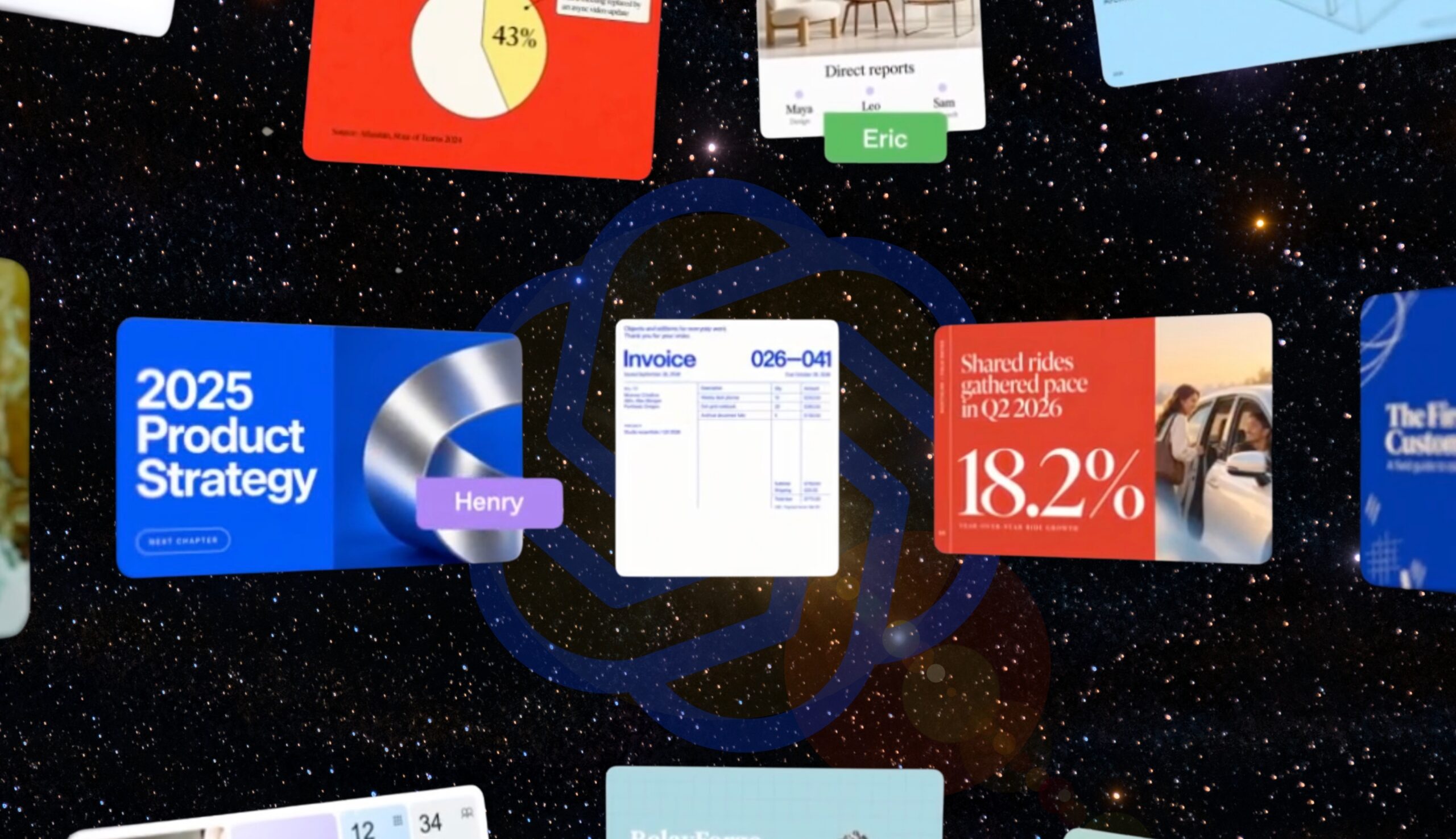
It’s OpenAI’s fourth annual DevDay, its equivalent to Apple’s WWDC, but for developers building with AI. While last year focused on big releases like apps in ChatGPT and an agent builder, this year’s announcements seem to fulfill a long-held suspicion that OpenAI is coming for Google Workspace.
Also: OpenAI’s Dots: How OpenClaw declawed – for $200/mo ChatGPT Pro User
Here’s what’s new for the Pro, Business and Enterprise plans.
Room, pages and slides
ChatGPT Space is “a new home for your team to collaborate with AI to get work done,” OpenAI said in a blog. Users can work with ChatGPT, other teammates, and a new agent feature called Dots. Pro, Business, and Enterprise users can start trying ChatGPT Space today on the desktop app and on the web.
OpenAI said mobile access is on the way.
Also: How to use ChatGPT Work – and my top 10 tips for getting started with agent AI
Pages and collaborative slides, both new today, are “built for human and agent collaboration,” OpenAI said. Each lets users create documents and presentations using ChatGPT’s generative capabilities, including on-page research, graphics and images.
Users can build interactive slides using collaborators in ChatGPT, design conversationally or import their own templates. As in Google Slides, multiple users (and agents) can edit slides simultaneously; Users can present directly from ChatGPT or export their slides to PowerPoint or Google, supposedly without disturbing the formatting. Pages are available now, while the slide feature is coming in the coming weeks.
These two releases are very similar to Anthropic’s recent launch of Claude Docs, part of its Claude Cowork consolidation, which also absorbed Claude Design and Slides. For both ChatGPT and Claude, document and slide creation are now features within a central agent home base rather than disparate tools.
During a demo of pages that looked like a Notion landing page, an OpenAI representative tagged their dot (an OpenClaw-like agent) directly in comments in the workspace, assigned feedback from a contributor, and otherwise iterated on the project, all in one place.
Also: I ran ChatGPT Work and Claude Cowork on my files – only one made me nervous
During the keynote, OpenAI CEO Sam Altman talked about Space, Pages, presentation slides and dots as pieces of a new system, though he didn’t frame it as a workspace competitor.
Private intelligence
One of the primary obstacles for businesses adopting AI is data security. Enterprise customers are understandably concerned that while they have a use case for AI, the risk of exposing sensitive data to agents or the companies behind frontier LLMs is too great.
At DevDay, OpenAI announced Private Intelligence, a data access approval layer to give enterprise customers “more confidence that their data is protected,” OpenAI said.
Also: Could AI really destroy us all, or are humans still the bigger threat?
“Zero Data Retention with Private Safety Processing enables automated security assessments without giving OpenAI staff access to the underlying content,” the company explained. It added that “our preview of Private Inference, coming this fall, combines confidential computing with strict, verifiable controls,” but did not yet offer more details about intelligence versus inference.
The name Private Intelligence is immediately reminiscent of Apple’s Private Cloud Compute, which gives the impression that businesses can access the full power of OpenAI’s frontier models without sacrificing security. In consumer AI, this was not the case: getting better results from an assistant tends to rely on giving up more of your information to an AI model, as with Gemini’s Personal Intelligence.
Why now?
Last year, OpenAI was supposedly exploring features that would turn ChatGPT into more of a productivity suite, including a collaborative document editing tool similar to Google Docs. But since then, OpenAI has followed a seemingly meandering path, launching its consumer video app Sora and then sunsetting while Anthropic dominated in enterprise revenue.
That said, OpenAI has taken Anthropic’s cue with several key releases over the past six months. ChatGPT Work, launched in July as a response to Claude Cowork, splices out non-coding-related tasks for other types of workers to give an agentic boost.
Also: 5 ways I actually use ChatGPT Work in my small business to save time and money
Anthropic absorbed Cowork back into Claude to create a more seamless one-stop shop for users’ agent needs, but the tool’s initial purpose made sense for workplace use cases. OpenAI’s new features appear to follow the same line of thinking, though the company is hesitant to confirm any productivity suite plans.
“Space is built for people and AI to work together on the same content,” an OpenAI representative told ZDNET via email. “Pages are a format native to ChatGPT that AI can read and create, and that teammates can edit together in real time. Today, people develop ideas in ChatGPT, move work elsewhere to share it, then bring feedback back to ChatGPT. Space brings that process together so people can create, share and continue working with their team in ChatGPT in one place.
In that sense, the move is similar to the Anthropic Claude Cowork consolidation. By making the new Docs available in Claude alongside Claude Design and Slides, Anthropic has turned its chatbot into a gateway to a workplace suite where multiple teammates (human and agent) collaborate on projects. ChatGPT Space seems to do the same.

See full bio