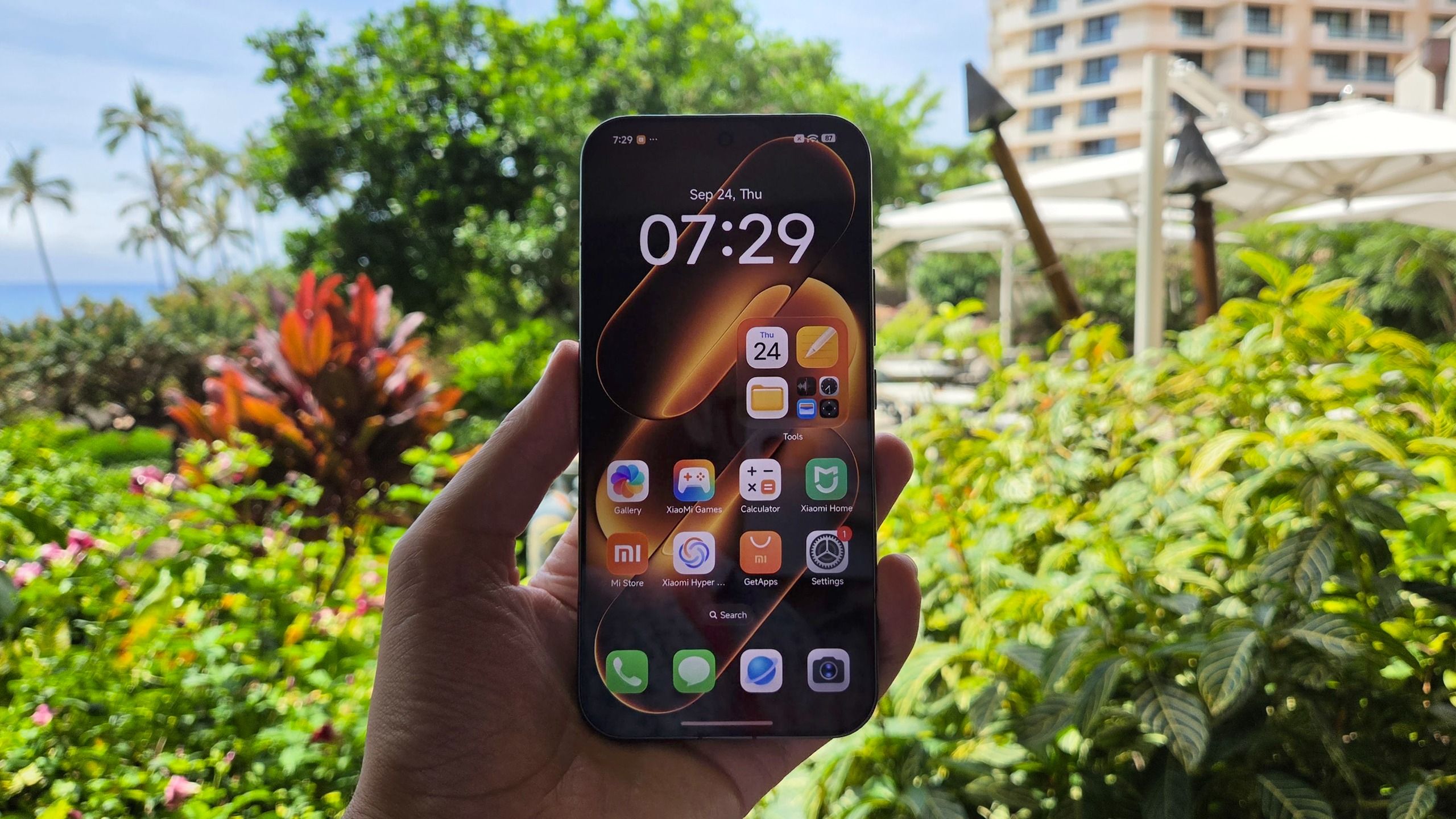
Xiaomi revealed its latest flagship, the Xiaomi 18 Pro, at a big launch event in Beijing – but, as the first brand to launch a handset with Qualcomm’s Snapdragon 8 Elite Extreme Gen 6, it also showed up in the US at the Snapdragon Summit.
I was invited to a meeting behind closed doors during Summit to see the new handset, which will be launched outside of China – and imminently, within the year, according to a Xiaomi spokesperson – and aims to rival the Samsung Galaxy S26 Ultra with some familiar features, such as privacy display.
Not only that, the 18 Pro has a second display on the rear. That repeats what the previous Xiaomi 17 Pro also showed, but since that was a China-only handset – the basic Xiaomi 17 model was the only one that came to Europe – its presence also feels like a significant point of distinction.
HyperRGB privacy display
A quick explanation of what Privacy Display actually does first, though: when enabled, it limits the viewing angle by disabling portions of pixels, preventing potential snoopers from seeing what’s on the screen.
Although I didn’t have long to discover the Xiaomi 18 Pro, I quickly delved into its privacy display settings to see what it was all about. Xiaomi has deployed its own technology here, in what it calls a HyperRGB panel.
Why is this important? HyperRGB offers a full red, green and blue composition in each ‘pixel’ – unlike the sub-pixel structure in a typical pentil array, where green has to be ‘shared’, causing a noticeable loss of resolution with privacy display enabled.
I have to admit, with Xiaomi’s feature activated, the perceived resolution seems very clear – more so than Samsung’s equivalent feature in the S26 Ultra. So that’s one tick in the box.
However, my other immediate observation was that Xiaomi’s method is less effective than the Samsung equivalent. It doesn’t hide what’s on the display nearly as well, in my opinion, with even acute angles not completely obscuring the contents of the display.
From a software perspective, however, Xiaomi has really opened up more customization options than Samsung is able to offer. While both offer per-app selection, including the ability to block dynamic notifications, the Xiaomi can also handle split-screen and floating window situations – which is a very neat take indeed.
I pulled up two apps in a split-screen view, 50/50 in the middle of the display, one of which had privacy display enabled, the other didn’t, and the device can differentiate. It’s a dynamic take that showcases the brand’s HyperOS very well. That said, I still don’t think the effect is strong enough in this solution.
Rear display
(Image credit: Future / Mike Lowe)
It is impossible not to talk about the rear display in the Xiaomi 18 Pro, too, because if it has been presented in some devices before, it is a very unusual addition.
I can see why it makes sense though, as you can forego the need for a lower-quality selfie camera in the display and use the top-tier cameras on the back of the device instead.
Beyond that, Xiaomi’s point of view is that this display is an opportunity to reduce the use of the phone. Think of, say, Motorola’s Razr flip phone, where the small window in its closed format offers a pared-back view rather than a full experience. This can do much the same.
It’s also a place to add custom wallpapers, clocks and the like – to make the phone feel more unique. I was able to swipe between several camera settings and the calendar, and found it to be a very responsive experience – much better than I expected.
With many other brands deploying their own equivalent features – think Nothing’s Glyph or Google’s HiLight on the Pixel 11 Pro – it seems that 2026 was a bigger year for more expansive ways to interact with your phone. And while Xiaomi’s is arguably the most in-your-face solution, it’s also the most sophisticated of the lot.
Serious spec
- Battery: 7000mAh Silicon-Carbon / 100W HyperCharge / 50W Wireless
- Cameras: 200MP f/1.67 Main, 200MP f/2.4 75mm Zoom, 50MP Wide Angle
- Display: 6.4 inches, 2436 x 1120 HyperRGB 2.0, 4000 nits maximum brightness, 1-120Hz
- Power: Qualcomm Snapdragon 8 Elite Extreme Gen 6, LPDDR5X RAM, UFS 4.1
The full specification of the Xiaomi 18 Pro is now out in the wild, with some headline features that I’ve highlighted in bullet points above. This is a seriously powerful phone – and the first to ship with Qualcomm’s latest and most powerful hardware.
There are many other striking features, however, from the large battery capacity – no word on whether this can be supplied to an international market, however, as EU regulation caps 20Wh (about 5,000mAh) in individual cells – to the incredibly fast charging times.
The cameras are also top of the line. Xiaomi continues its collaboration with Leica, adding another standout reason to consider the brand over its competitors. In the Xiaomi 18 Pro, the triple sensor arrangement includes two 200-megapixel and one 50MP – with the main and telephoto receiving high resolution.
There is also the Xiaomi 18 Pro Max, which is even bigger and more significant – with even more display and battery packed in its larger shell – and I wonder if both models will make their way to international markets. At the moment, Xiaomi is not saying – just “stay tuned”, because the global launch will be “in the quarter” for an official release on the shelf before the year is out.
That will likely mean that Samsung’s rumored Galaxy S27 Ultra isn’t far off from its own early 2027 launch. It is expected that the Korean brand will deliver a product that differs significantly from its current design – and with the current advanced nature of its competition, I think that can only be a good thing.