ZDNET’s key takeaways
- After a year in the works, the latest Mint is a complete refresh.
- It includes an improved Nemo file manager and a new system monitor app.
- It will also come with many updated programs, such as the GIMP image editor.
Linux Mint, my favorite Linux desktop distribution, is ready for a fresh start.
Its lead developer, Clement “Clem” Lefebvre, announced earlier this year that the team behind it was considering slowing Mint’s release cadence because the old twice-a-year release cycle was time-consuming and limited their ability to make major changes. So it is that the next release, Linux Mint 27, will appear in your Christmas tree.
Also: 5 Premium Linux Distros Absolutely Worth Paying for in 2026
The developers officially changed the designation on October 13, when Mint changed its release cadence and numbering. Clem is happy about the change: “It was a difficult decision to make, but we are really starting to see that it will pay off. We are taking on projects and implementing changes that would previously have been considered too big or ambitious.”
Why Mint 27 instead of Mint 24?
Early development snapshots were labeled Mint 23 “Alfa”. This title was explicitly a placeholder while the team decided on its release strategy. His final name is Adrien. Going forward, release numbers are based on the coming year. Clem said, “We won’t be using point releases anymore, so the next release will be 28. You’ll upgrade from 27 to 28 to 29, and so on.” Instead of girls’ names, Mint will use boys’ names for distro titles.
The biggest changes
On Halloween, Clem announced the top changes in Mint 27. It starts with Mint bringing hibernation back to its supported desktop configuration through a dedicated sleep mode page in its system management tool. The page is intended to make enabling and configuring hibernate easier, including addressing its swap space requirements.
It might not sound like much, but Clem explained that it’s actually rather a big deal. “When you close the lid of your laptop, it goes into a sleep mode called “Suspend”. This mode is very useful… but it has a big limitation: It uses power. People often forget that it is not really off and that your laptop will eventually run out of power. When this happens, “the result is worse than a normal shutdown. The session is gone, and the battery is empty.”
Also: Linux Mint vs RefreshOS: I compared the two best distros for new users
That’s where “Hibernation comes into play. It saves the session to disk and shuts down the computer completely. No power is used. When you open the lid again, the session is as it was, and so is the battery.”
Superlight: System monitoring and storage analysis
Another new feature is Superlight. This fresh system monitoring application replaces the older GNOME System Monitor. It comes with CPU, RAM, swap, GPU, network, disk I/O, temperature and fan speed graphs. It also includes per-application and per-process resource views. Battery-equipped systems also receive charge and power flow history.
Its storage analysis is particularly interesting: it can break down disk usage in files and folders, Steam games, and Flatpak applications. That brings up some common troubleshooting tasks – “What’s using the CPU?” and “Where did my disk space go?” – in an interface. I tested it on a Mint virtual machine (VM), and I already like it.
Cinnamon’s Nemo file manager gets a preview
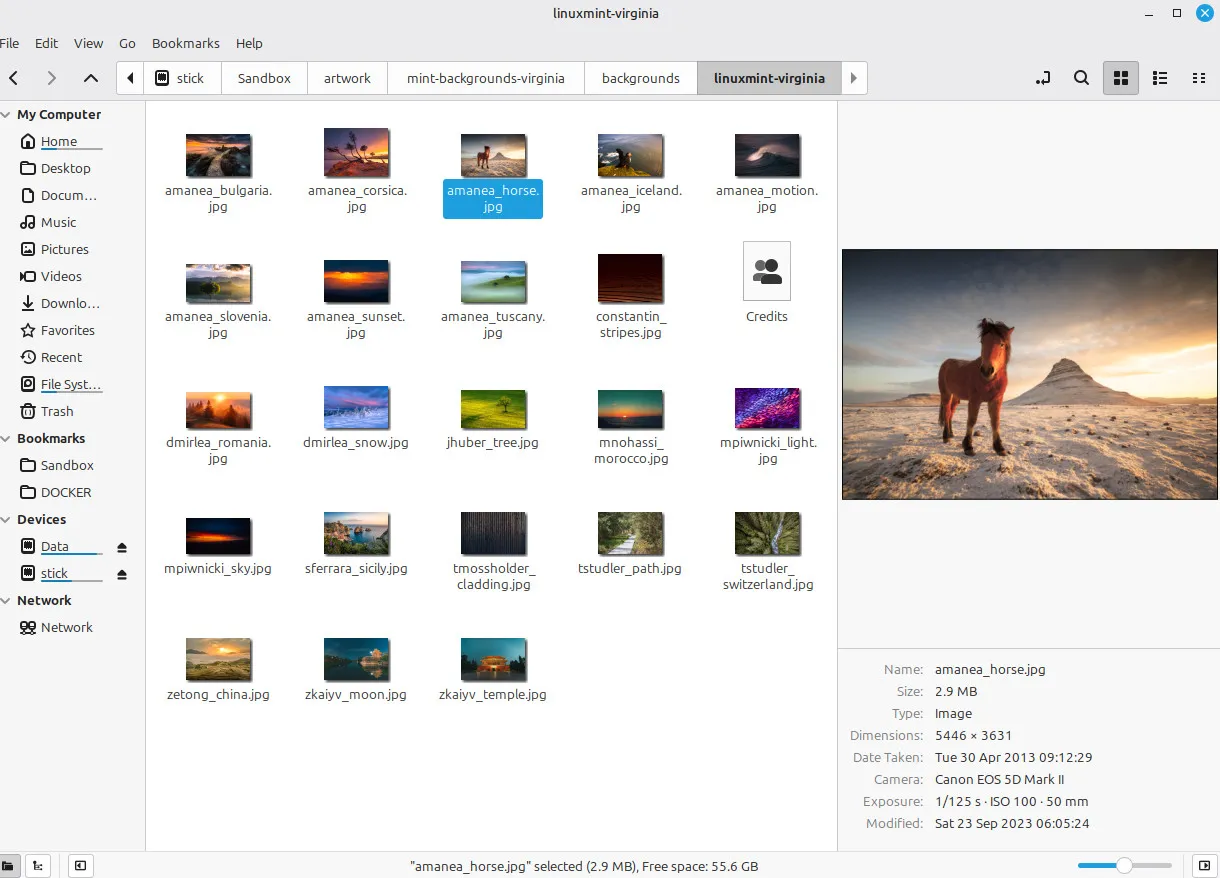
The Nemo file manager gets a media preview, toggled with F7 or a status bar button. It supports images, audio, and video, and displays associated information—for photos, including the capture date and camera model. I like this feature a lot. I’ve always done a lot of work with file managers going all the way back to the classic Norton Commander and its Linux successor, Midnight Commander.
Velocity: a new terminal with convenient session management
I’ve said it before, I’ll say it again. You never have to touch a Linux shell via a terminal to use Mint. But if, like me, you’re an old-school Linux user and you like using the terminal, Velocitty, Mint’s new terminal application, looks interesting. Its announced features include:
- A graphical tab overview and configurable color palette.
- Tabs that can be reordered, moved between windows or collapsed.
- Configurable shells and startup commands.
- Named, color-coded custom tabs with preset commands and optional automatic opening.
- Context-sensitive tab colors: red for elevated privileges, blue for remote sessions, and a lighter shade for running processes.
The point is to make repeating projects in SSH sessions easier to find and reopen. If you like other terminal programs, my latest favorite is the Rust-based WexTerm; You don’t have to use Velocity.
Unfold: a simpler archive manager
Unfold is a new archive manager for viewing, creating and extracting archives. It uses 7-Zip and 7zip-RAR and supports the encryption formats that these backends handle, including password-protected archives. Its design goal is simplicity rather than a sprawling feature set.
Under the hood: Ubuntu Basic, Installer, and Wayland
The new Mint uses Ubuntu 26.04 LTS as a base. Mint is also moving from Ubiquity to the Linux Mint Debian Edition Live Installer for installing the operating system. This fresh installer comes with support for OEM bulk-produced installations, installation on both BIOS and EFI PCs, support for Secure Boot, and LVM/LUKS configurations.
Also: Linux Mint vs. Zorin OS: I’ve tried both Windows alternatives, and here’s my winner
For the Linux kernel, Mint 27 will use version 7.0. Which one exactly? Good question. We will see more after Christmas.
Wayland compatibility remains the goal, but X11 isn’t going away. As Clem said in June, “In an ideal scenario, we manage to make Wayland as good as X11.” But they are not there yet.
What makes this release different?
The central change is a cleanup of the existing code. Mint’s longer cycle gives developers room to revise different parts of the desktop together, rather than squeezing individual improvements into six-month windows. As Clem put it in the September newsletter, “I don’t think I’ve ever seen so many changes and new features implemented for a single release.”
What this means for you and me is better laptop power management, more capable built-in utilities, and a more complete collection of everyday desktop applications. For example, I expect the updated Mint to ship with GIMP 3.2.2 as its default photo editor, rather than Mint 22.3’s year-old GIMP 2.10.