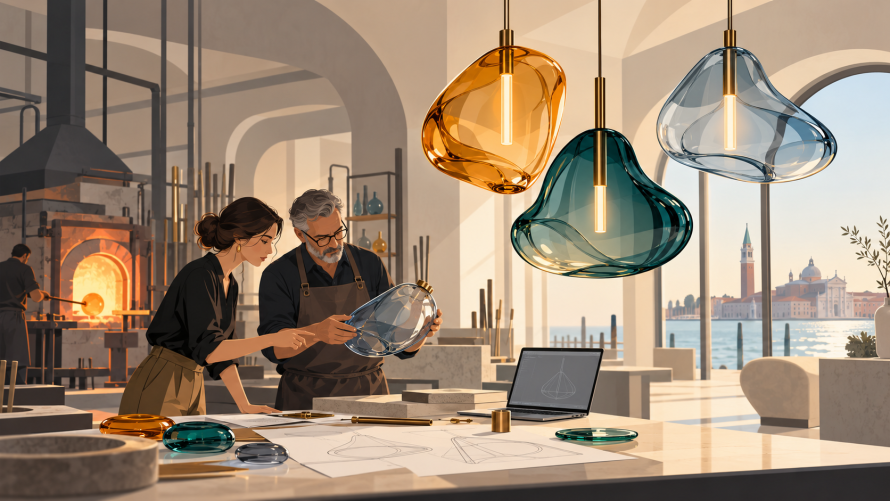
Great glass work begins long before a furnace is lit. For architects, lighting designers and interior specialists, the most successful pieces emerge from a productive exchange between creative ambition, knowledge of materials and the practical realities of manufacturing.
From the visual idea to the workable glass form
A sketch can communicate the character of a pendant, but it rarely answers every production question. Dimensions, weight, wall thickness, lifting points, color density, and light diffusion all influence whether an attractive concept becomes a reliable finished object. A Murano glass maker contributes valuable insight during this transition, helping the design team understand how molten glass behaves and where an initial proposal needs thoughtful refinement.
This process is not about reducing creative freedom. It is about translating the intention into a material language that the glass can express convincingly. A sharp digital rendering might need softer transitions when produced by hand, while a seemingly simple curve requires considerable control in the oven. If these details are explored early, the resulting design is more likely to retain its visual identity without neglecting installation, consistency or everyday use.
Customization requires choosing more than one color
True customization extends far beyond picking a shade from a sample chart. Surface texture, opacity, bubbles, layer color, scale, and the relationship between glass and hardware can completely change the appearance of a lighting piece. Designers may also need several related forms for a clustered installation, with enough variation to convey handcrafted character while maintaining a coherent overall composition.
For projects that require this level of dialogue, working with a Murano glass maker can combine creative planning with specialized production skills. The collaboration may include prototype development, proportion adjustments, testing under different light sources, and decisions about how individual components are assembled. Such steps are especially important for hospitality, retail, and residential projects where the lighting functions as both illumination and a central architectural feature.
Digital tools can make this relationship more precise. Three-dimensional models, technical drawings, common reference boards, and accurate measurements allow remote teams to communicate complex requirements efficiently. However, technology does not replace the judgment of the craftsman. Glass responds to heat, gravity, timing and hand movement, meaning that the final object always reflects a combination of controlled planning and informed sensitivity to the material.
Evaluate craft through process and communication
A polished portfolio may show style, but it doesn’t show the whole working method. Design professionals benefit from examining how a workshop interprets specifications, manages revisions, discusses tolerances, and prepares components for integration with metal fixtures or electrical systems. Clear communication is especially valuable when a project includes repeated pieces, unusual dimensions, complex finishes, or deadlines tied to a broader construction plan.
The right Murano glass maker should also be able to explain where consistency is essential and where natural variation adds to the design. Handmade items are not expected to be anonymous machine made in every microscopic detail. Subtle differences in outline, tone or internal texture can give an installation depth, but these differences must remain compatible with the intended rhythm and visual balance of the designer.
Why material intelligence creates lasting value
Contemporary interiors combine increasingly advanced controls, efficient light sources, and carefully constructed fixtures with materials that bear a visible human presence. Blown glass is particularly effective in this setting because it can soften technical lighting systems without hiding their sophistication. Its reflective, translucent and sculptural qualities change throughout the day, so that a single fixture offers different impressions under natural and artificial light.
A Murano glass maker therefore contributes more than a decorative finish. The studio becomes part of the design intelligence behind the object, shaping how it occupies space, distributes light and interacts with surrounding materials. When the creative direction and manufacturing expertise are aligned from the start, bespoke glass can feel neither nostalgic nor decorative for its own sake. Instead, it becomes a purposeful component of modern design, distinguished by precision, character, and an enduring connection between idea and making.