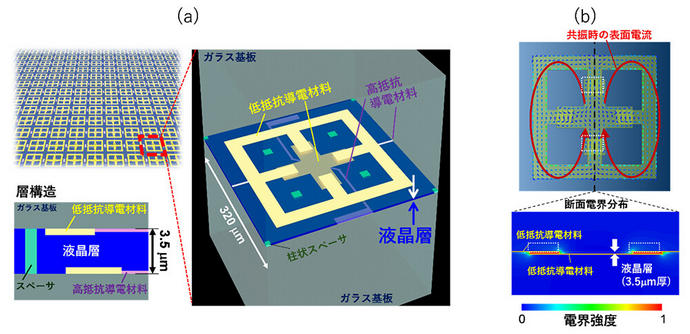

Nippon Telegraph and Telephone (NTT) has developed a thin, transparent metasurface device capable of controlling the direction of radio waves by simply installing it on surfaces such as window glass. This innovative technology uses the world’s thinnest liquid crystal layer measuring approximately 3.5 µm, which enables precise manipulation of the direction and convergence of radio waves passing through it. A transmissive metasurface device is an ultra-thin artificial structure that allows radio waves and light to pass through while controlling how they propagate. NTT has implemented its own unique metasurface design that supports a wide frequency range from microwave to sub-terahertz bands. At the same time, it maintains a liquid crystal thickness comparable to that of conventional liquid crystal displays, making it both efficient and practical for large-scale applications
This advance makes it easier to fabricate large-area metasurface devices. Thanks to the ultra-thin liquid crystal layer, the device also achieves faster response speed, which allows dynamic radio waves to be controlled and even moving terminals to be tracked in the future. By installing these devices on windows or similar surfaces, indoor radio wave environments are expected to improve significantly, helping to expand the coverage of future 6G wireless services. Next-generation 6G communication relies on high-frequency bands such as FR3 and sub-terahertz waves. While these frequencies enable extremely fast data transmission, they also have strong directional characteristics and struggle to reach buildings. As a result, signal dead zones often occur, especially when transitioning from outdoor to indoor environments, where radio waves are limited by windows and openings.

Metasurface devices, which are thin and planar structures designed to guide radio waves and light, are considered a promising solution to this challenge. Traditional liquid crystal-based approaches were considered suitable for large-scale metasurface production, but their thick liquid crystal layers made manufacturing difficult and led to slower response times. NTT’s newly developed transmissive metasurface overcomes these limitations with a redesigned structure that works effectively even at high frequencies. By reducing the liquid crystal layer to less than one-tenth the thickness of conventional designs, the company has enabled faster operation and improved scalability, making the creation of large surfaces more feasible.
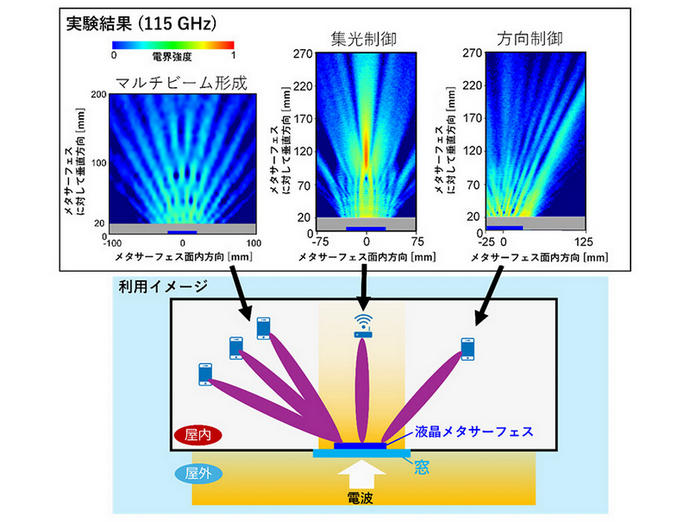
Transparent metasurface devices can actively change the direction of radio waves, guiding 6G signals into indoor spaces where they are otherwise weak or unavailable. Their thin and flexible nature allows them to be integrated not only into windows, but also into walls, displays and other surfaces. With the design, including control wiring, already close to practical implementation, this technology represents a significant step towards improving indoor connectivity in the 6G era.