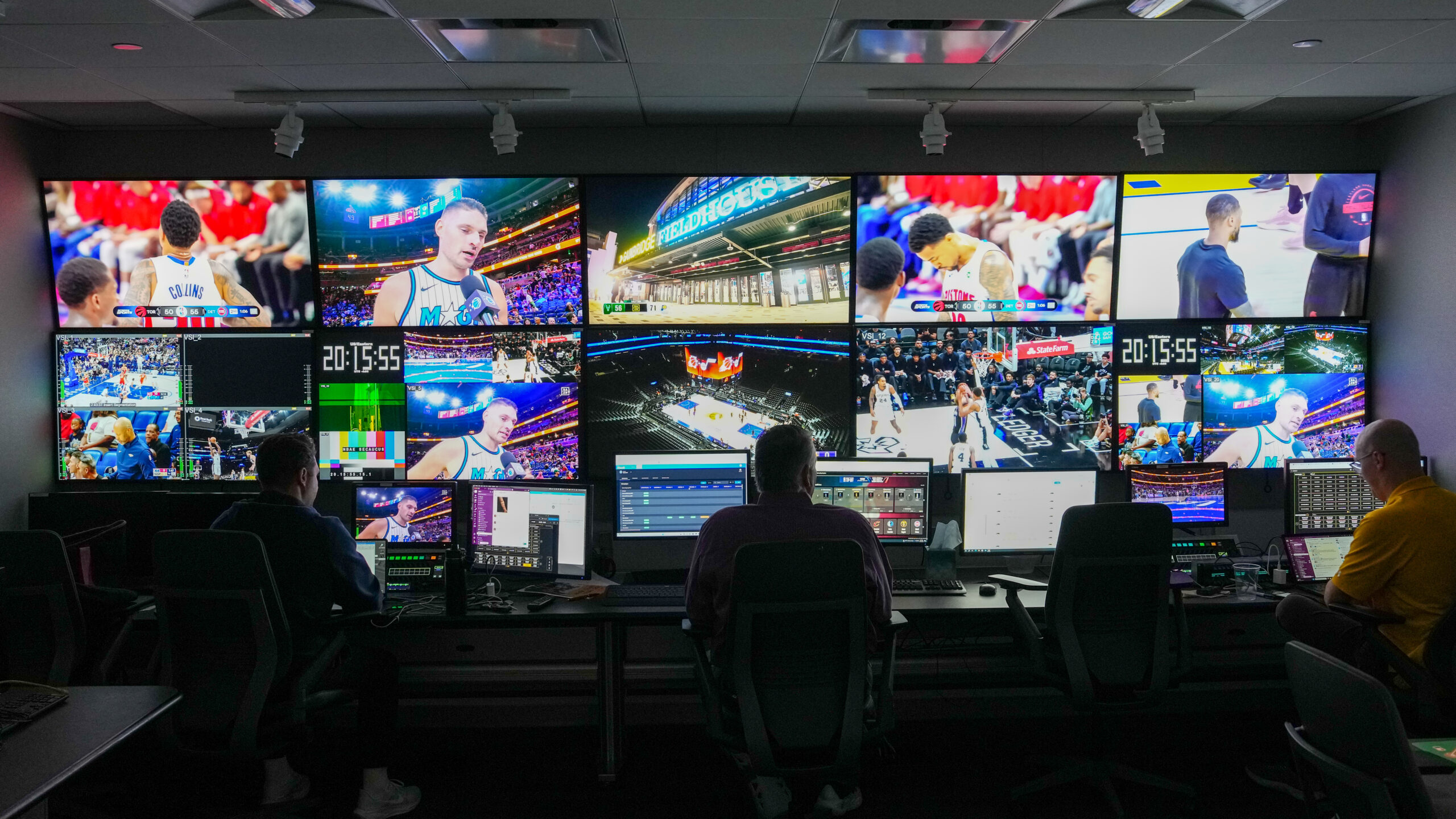
The days of simply sitting in front of a television and watching professional basketball are long gone. Now your gaming experience is likely to include real-time stats and player spotlights on your phone, along with keeping an eye on another game on a nearby tablet or laptop whose outcome could move your favorite team up or down in the rankings.
That requires a huge and ever-growing amount of data and coordination. To keep up with this demand and anticipate the needs of tomorrow, the National Basketball Association, Women’s National Basketball Association and AT&T will install the fourth generation of their high speed arena network infrastructure starting in the 2026-27 season,
“It’s more, more, more,” said Ken DeGennaro, executive vice president of media operations and technology in the NBA, explaining the demands the organization sees every time two teams tip. “More video angles, higher density video angles, video content, higher frame video, higher quality video, all of that.”
The fourth generation network will be installed in all 30 places where the NBA operates, starting with the Intuit Dome in Inglewood, California, Barclays Center in New York City, United Center in Chicago, American Airlines Center in Dallas, State Farm Arena in Atlanta and Crypto.com Arena in Los Angeles. The official launch of the updated HSAN will happen in July 2027.
A full-court press of live data
The network upgrade will include more than 68,000 miles of AT&T fiber and all new network equipment at the locations. That will provide four times the bandwidth of the existing infrastructure.
DeGennaro said an average game uses about 118 streams of high-quality, low-latency data. “The majority of video content comes back as uncompressed video at about 250 megabits per second per stream, so there’s quite a bit of throughput bandwidth on the network,” he said.
That includes live broadcast video, in-arena content, studio programming from the league and regional sports networks, mobile content and virtual signage. These streams are also distributed for redundancy and resilience.
“We went from point-to-point networks to a full network that allows for greater reliability and scalability across all of our intake and distribution channels,” DeGennaro said.
The work to upgrade the locations goes beyond installing new server racks and fresh fiber, although those are essential components. In some places, that means breaking ground to bring fiber-filled conduit into place from multiple directions so it doesn’t all pass through a single potential failure point.
Joe Drygas, vice president of global enterprise solutions at AT&T Business, pointed to the increased capacity and the diverse architecture of data centers that immediately pick up the slack when needed. AT&T has a dedicated engineering unit that runs network telemetry 24/7, predictive capacity modeling and automated traffic rerouting around bottlenecks.
“Ultimately, what you don’t have is any disruption during games,” Drygas said, especially when multiple games are happening at the same time. “When the season starts in all these teams, it’s time.”
Although HSAN is focused on getting NBA content out to the world, Drygas said AT&T is also focused on the overall network experience for fans, including the company’s Turbo Live service for prioritizing mobile data in high-congestion environments like games and concerts.
“[In the venue] one of the first things people do is take out their cell phones. They take videos, they stream live, a lot [data] is uploaded from the location,” Drygas said. “So it’s really changed how we architect these networks, so [the NBA] absolutely could benefit from this and benefit from other uses.
Both Drygas and DeGennaro reiterated that they are also looking ahead to additional venues that need to be equipped, both in the United States and around the world, as professional basketball expands.
“When we built our first version of the high-speed arena network, we would never have imagined where we are today,” DeGennaro said. He said the partnership between the NBA and AT&T will allow them to keep up with fan demand.

NBA, WNBA and AT&T also extend their marketing agreement
In addition to the fourth-generation HSAN announcement, AT&T, the NBA and the WNBA have extended their marketing partnership, with AT&T serving as the leagues’ Official Connectivity Partner. That extends to the NBA G League, USA Basketball and NBA Take-Two Media.
“The growth of the WNBA has been incredible to be a part of, and it takes partners who are committed to investing in the game and its future,” A’ja Wilson, three-time WNBA champion, five-time Kia WNBA MVP and Las Vegas Aces center, said in a statement. “AT&T has consistently shown up for our league, our players and our fans.”

See full bio