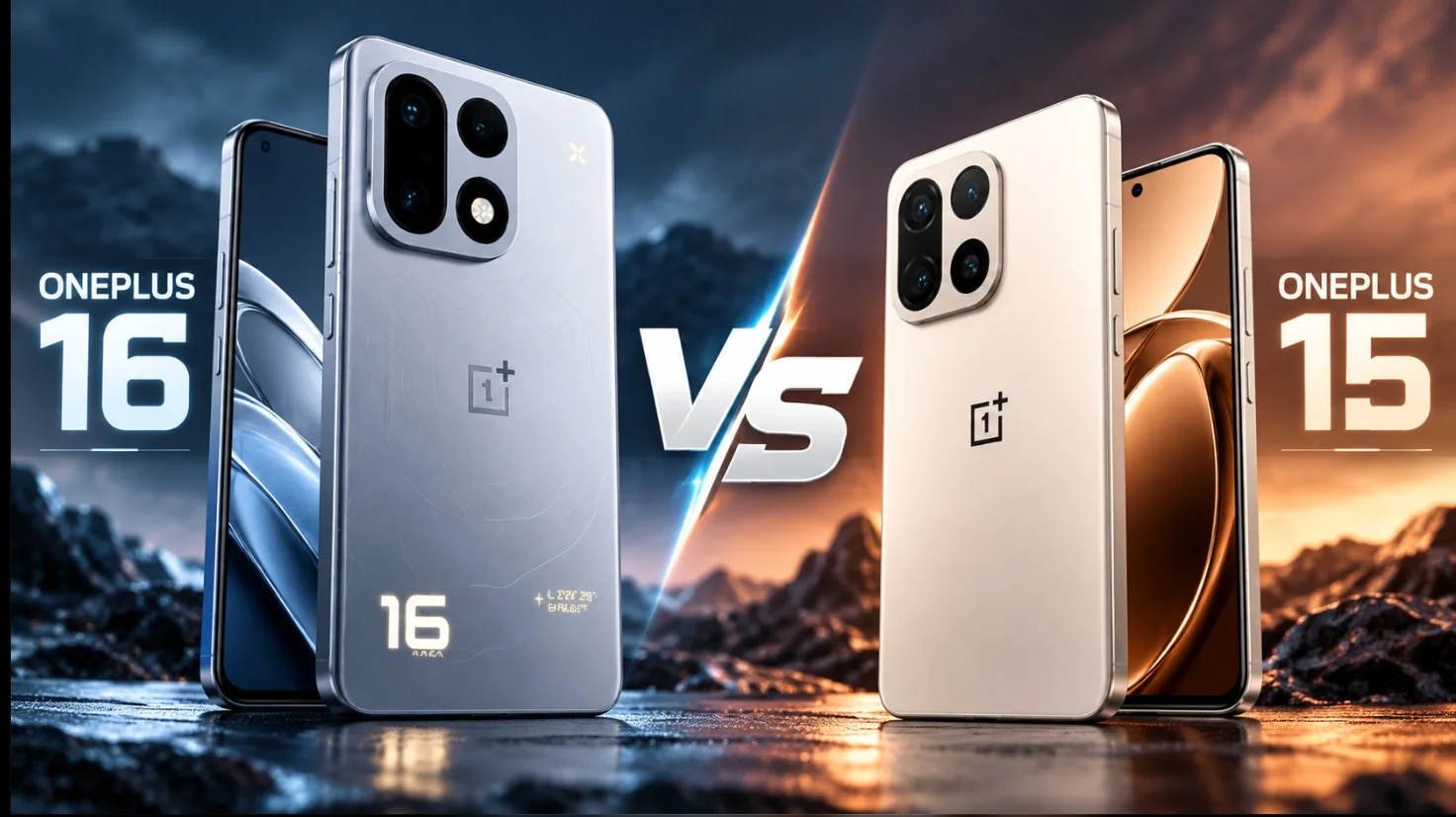
OnePlus launched the OnePlus 16 in China on October 12, 2026, and on paper, it’s more than a typical yearly refresh. The battery grows from 7,300mAh to 9,000mAh, the main camera jumps from 50MP to 200MP, and the chip moves to Qualcomm’s 2nm Snapdragon 8 Elite Extreme Gen 6. Outside games, the display now refreshes adaptively at up to 165Hz, and it supports up to 185Hz in games.
Not every number moves forward, though. Comparing Chinese models, wired charging drops from 120W to 100W and the telephoto lens shortens from 3.5x to 3x. The entry price is also 2,000 yuan higher at the official suggested retail price.
For Indian readers, the bigger point is simpler. OnePlus has not announced the OnePlus 16 for India, and current reports suggest it may stay in China. If you already own a OnePlus 15, nothing here demands an urgent switch before it launches in India and gets reviewed.
OnePlus 16 vs OnePlus 15: Key Differences at a Glance
Both columns use the Chinese models unless a row says otherwise, so the comparison stays like-for-like.
| Feature | OnePlus 15 | OnePlus 16 (China) |
|---|---|---|
| Display | 6.78-inch LTPO OLED, 2772 × 1272; up to 120Hz in general use, 165Hz in supported games | 6.78-inch flat OLED, 2772 × 1272; 1–165Hz adaptive outside games, up to 185Hz in games |
| Chipset | Snapdragon 8 Elite Gen 5 | Snapdragon 8 Elite Extreme Gen 6 (2nm, up to 5.01GHz) |
| RAM and storage | LPDDR5X, UFS 4.1; 12GB/256GB up to 16GB/1TB | LPDDR5X Ultra, UFS 4.1; 12GB/256GB, 12GB/512GB, 16GB/512GB, 16GB/1TB |
| Main camera | 50MP, 1/1.56-inch, f/1.8, OIS | 200MP, 1/1.4-inch, f/1.6, 23mm, AF, two-axis OIS |
| Ultrawide | 50MP, f/2.0, 116° | 50MP, f/2.0, 16mm, 116° |
| Telephoto | 50MP periscope, 1/2.76-inch, f/2.8, 80mm, 3.5x optical, OIS | 50MP periscope, f/2.6, 73mm, 3x optical, two-axis OIS |
| Selfie camera | 32MP | 50MP, f/2.0, AF |
| Rear video | Up to 4K 120fps with Dolby Vision | 8K 30fps; 4K up to 120fps, including Dolby Vision |
| Battery | 7,300mAh | Dual-cell: 9,000mAh typical equivalent (2 × 4,500mAh), 8,780mAh rated |
| Wired charging | 120W (China and India); 80W (US) | 100W SuperVOOC, 100W UFCS |
| Wireless charging | 50W | 50W (wireless charger sold separately) |
| Weight and thickness | 211g to 215g, about 8.1mm to 8.2mm | 217g to 220g, 8.45mm to 8.55mm (varies by colour) |
| Water and dust | IP66, IP68, IP69, IP69K | IP66, IP68, IP69, IP69K |
| Software at launch | ColorOS 16 (China), OxygenOS 16 (India) | ColorOS 17.0 |
| China launch price (12GB/256GB) | 3,999 yuan | 5,999 yuan suggested retail (5,699 yuan first-sale offer) |
| India availability | On sale since November 2025 | Not announced |
OnePlus 16 figures come from OnePlus’s official Chinese specification page, except the 1/1.4-inch main sensor size, which OnePlus gave in its camera announcement. OnePlus 15 figures come from launch specifications and published reporting.
1. Display: What Does 185Hz Change?
The 185Hz figure gets the headline, but the change outside games matters more. On the OnePlus 15, 165Hz was reserved for supported games, and general use topped out at 120Hz, according to 91mobiles. OnePlus’s official specifications say the OnePlus 16 switches adaptively between 1Hz and 165Hz in non-gaming use, so everyday scrolling and animations can now reach 165Hz.
That does not mean every app or animation will run at 165 frames per second. The panel can refresh that fast, but what you actually see depends on whether an app renders that many frames, on your refresh-rate settings and on how the software manages power.
The 185Hz mode is narrower still. OnePlus limits it to optimised games, and a OnePlus product manager said 165Hz was chosen as the default for frame-rate stability. OnePlus has not published a list of supported titles, and a game has to render at 185fps for the mode to matter.
On paper, the refresh interval shrinks from about 6.1 milliseconds at 165Hz to about 5.4 milliseconds at 185Hz. That is the gap between screen refreshes, not a cut in total input lag, which also depends on touch sampling, the game engine, and network conditions. By itself, it is not a guaranteed gaming advantage.

OnePlus claims its new BOE panel adds less than 1% to screen power at global 165Hz compared with the previous generation at 120Hz. That is a manufacturer claim and needs battery testing by us.
The rest of the panel is familiar. Both phones use a flat 6.78-inch OLED at 2772 × 1272 resolution, and OnePlus already marketed 1.15mm bezels on the OnePlus 15. OnePlus lists the OnePlus 16 at 1,000 nits typical maximum brightness by default and 2,000 nits typical peak, with Crystal Shield Glass on the front. Its 3,840Hz PWM dimming applies only at 70 nits and below; above that, the panel switches to DC-like dimming. OnePlus quoted 1,800 nits peak for the OnePlus 15 in China, but brands measure brightness under different conditions, so the two figures are not directly comparable.
2. Performance: Is the New Snapdragon Chip a Meaningful Upgrade?
The OnePlus 16 uses the higher-end of Qualcomm’s flagship chips, which Qualcomm names the Snapdragon 8 Elite Extreme Gen 6. OnePlus’s Chinese spec page calls it the sixth-generation Snapdragon 8. OnePlus lists a 2nm process, an eight-core CPU in a 2 + 3 + 3 layout, a 5.01GHz peak clock, and an Adreno 850 GPU. The OnePlus 15’s Snapdragon 8 Elite Gen 5 is a 3nm chip.
Qualcomm claims the Extreme Gen 6 is 13% faster on the CPU and 44% faster on the GPU than the Snapdragon 8 Elite Gen 5. Those are Qualcomm’s figures, not results from a OnePlus 16.
Memory technology has not changed. OnePlus lists LPDDR5X Ultra RAM and UFS 4.1 storage, the same combination reported for the OnePlus 15. Pre-launch leaks of LPDDR6 did not hold up.
OnePlus has also put a lot of its messaging into gaming hardware. Launch coverage from BigGo Finance and Smartprix reports a 6,428mm² vapour chamber that OnePlus says is 40% more efficient than the last generation. The same reports cover OnePlus’s own G3 network, P4 display and T3 touch chips, with a claimed 520Hz touch sampling rate and 29% lower average touch latency. None of these figures appear on the official spec page, and all of them are OnePlus’s own claims.
None of these claims has independent testing behind it yet. There are no credible benchmarks or sustained-load results for the retail OnePlus 16 at the time of writing, so any percentage figure circulating online should be treated with caution.
In practical terms, the OnePlus 15 is not slow. Opening apps, browsing, and everyday multitasking are unlikely to feel very different. The new chip and cooling matter most for long gaming sessions and heavy workloads, where heat decides how long peak speed lasts. Reviews that measure throttling over 20 to 30 minutes will tell buyers far more than launch-day spec sheets.
3. Camera: From 50MP to 200MP
The main camera is the biggest hardware change on the back. The OnePlus 15 uses a 50MP 1/1.56-inch sensor behind an f/1.8 lens. OnePlus’s official specifications list the OnePlus 16’s 200MP main camera at f/1.6, with a 23mm equivalent focal length, autofocus, and two-axis OIS. OnePlus’s camera announcement gave the sensor size as 1/1.4 inch. Some coverage has quoted f/1.4, which appears to confuse the aperture with the sensor size.

The megapixel count is not the part to focus on. A 200MP sensor packs far smaller pixels, and phones usually combine them into lower-resolution images by default. The larger sensor and brighter aperture matter more, because both let in more light. Whether that turns into better photos depends on OnePlus’s processing, and no outside-China comparisons have been published yet.
The zoom change deserves a closer read. The OnePlus 15’s periscope offers 3.5x optical zoom at 80mm, with an f/2.8 lens on a 1/2.76-inch sensor. Officially, the OnePlus 16’s telephoto offers 3x optical zoom at 73mm, with an f/2.6 lens, autofocus, and two-axis OIS. Photos support up to 120x digital zoom, and video tops out at 18x.
OnePlus’s earlier camera announcement named the telephoto sensor as Sony’s IMX882 and claimed 6x lossless zoom. Launch reports put that sensor at 1/1.95 inch. Neither detail appears on the final spec page. If the larger sensor is confirmed, it could help at 3x and in dim light, while distant subjects would rely more on cropping. Reviews will need to show which approach takes better zoom photos.

The ultrawide stays at 50MP with an f/2.0 lens and a 116-degree field of view. Reports suggest it uses the same 1/2.88-inch sensor as the OnePlus 15, but OnePlus does not list a sensor size. The selfie camera moves from 32MP to 50MP, with an f/2.0 lens and autofocus.
For video, OnePlus lists 8K at 30fps and 4K at up to 120fps on the rear cameras, including 4K Dolby Vision at 120fps. The front camera records 4K at up to 60fps. The OnePlus 15 already offered 4K 120fps Dolby Vision, so that part is not new.
4. Battery: A Much Larger Capacity

The OnePlus 16’s battery uses two cells. OnePlus lists two 4,500mAh cells in series, which it describes as equivalent to 9,000mAh typical capacity, or 8,780mAh rated. Against the OnePlus 15’s advertised 7,300mAh, the typical figure is about 23% higher.
OnePlus managed this with a small physical cost. The OnePlus 16 is 8.45mm to 8.55mm thick and weighs 217g to 220g depending on colour, compared with roughly 8.1mm and 211g to 215g for the OnePlus 15.
A bigger battery should translate into longer runtime, but not in a straight line. The new phone also refreshes at up to 165Hz outside games, runs a different chip, and ships with new software. Any of those can eat into the extra capacity. A 23% larger cell does not guarantee 23% more screen-on time, and the real answer will come from standardised battery tests.
Launch reports say OnePlus promises the OnePlus 16’s battery will keep at least 80% of its health for five years, but that claim is not on the official spec page. For the OnePlus 15, OnePlus quoted 80% capacity after 1,600 charge cycles. One claim is time-based and the other cycle-based, so they cannot be compared directly.
5. Charging: Has Anything Gone Backwards?

Yes, on wired charging, but only once you compare the right versions. The OnePlus 15 shipped with different wired charging in different markets. The Chinese and Indian models support 120W, while the US model was limited to 80W. A comparison against the 80W US figure would make the OnePlus 16 look like an upgrade, which it is not.
Like for like, the picture is clear. The Chinese OnePlus 15 supports 120W wired charging. The Chinese OnePlus 16 supports 100W. Wireless charging stays at 50W on both.
How much the lower wattage matters is harder to say. The new phone has a larger battery to fill, and peak wattage only applies for part of a charge. Maximum wattage alone cannot tell you which phone charges faster. That needs side-by-side testing.
The spec page adds two practical details. A 100W charger comes in the box, but the 50W wireless charger is sold separately. For third-party chargers, OnePlus lists 100W UFCS, 55W PPS, and 18W USB PD. GSMArena lists the OnePlus 15 with 36W USB PD, so anyone relying on a generic USB-C PD charger may see slower charging on the new phone.
6. Design, Software and Other Changes
The OnePlus 16 looks like an evolution rather than a redesign. Screen size and resolution are unchanged, and both phones carry the same IP66, IP68, IP69 and IP69K ratings. The new model is slightly thicker and a few grams heavier, which follows from the larger battery.
It comes in three colours in China: Tomorrow’s Starlight, Dark Forest and Mars Masterpiece. The first two have a Crystal Shield Glass back and weigh about 220g. Mars Masterpiece uses a glass-fibre reinforced composite back, which makes it the lightest at about 217g and the thinnest at 8.45mm.
Software is where the regional split matters most. OnePlus lists ColorOS 17.0 on the Chinese model. Launch reports say it is based on Android 17, though the spec page only says Android. Indian OnePlus 15 owners use OxygenOS, so they should not assume the Chinese software matches what they have today. OnePlus has not published a software update policy for the OnePlus 16.

OnePlus also lists an in-display ultrasonic fingerprint sensor, an infrared remote, dual speakers, Wi-Fi 7, Bluetooth 6.0, and USB 3.2 Gen 1. The OnePlus 15 already supported Wi-Fi 7 and Bluetooth 6.0, so those are not upgrades.
OnePlus 16 vs OnePlus 15: Price Difference
The OnePlus 16 costs 2,000 to 3,100 yuan more than the OnePlus 15 did at launch, depending on the configuration. All prices below are Chinese prices in yuan. The OnePlus 16 column uses the official suggested retail price, and the OnePlus 15 column uses its October 2025 launch price.
| Configuration | OnePlus 15 launch price | OnePlus 16 suggested retail price | OnePlus 16 first-sale price | Difference (suggested retail) |
|---|---|---|---|---|
| 12GB + 256GB | 3,999 yuan | 5,999 yuan | 5,699 yuan | +2,000 yuan |
| 12GB + 512GB | 4,599 yuan | 6,799 yuan | 6,499 yuan | +2,200 yuan |
| 16GB + 512GB | 4,899 yuan | 7,499 yuan | 7,199 yuan | +2,600 yuan |
| 16GB + 1TB | 5,399 yuan | 8,499 yuan | 8,199 yuan | +3,100 yuan |
The OnePlus 15 also sold a 16GB + 256GB version at 4,299 yuan, which the OnePlus 16 range does not include.
Indian readers may want a rupee figure. At the current exchange rate, 5,999 yuan works out to around ₹85,800, and the 16GB + 1TB model to around ₹1.22 lakh. These are approximate currency conversions only. They are not Indian prices, and they leave out import duty, GST, and OnePlus’s own pricing decisions for India.
| Configuration | China suggested retail | Approx. in rupees |
|---|---|---|
| 12GB + 256GB | 5,999 yuan | ~₹85,800 |
| 12GB + 512GB | 6,799 yuan | ~₹97,300 |
| 16GB + 512GB | 7,499 yuan | ~₹1.07 lakh |
| 16GB + 1TB | 8,499 yuan | ~₹1.22 lakh |
The OnePlus 15 has also become more expensive since launch. Memory costs pushed its Chinese starting price to 5,099 yuan by August 2026, so the OnePlus 16’s base first-sale price is 600 yuan higher than what the OnePlus 15 sells for now. The first-sale offer runs until November 13, and China’s national subsidy can bring the base model down to 5,199 yuan for eligible buyers.
Is the OnePlus 16 Coming to India?
Not officially. As of October 13, 2026, the OnePlus 16 is on sale only in China, and OnePlus has not announced an Indian launch date or Indian price.
OnePlus said in July 2026 that it would stop launching new products in North America and Europe, but it continues to launch phones in India. On the OnePlus 16 itself, the leaks conflict. Tipster Yogesh Brar says it will stay in China, with a OnePlus 16R leading the Indian line-up, while tipster Debayan Roy has guessed it could be one of two flagships headed to India. OnePlus has confirmed neither claim.
Until OnePlus says more, treat any OnePlus 16 India price as speculation, and do not assume an Indian model would match the Chinese specifications. Importing a Chinese unit is possible but comes with trade-offs: it runs ColorOS rather than OxygenOS, and Indian warranty support is not guaranteed.
The OnePlus 15 remains OnePlus’s current flagship in India. It launched in November 2025 at ₹72,999 for the 12GB + 256GB model and has received price increases since, so check the official OnePlus store for the current price.
Should You Upgrade from OnePlus 15 to OnePlus 16?
For most OnePlus 15 owners, no, at least not yet. The OnePlus 15 is less than a year old, and its battery, display, and chip were already among the strongest in its class. The answer changes depending on what you actually use your phone for.
If the higher refresh rate is the main attraction, the case is weak. Faster refresh outside games is a real change, but the 185Hz mode only works in optimised games, and a shorter refresh interval does not by itself guarantee a competitive edge. That alone does not justify a phone costing upwards of 5,699 yuan.
If battery life is your biggest frustration, the OnePlus 16 deserves a closer look. A 23% larger battery is the most practical upgrade here. Wait for reviewers’ endurance tests first, because the higher 165Hz ceiling and the new chip will shape how much of that extra capacity you actually get.
If photography matters most, the decision is more nuanced. The larger main sensor is promising on paper. But if you rely on longer zoom shots, the shorter 3x telephoto could be a step back. Look for side-by-side camera comparisons before deciding.
If you play competitive games for long sessions, the new chip, bigger vapour chamber, and 185Hz mode add up to the strongest argument for switching. This only holds if sustained performance tests confirm the gains and your games support the higher frame rate.
If you are in India, the question is mostly hypothetical for now. There is no Indian model to upgrade to, and an imported Chinese unit comes with software and warranty trade-offs.
For someone buying a flagship for the first time, the comparison is different. In China, the OnePlus 15 now sells for less than the OnePlus 16 and remains a capable phone. In India, the OnePlus 15 is the one you can actually buy with official support today.
Final Verdict
The OnePlus 16 is a bigger hardware change than its unchanged design suggests. The 9,000mAh battery, the larger 200MP main sensor, and the 2nm chip are substantial upgrades on paper, and allowing 165Hz outside games fixes a real limitation of the OnePlus 15.
It also gives some things up. Chinese buyers get 100W wired charging instead of 120W, and the telephoto drops from 3.5x to 3x. The price rises by at least 2,000 yuan at the suggested retail level.
The people most likely to benefit are heavy users who drain their battery daily and mobile gamers playing supported titles, provided reviews back up OnePlus’s claims. Most OnePlus 15 owners can comfortably skip this generation, and Indian buyers have nothing to act on until OnePlus confirms its plans.
FAQ
The 12GB + 256GB model has a suggested retail price of 5,999 yuan, with a first-sale offer of 5,699 yuan. The top 16GB + 1TB model is 8,499 yuan, or 8,199 yuan during the launch offer.
Its peak wired charging is lower. The Chinese OnePlus 16 supports 100W, while the Chinese and Indian OnePlus 15 support 120W. Wireless charging is 50W on both.
The main sensor is larger and higher in resolution, and reports point to a larger telephoto sensor. The zoom drops from 3.5x to 3x, though. No outside China camera comparisons were available at the time of writing, so it is too early to call either phone better.
OnePlus rates it at 9,000mAh typical equivalent capacity (8,780mAh rated) from two cells, against 7,300mAh on the OnePlus 15. On typical figures, that is about 23% more.
OnePlus has not announced an Indian launch. Leaks disagree on whether the OnePlus 16 will come to India at all, with some reports saying a OnePlus 16R will be the brand’s top model there.