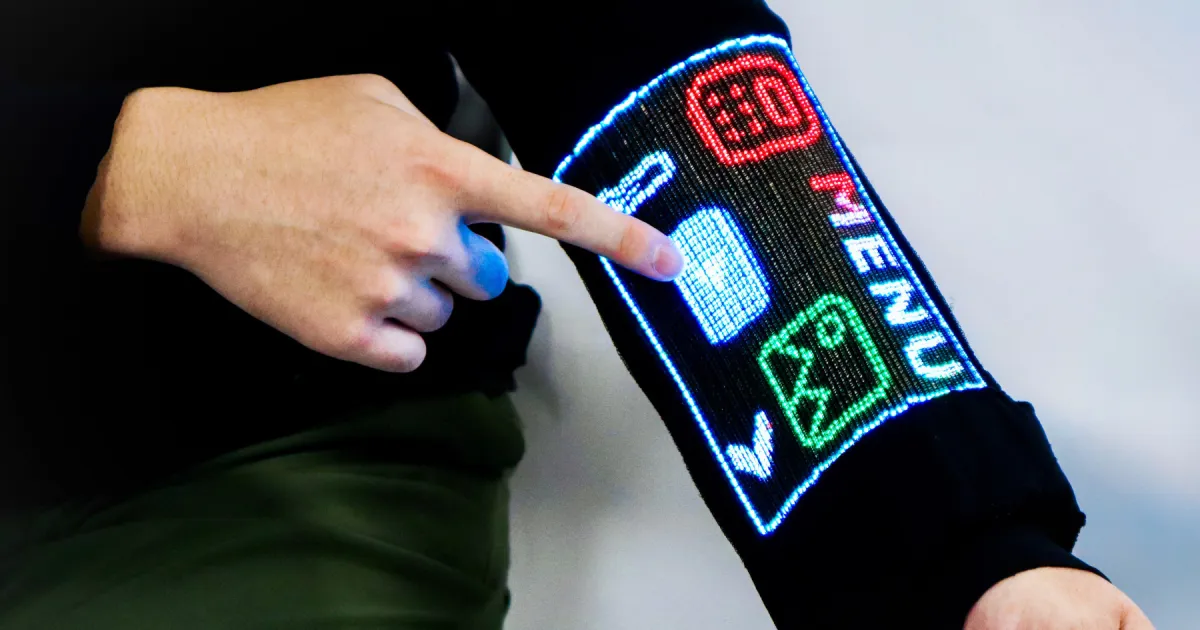
Forget smartwatches. Scientists have developed a touchscreen that can be woven directly into clothing, allowing users to interact with digital content without wearing a rigid display. Researchers at the National University of Singapore (NUS) have integrated 54 specialized fibers into a sleeve to create what they claim is the world’s first touchscreen built into a garment. Published in Naturethe research could open the door to clothes that do more than just look good. Your next smart outfit could actually be smart enough to show what’s happening on your phone.
Your clothes could soon be running apps
The prototype has a 96 x 54-pixel display that can show pictures, play videos, run a calculator and respond to touch. It can also receive images via Bluetooth, respond to voice commands, and display body temperature readings. The technology works by integrating thousands of microelectronic components into flexible fibers about a millimeter thick. These fibers combine display and sensing capabilities, while a touch-sensitive layer detects finger presses and activates the corresponding pixels. In other words, the screen is not simply attached to the fabric. The electronics are built into the fibers themselves.
The team believes that the technology could eventually make wearable devices less bulky and more practical. Instead of checking a smartwatch or pulling out a phone, users can interact with information right on their sleeve. Potential applications include health monitoring, where garments can display physiological readings, as well as communication and other wearable computing tasks. The current display is relatively low resolution, so don’t expect to stream a blockbuster in glorious 4K on a jacket. Nevertheless, it shows how electronic textiles can become more interactive.
Yes, it can survive washing
Here’s the impressive part: all that electronics doesn’t make the garment a fragile science experiment that needs to stay away from water. NUS researchers found that the display and touch response remained almost unchanged after 50 machine wash cycles and 1,000 bending cycles. The fabric also remains flexible and breathable, addressing two major challenges for electronics designed to be worn every day.
There is still a long way to go before touchscreen shirts become a regular sight. The resolution and capabilities of the prototype are limited, and the researchers have not announced a commercial release. But the concept is a meaningful step towards clothing that can display information and respond to touch without relying on a conventional screen. Smart clothing could finally mean more than a jacket with Bluetooth speakers, and I’m all for it.
RELATED COVERAGE: