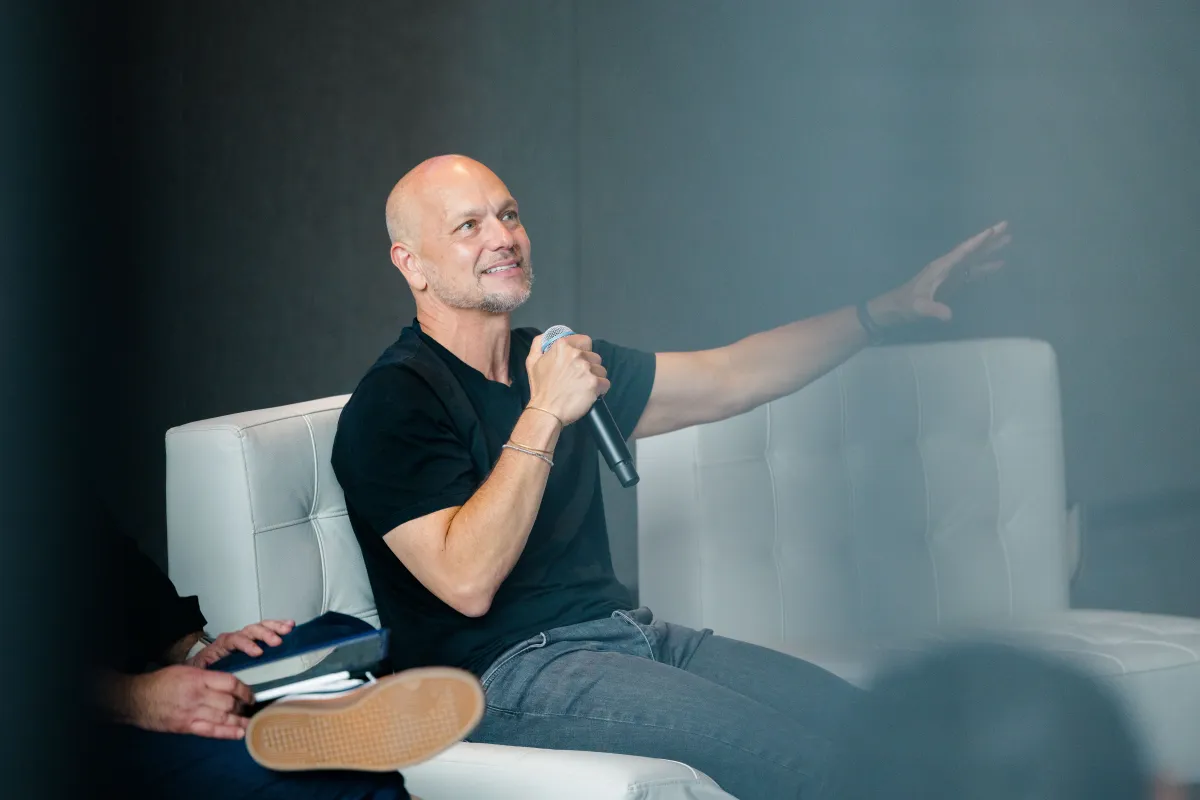
When Tony Fadell takes the stage at the first MIT Future Fest, he projects a slide with three images of once-hyped AI devices that have already been discontinued: the Rabbit R1, the Humane Ai Pin, and the Limitless Pendant.
“These were kind of the ‘Gen 1’ AI products, and because of my background, these companies called me and asked me to help them,” Fadell said. “I don’t have.”
It’s no surprise that these companies want Fadell’s advice. He is referred to as the “father of the iPod”, a co-creator of the iPhone, and the founder of Nest, the smart thermostat company that was acquired by Google.
“You really have to understand what you’re trying to do, what pain you’re trying to solve,” he said. “In each of these cases, each of them didn’t fulfill a need — it was just interesting technology for geeks, and you’re like, ‘Okay, that’s neat, but it doesn’t really apply to my life.’
These early AI devices promised the convenience of having a personal assistant, but didn’t actually perform that well. Even if they did, most people have never had an assistant and know how to use – or grow to trust – a personal robot helper.
“It’s less than 0.01% of the world’s population that has ever had a human [assistant] do something, and so when [companies] saying, ‘Oh, we want an assistant,’ that’s a bunch of people who have assistants saying it,” he said. “Most consumers don’t even know what an assistant is.”
Fadell goes on to explain to those of us in the 99.99% that hiring a reliable personal assistant isn’t as simple as pulling the most promising resume from a pile of applications.
“It took me a few years at first to understand how to use it best [an assistant]and then to trust them with the most sensitive data, and to be an agent where they set up meetings with people and work with my bank,” he said. “I understand that we have this vision of the future, but there are many steps to get the general consumer and also the general enterprise on this path.”
It’s hard to talk about the struggles of building trust in your personal assistant without sounding a little entitled, but Fadell has a point. When you hire a human assistant, you don’t give them your bank account login on day one. We are entering a world where everyone can have a personal AI assistant, but these tools are only valuable if we can trust that they are completely safe.
At this point, building trust with an AI assistant seems even more difficult than trusting a human. Meta recently launched Muse, its all-purpose AI assistant, but users have reason to be cautious. A security researcher quickly found a serious vulnerability in Muse after launch, and a recent 404 Media report says that several Meta employees discovered security issues that prompted some teams to embark on a “mad dash” to fix these problems before launch, working overtime.
“Trust and security are going to be important with anything we transition to some kind of intelligence,” Fadell said. “The only company that I see right now — maybe another one — that could do this. Apple has all the hardware, they have all the chips, they have all the pieces, but they don’t have all the AI stuff.”
While it won’t be Apple that ultimately produces the soundest AI agent, Fadell predicts that a successful agent will need to operate only on the device, both for privacy and to keep the tech light.
“When you hear all this stuff about, ‘Oh, data centers are going to take over the world’ … I don’t believe it,” he said. “I’ve seen this before. I’ve seen this in the internet days and what have you. We have so much power on the device now, and even more computing, and they’re still battery operated.”
By keeping sensitive data on the device, rather than transmitting it through the cloud, Apple has gained trust from users to share their biometric data through features like Face ID. As Fadell notes, Apple seems to have more goodwill with consumers than its competitors when it comes to privacy, but unlike other top tech companies, Apple doesn’t have its own world-class AI model – the new Siri AI runs on customized versions of Google Gemini.
While Apple is lagging in proprietary AI, it’s leaps and bounds in hardware. Fadell theorizes that companies like Meta and OpenAI are turning their attention to gadgets because they don’t have billions of devices in circulation like Apple.
“It’s because they don’t have access to the sensors on your phone. They’re like, ‘Oh, we need video,’ and you have to check, ‘Yeah, I’ll give you video.’ Then they say, ‘Well, we need audio.’ Check. “We need your GPS location.” Check. And before you know it, there’s a list of 20 things or more that you then allowed them to have,” he said. “So what do they do? They go and make a device with all that stuff and no screen … and then they just Bluetooth or Wi-Fi into your phone and then back to the web, or to a 5G network, so they get all the sensor data.”
Given his history creating the iPhone and iPod, it may seem as if Fadell still views his former employer through rose-colored glasses. While he can give Apple credit where it’s due, he hasn’t been shy about calling Apple out when he thinks they’re messing up.
When an audience member asks about the luck involved in finding product-market fit, Fadell points out that it’s harder for startups to manufacture that luck because a failed product can spell the end of the company.
“Because it’s a startup, you get one shot,” he said. “It’s not like Apple with the Vision Pro.”
If you buy through links in our articles, we may earn a small commission. This does not affect our editorial independence.