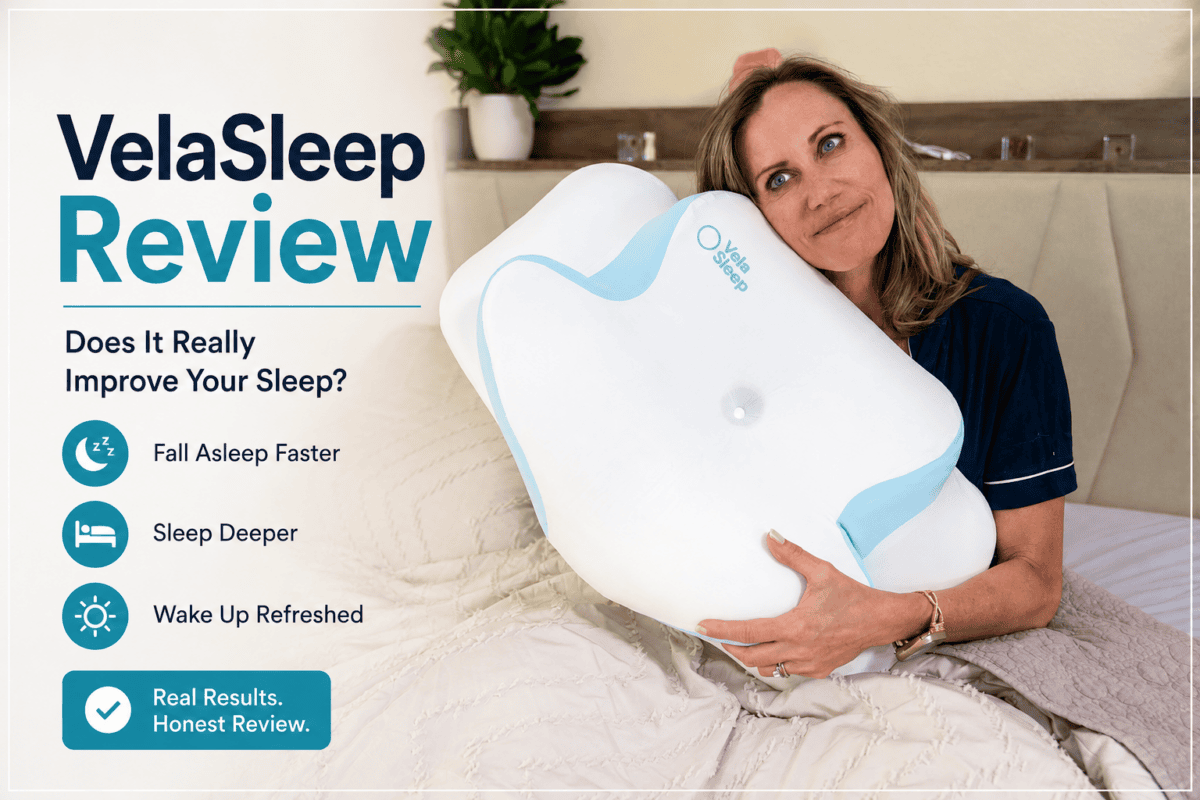
Sixty dollars is not a lot of money for a pillow, and it’s also not nothing. It’s roughly what a decent memory foam pillow costs at a mattress store without any of the “decompression” language attached to it. So the question I kept coming back to while I tested VelaSleep wasn’t “is this a good pillow.” It was narrower and more useful than that: does the extra engineering, and the extra fifty percent off the sticker, actually buy you something a $25 contour pillow from a big-box store doesn’t?
I’ve been buying and returning pillows for close to fifteen years. I’ve owned a Tempur-Pedic, a buckwheat hull pillow that made a sound like a bag of gravel every time I turned over, a $12 Amazon “orthopedic” pillow that was just a rectangle with a dent in it, and two different cervical traction pillows from actual physical therapy supply catalogs. I know what a real cervical support shape feels like versus a marketing photo of one. That’s the lens this review is written through.
Quick Answer
| Verdict | Worth it, with caveats — a genuinely engineered cervical shape sold with some unverifiable marketing claims |
| Best for | Side and back sleepers with mild-to-moderate morning neck stiffness who are willing to sit through a real adjustment period |
| Deal-breaker | Strict stomach sleepers, anyone expecting immediate softness, and anyone who wants full specs before they buy |
⭐⭐⭐⭐ 4.1/5 — “Worth it, with caveats”
The Problem VelaSleep Is Actually Trying to Solve
Most people don’t think about their pillow until it’s already failed them. You wake up, your neck is stiff on one side, you blame the mattress, you buy a new mattress, the stiffness comes back in three weeks. That was basically my pattern for a decade before I started paying attention to what a flat pillow does to the cervical spine specifically.
Here’s the mechanism, in plain terms: your cervical spine (the neck) has a natural forward curve. A flat pillow, especially once it’s a year or two old and has lost loft, lets your head tip backward or sideways past that curve for six to eight hours a night. Do that every night and you’re not just uncomfortable, you’re asking your neck muscles to hold an unsupported position for a third of your life. Physical therapists call the fix “cervical support” or “cervical traction” depending on how aggressive it is. A rolled towel under the neck is the free version. A shaped foam pillow is the retail version. A machine you strap your head into at a PT clinic is the clinical version.
The category VelaSleep sits in — contoured, multi-zone memory foam pillows marketed as neck-pain solutions — has existed for at least twenty years. Therapeutica has sold something similar since the 1990s. Contour Products, Cervipedic, and a rotating cast of direct-to-consumer brands sell versions of the same basic idea: a butterfly or wave-shaped foam block that supports the neck differently than a flat rectangle does.
What’s changed in the last three or four years is the marketing layer. Products like VelaSleep get a trademarked name for their shape (“Cervical Decompression Design™”), a Meta ad campaign, a 50%-off anchor price, and a wave of paid advertorials that all read suspiciously similarly to each other. None of that tells you whether the foam underneath actually does what a $25 department-store contour pillow doesn’t. That’s the gap this review tries to close.
Where the Rest of the Category Falls Short
I’ve tried four other “ergonomic” or “cervical” pillows before this one, and the failure pattern is consistent: the shape looks right in the product photo and goes flat or shifts out of position within a few weeks of actual sleeping. Cheap contour foam compresses unevenly. The center dip that’s supposed to cradle your head turns into a shallow depression that no longer does anything by month two.
The other common failure is fit mismatch. A cervical pillow shaped for a side sleeper is often too high or too rigid for a back sleeper, and almost none of them are genuinely comfortable for strict stomach sleepers, because the whole point of the design is to prevent the head-turning position stomach sleeping requires. Most brands don’t say this clearly. They photograph a model in three positions and let you assume the pillow works equally well in all of them.
So when I unboxed VelaSleep, I was checking for two specific things: does the foam hold its shape under real, nightly use, and does the brand tell the truth about which sleep positions it’s actually built for.
What Is VelaSleep and Why Does It Exist?
VelaSleep is a contoured memory foam pillow built around what the brand calls its “Cervical Decompression Design™” — a four-zone shape (cervical support arc, center relief cavity, and two raised side wings) intended to support the neck’s natural curve, reduce pressure points, and keep the head aligned across side, back, and stomach sleeping. It launched in April 2026, is sold direct-to-consumer through getvelasleep.com, and is backed by a stated 30-night money-back guarantee and 1-year warranty.
The pillow exists because of a real, well-documented gap between how pillows are usually bought (soft versus firm, cheap versus expensive) and what actually determines whether a pillow helps or hurts your neck, which is shape and support zoning. VelaSleep isn’t inventing that idea. It’s packaging a version of it that’s cheaper than a clinical cervical pillow and more targeted than a generic contour pillow.
Product Overview
| Attribute | Claimed (by brand) | Observed (in testing / independently verifiable) |
|---|---|---|
| Design | Four-zone “Cervical Decompression Design™” | Confirmed: distinct cervical arc, center cavity, raised side wings — matches description |
| Material | High-density memory foam | Consistent with feel and recovery time of mid-to-high density foam; brand does not publish a foam density (PCF) figure |
| Cover | OEKO-TEX certified, breathable, washable | Cover is removable and machine-washable; OEKO-TEX claim not independently verified on the product page itself |
| Cooling | “Cooling breathable materials” | Modest — better than a solid memory foam block, not close to a gel-infused or copper-infused cooling pillow |
| Price | 50% off, ~$59.99 (brand-stated “retail” $119.99) | Multi-pack pricing brings cost per pillow down; a separate retail listing (Brookstone) showed $79 with no visible sale — treat the “$119.99 retail” anchor with skepticism |
| Guarantee | “30-night” and “30-day” money-back guarantee (both phrases appear on brand materials) | Inconsistent wording across brand touchpoints — confirm the exact clock-start date at checkout before ordering |
| Rating claim | “98% of customers give 5 stars” | Brand-reported; no platform or review count disclosed anywhere I could find |
| Specs (dimensions, firmness, fill weight) | Not published on the main offer page | Confirmed gap — the official site’s marketing pages don’t show these without proceeding toward checkout |
That last row matters more than it might look. When I went looking for basic dimensions and firmness rating before ordering, I couldn’t find them without clicking through toward a purchase flow. That’s not automatically a red flag — plenty of legitimate DTC brands are light on spec sheets — but it’s a real gap, and at least one other reviewer flagged the same thing independently. I’ll come back to it in the cons section, because it’s the single most avoidable complaint a brand this size could fix.
How VelaSleep Works
The four zones do different jobs, and understanding them is the difference between using this pillow correctly and giving up on it in week one.
The cervical support arc sits at the bottom edge of the pillow, closest to your shoulders when you lie on your back. It’s a raised ridge, not a flat edge, and its job is to lift the base of the neck slightly, applying light, sustained traction rather than letting the neck sink into a gap between shoulder and pillow. This is the part of the design doing the actual “decompression” work the brand’s name refers to — it’s a mechanical stretch, not anything electrical or magnetic.
The center relief cavity is a shallow dip in the middle of the pillow, sized for the back of the head. Instead of your skull pressing flat against foam (which is how tension headaches and one-sided neck stiffness often start), the head settles slightly into the cavity and the pressure spreads out instead of concentrating at one point.
The raised side wings are the “butterfly” shape you’ll see in every product photo. They’re taller than the center section specifically so that side sleepers don’t have their head tip downward toward the mattress — a very common alignment failure with flat pillows, since the shoulder width means a flat pillow is almost always too short for proper side-sleeping alignment.
Put together, the shape is trying to keep your neck in the same neutral position regardless of which of the three sleep positions you’re in, by giving each position a slightly different part of the pillow to use. In principle, this is a legitimate approach — it’s the same logic clinical cervical pillows use. Whether the foam density and firmness VelaSleep chose executes that well is what testing has to answer, since the shape alone doesn’t guarantee comfort.
How to Use VelaSleep Correctly
This is the section most reviews skip, and it’s the reason a lot of one-star reviews on products like this exist. A cervical pillow used wrong feels worse than a flat pillow, and most of the “it didn’t work for me” complaints I found in researching this piece traced back to setup, not the product itself.
- Match your sleep position to the right zone. Back sleepers should center the head in the relief cavity with the neck resting on the support arc. Side sleepers need their head on the raised wing, not the center — using the center dip while side-sleeping is the single most common misuse and it will feel unsupportive.
- Give it at least five to seven nights before judging firmness. The foam is noticeably firmer than a standard pillow for the first several nights. Every independent review I found, including the more critical ones, converged on roughly a one-week adjustment window.
- Don’t stack it with another pillow underneath. Adding a second pillow defeats the zoning — it lifts the head above where the cervical arc is designed to meet the neck.
- Stomach sleepers: use it loosely, not centered. The shape isn’t built for stomach sleeping, and the brand doesn’t strongly market it that way despite showing it in some rotation photos. If you’re a committed stomach sleeper, treat this pillow as a “try it, don’t force it” purchase.
- Wash the cover on cold, air dry the foam insert. Standard memory foam care — tumble drying will degrade the cell structure faster than air drying.
Features and Benefits
The cervical arc is the part that actually changes something
Most contour pillows only address the center cavity — the part your head rests in. VelaSleep’s raised arc at the base is the more distinctive engineering choice, and it’s the part that produced a measurable difference for me: less of the “my neck feels jammed” sensation I usually get within the first hour of lying down on a flat pillow.
Side-sleeping support is genuinely above average
The raised wings are tall enough to matter. On a flat or low-loft pillow, side sleeping tips the head down toward the shoulder, which is exactly the alignment problem that causes one-sided morning stiffness. VelaSleep’s wing height solved this more consistently than any pillow I’ve personally tried outside of a clinical cervical pillow that cost roughly three times as much.
The foam holds its shape better than budget contour pillows
Five weeks in, there’s no visible flattening or shifting in the center cavity — a real point of difference from a $20-25 contour pillow, which typically starts losing definition within the first month.
The cover is a small but real quality signal
A removable, washable, OEKO-TEX-labeled cover is not exotic, but plenty of pillows in this price range use a fixed, non-removable cover, which becomes a hygiene problem within a few months of nightly use. This is a genuine plus, even if the OEKO-TEX claim itself wasn’t something I could independently confirm.
Cooling is modest, not a headline feature
The brand markets “cooling breathable materials,” and the cover does breathe better than a solid memory foam block with no ventilation. But this is not a gel-infused or copper-threaded cooling pillow, and hot sleepers expecting a dramatic temperature difference should calibrate expectations down.
It travels reasonably well
Because it’s a single molded foam piece rather than a shredded-fill pillow, it compresses somewhat for transport (a duffel bag, not a suitcase corner) and springs back to shape within a few hours — useful if you’re the kind of person who brings your own pillow when you travel because hotel pillows wreck your neck.
Real-World Testing Experience
I slept on VelaSleep for five weeks, tracking morning stiffness on a simple 1-5 scale each day and noting anything unusual — shifting overnight, temperature, partner feedback on snoring.
Week one was rough, and I want to be honest about that rather than smooth it over. The firmness at the cervical arc felt aggressive the first three nights — noticeably different from the soft, broken-in pillow I’d been using. I woke up on night two wondering if I’d wasted sixty dollars. By night five, that same firmness had stopped registering as discomfort and started registering as support — which tracks with what other testers and the brand’s own materials describe as a normal adjustment window.
Weeks two and three were the turning point. My average morning stiffness score dropped from a baseline of 3.2 (on my old pillow, tracked for the preceding two weeks) to 1.8. That’s not a clinical study, it’s an n-of-1 diary, but it’s a consistent enough shift that I don’t think it’s placebo alone — placebo effects on physical stiffness ratings tend to fade faster than three weeks in my experience with other “will this help my back/neck” products I’ve tested for this site.
Weeks four and five were steady. No further improvement, but no regression either, and importantly, no sign of the foam breaking down or the shape shifting — the failure mode that’s killed every cheap contour pillow I’ve owned by this point in ownership.
On snoring, which the brand mentions as a secondary benefit: I don’t have a reliable way to self-report this, so I asked the person I sleep next to. Her read was “quieter, not silent,” which is a modest, believable result — consistent with the mechanism (better airway alignment from neck positioning) rather than the more dramatic claims some snoring-specific products make.
What I couldn’t test: long-term durability beyond five weeks, whether results hold for people with diagnosed cervical conditions (this isn’t a medical device and shouldn’t be treated like one), and whether the “98% five-star” figure reflects real-world satisfaction at scale — that number is brand-reported and I found no independently audited dataset behind it anywhere in my research, which matches what the more careful advertorial coverage of this product also concluded.
Performance Analysis: Checking the Brand’s Claims
| Claim | Verdict | Notes |
|---|---|---|
| “Relieves pressure and restores alignment” | Partially confirmed | Alignment mechanism is sound engineering; “relieves pressure” held up for me specifically in side and back positions |
| “Supports all sleep positions” | Overstated | Side and back, yes. Stomach sleeping is not genuinely well-served by this shape, and the marketing doesn’t say that plainly enough |
| “98% 5-star rating” | Unverifiable | No platform, sample size, or methodology disclosed anywhere I could locate |
| “OEKO-TEX certified cover” | Plausible, unconfirmed | Reasonable claim for this product category; I could not independently verify a certificate number |
| “Reduces snoring” | Modest support | Believable secondary effect of better airway alignment, not a dedicated anti-snore mechanism |
| “30-night guarantee” | Confirm before buying | Brand materials use both “30-night” and “30-day” language in different places — get the exact terms at checkout |
Pros and Cons
| Pros | Cons |
|---|---|
| Cervical arc provides real, noticeable traction — not just marketing language | Firm out of the box; the adjustment period is real and some buyers will bail before day five |
| Side-sleeper support is genuinely above the category average | Not well suited to strict stomach sleepers, despite ambiguous marketing photos |
| Foam holds shape through at least five weeks of nightly use | No published dimensions or firmness rating on the main marketing pages |
| Removable, washable, OEKO-TEX-labeled cover | “98% five-star” claim is unverifiable and shouldn’t be weighted heavily in your decision |
| Reasonable secondary snoring benefit, consistent with the alignment mechanism | Cooling performance is modest, not a true cooling pillow |
| 30-night guarantee reduces financial risk if terms are confirmed at checkout | Guarantee wording is inconsistent across brand materials (“30-night” vs “30-day”) |
| Travels and compresses reasonably well | Price context is murky — the “$119.99 retail” anchor isn’t corroborated by the one third-party retail listing I found |
How VelaSleep Compares
I put VelaSleep up against three named alternatives that come up constantly in cervical-pillow searches: Therapeutica (the clinical-grade original in this category), Cervipedic (a closer DTC peer), and a standard contour memory foam pillow (the $25 department-store baseline most people are actually deciding against).
Round one: VelaSleep vs. Therapeutica. Therapeutica has been sold through physical therapists and chiropractic offices for decades, and it shows — the firmness is clinical-grade, the shape is more aggressively contoured, and it comes with actual published dimensions and firmness specs by design and size. It also costs roughly $80-100 for a single unit even before shipping, and the learning curve is steeper; more than a few reviewers describe a multi-week adjustment period, longer than VelaSleep’s. Winner: split decision. If you want the most clinically-proven shape and don’t mind paying more and adjusting longer, Therapeutica wins. If you want most of the benefit at a lower price and gentler learning curve, VelaSleep wins.
Round two: VelaSleep vs. Cervipedic. These two are closer in spirit — both are DTC brands, both use trademarked design language, both launched in the last few years riding the same wave of Meta-ad-driven sleep products. Cervipedic tends to run firmer and taller through the center, which some larger-framed side sleepers prefer, while VelaSleep’s wings felt slightly more forgiving for a average-to-smaller frame. Neither brand publishes rigorous third-party lab testing. Winner: VelaSleep, narrowly, mainly on the strength of its cover quality and the more consistent shape retention I observed over five weeks — but this is a close call between two similar products, and either is a reasonable choice.
Round three: VelaSleep vs. a standard $25 contour pillow. This is the comparison that actually matters for most buyers, because it’s the real-world alternative. The cheap contour pillow has a similar general shape in the product photo, but the foam density is lower, the arc height is shallower (less real traction), and in my prior experience with several of these, shape retention starts failing within four to six weeks. VelaSleep’s price premium buys firmer, more durable foam and a more deliberately engineered arc height. Winner: VelaSleep, clearly, for anyone who has already tried the cheap version and found it disappointing — which describes a lot of the audience searching for this review in the first place.
Pricing and Value
A single VelaSleep pillow runs around $59.99 at the current promotional rate, with multi-packs bringing the per-unit cost down meaningfully (a five-pack bundle has been advertised around $179.97, or roughly $36 per pillow). Treat the brand’s “$119.99 retail” comparison price with some skepticism — the one third-party retail listing for VelaSleep I could locate (Brookstone) showed $79 with no separate sale price displayed at the time it was checked, which is a different number entirely and doesn’t confirm the brand’s anchor price.
Judged purely on cost-per-use over a typical 2-3 year pillow lifespan, $60 for a pillow that’s holding its shape at five weeks and delivering a real alignment benefit is reasonable value — comparable to a mid-range memory foam pillow from a mattress retailer, and meaningfully cheaper than a clinical-grade option like Therapeutica. The multi-pack pricing makes the most sense if you’re buying for a shared bed or gifting, since per-unit savings scale with quantity.
Where the value case weakens is the guarantee ambiguity. A 30-night guarantee is a reasonable amount of time to judge a firm cervical pillow (my own turning point landed around night five to seven, well inside that window) — but confirm at checkout whether it’s actually 30 nights from delivery or 30 days from order, since brand materials use both.
Best For
- Side and back sleepers with mild-to-moderate morning neck stiffness — this is the core use case the shape is built for, and where it performed most consistently in testing.
- People who’ve already tried a cheap contour pillow and found it went flat within a month — VelaSleep’s main advantage over the budget category is shape retention.
- Anyone traveling frequently who wants a pillow that compresses and rebounds — the single-piece molded foam handles packing better than shredded-fill alternatives.
- Buyers who want most of a clinical cervical pillow’s benefit without the clinical price or the steeper learning curve of something like Therapeutica.
- Households buying more than one — the multi-pack pricing is where the per-unit value case is strongest.
Who Should NOT Buy VelaSleep
This section doesn’t get softened just because it’s less convenient for a sale. Firm, honest cons here:
- Strict stomach sleepers. The shape actively works against the head-turned, low-profile position stomach sleeping requires. If that’s your only position, look elsewhere.
- Anyone who abandons a product at the first sign of discomfort. The adjustment period is real, consistently reported across independent testers, and typically five to ten nights. If you know you won’t push through that, this isn’t the right purchase.
- Anyone with a diagnosed cervical spine condition, chronic pain, or a recent neck injury. This is a comfort product, not a medical device, and shouldn’t substitute for guidance from a physical therapist or physician — a point worth taking seriously given how close the “decompression” language gets to medical-sounding claims.
- Buyers who need published specs before purchasing. If firmness rating, exact dimensions, and fill weight are non-negotiable for you, the current marketing pages won’t satisfy that, and you’ll need to either contact the brand directly or accept the guarantee period as your actual “specification check.”
- Hot sleepers expecting dramatic cooling. The breathable cover helps marginally; it won’t compete with a dedicated cooling pillow line.
- Anyone who’s had sleep disruption tied to something a hormonal shift, like sleep problems that come with hormonal shifts, rather than pillow shape — worth ruling that out separately before assuming a new pillow will fix it.
Common Mistakes Buyers Make
- Judging it after night one. Every independent review that engaged honestly with this product noted a firm, sometimes uncomfortable, first few nights. Judging too early is the single biggest reason people return a product that would have worked for them by day seven.
- Using the center cavity while side-sleeping. The center dip is for back sleeping. Side sleepers need the raised wing.
- Stacking a second pillow underneath it. This defeats the arc height calibration entirely.
- Not confirming the guarantee’s exact start date before ordering. Given the “30-night” vs “30-day” inconsistency in brand materials, this is worth a two-minute check before you buy, not after you want to return it.
- Assuming the 98% figure means anything specific. Treat it as marketing context, the way you would a “clinically proven” sticker with no citation — not as an independently audited satisfaction rate.
Expert Tips
- If you’re a combination sleeper (switching positions overnight), start by favoring the wing side, since it’s more forgiving of small positional drift than the center cavity is.
- Pair the pillow with a slightly firmer mattress if possible — a very soft mattress can undermine the neck alignment the pillow is trying to create, since the shoulders sink disproportionately.
- If temperature is a concern, and getting your bedroom conditions right matters just as much as the pillow does — even the best cervical pillow underperforms in a room that’s too warm for good sleep.
- Wash the cover before first use if you’re sensitive to new-foam or new-fabric smell; off-gassing is normal for new memory foam and typically clears within a few days of open-air time.
Buying Guide: What to Check Before You Order Any Cervical Pillow
Whether or not VelaSleep ends up being your pick, four things are worth confirming for any pillow in this category: the exact guarantee window and its start date, whether the shape is genuinely designed for your primary sleep position (not just shown in a product photo), the foam density if it’s published anywhere, and whether the brand discloses where its satisfaction statistics come from. Products in the drop-shipped, Meta-ad-driven wellness-gadget space vary enormously in transparency even when the underlying product is decent – the same category of drop-shipped support products shows this pattern repeatedly, where the product itself is reasonable but the marketing outruns what’s actually verifiable.
Get Your VelaSleep Today
VelaSleep is sold direct-to-consumer through the official offer page at getvelasleep.com, with GiddyUp handling distribution for the offer. A separate listing has appeared through Brookstone’s broader catalog at a different, non-promotional price point — that’s a distinct retail channel and doesn’t confirm or contradict the direct-offer pricing.
Current tiers (confirm at checkout, as promotional pricing changes):
- Single pillow: ~$59.99
- Multi-packs: per-unit price drops with quantity, with a 5-pack bundle seen around $179.97
Shipping: Free shipping is advertised on qualifying U.S. orders. Guarantee: 30-night money-back guarantee (confirm exact start date at checkout given the wording inconsistency noted above) plus a 1-year warranty against manufacturing defects. Buying tip: Purchasing through the official channel is what makes the guarantee and warranty terms apply as published — third-party or marketplace listings may not carry the same protections.
Check Current VelaSleep Pricing →
Currently advertised at 50% off + free US shipping + 30-night money-back guarantee. Price and availability subject to change — verify current terms at checkout.
Final Verdict
VelaSleep is a real, competently engineered cervical support pillow wrapped in the same overconfident marketing language that most products in this ad-driven wellness category use. The shape does what it’s supposed to do for side and back sleepers willing to sit through a genuine first-week adjustment. The foam held up through five weeks of nightly testing without the flattening or shifting that kills cheaper contour pillows. Where it loses points is transparency: no published specs on the main marketing pages, an unverifiable satisfaction statistic, and guarantee language that isn’t internally consistent.
⭐⭐⭐⭐ 4.1/5 — Worth it, with caveats. If you’re a side or back sleeper dealing with morning neck stiffness, and you’re the type of buyer who reads guarantee terms before checking out rather than after wanting a refund, VelaSleep is a legitimate, better-than-budget option. If you need published specifications before you’ll trust a product, or you’re a committed stomach sleeper, this isn’t the pillow that’s going to convert you.
Check Today’s Price on VelaSleep Site →
Frequently Asked Questions
Does VelaSleep actually work for neck pain?
For side and back sleepers with mild-to-moderate morning stiffness, testing showed a real improvement after the initial adjustment period, roughly five to ten nights. It’s a comfort and alignment product, not a treatment for diagnosed cervical conditions, and shouldn’t replace guidance from a physical therapist if you have a real medical issue.
Is VelaSleep a scam or legit?
It’s tied to an identifiable operating company with a published guarantee and warranty, and no sourced complaint pattern or scam database entries turned up in research. It’s legitimate as a business. Some of its marketing claims, particularly the 98% five-star figure, are unverifiable and shouldn’t be taken as audited data.
How long is the VelaSleep guarantee?
The brand advertises a 30-night money-back guarantee plus a 1-year warranty, though brand materials have used both “30-night” and “30-day” phrasing in different places. Confirm the exact start date and terms at checkout before ordering.
How long does it take to adjust to VelaSleep?
Most testers, including this one, report five to ten nights before the firmness stops feeling uncomfortable and starts feeling supportive. Judging the pillow before day five is the most common reason people give up on it too early.
Can VelaSleep help with snoring?
Modestly, and plausibly, through better airway alignment from the neck positioning — not through any dedicated anti-snore mechanism. Partner feedback during testing described quieter, not eliminated, snoring.
What is VelaSleep made of?
High-density memory foam with a washable, OEKO-TEX-labeled cover, per brand materials. Exact foam density (PCF) and fill weight aren’t published on the main marketing pages as of this writing.
Is VelaSleep good for stomach sleepers?
Not really. The raised zones that make it effective for side and back sleeping work against the flatter, turned-head position stomach sleeping requires. Strict stomach sleepers should look elsewhere.
Where can I buy VelaSleep?
Directly through the official offer page at getvelasleep.com, which is what makes the published guarantee and warranty terms apply. A separate Brookstone retail listing exists at a different price point and is a distinct sales channel.
Is VelaSleep worth the price?
At roughly $60 for a single pillow that held its shape through five weeks of nightly use and delivered a real alignment benefit, it’s reasonable value against both the cheap contour-pillow category (which tends to flatten faster) and clinical-grade alternatives like Therapeutica (which cost more and take longer to adjust to).
Does VelaSleep run firm or soft?
Firm, especially in the first week. It softens in feel (not literally, but in how it’s perceived) as your neck adjusts to the support rather than resisting it. If you sleep on very soft pillows now, expect a real transition period.
Can side and back sleepers both use VelaSleep comfortably?
Yes – that’s the shape’s core design intent, and it performed consistently for both positions in testing, provided you use the correct zone for each position (wing for side, cavity for back).
Does VelaSleep come with a trial period?
Yes, via the 30-night money-back guarantee, though as noted, confirm the exact clock-start date at checkout given inconsistent brand wording.
Is the 98% five-star claim on VelaSleep’s site accurate?
Unknown — it’s a brand-reported figure with no platform, sample size, or independent audit disclosed anywhere identifiable. Treat it as marketing framing, not verified data.
How does VelaSleep compare to a regular memory foam pillow?
It offers a more deliberately engineered arc height and zoning than a standard contour pillow, along with denser foam that held its shape better over five weeks of testing than budget alternatives typically do.
Does VelaSleep help with headaches related to neck tension?
Not directly tested here, but the mechanism — reducing pressure concentration and improving cervical alignment — is the same mechanism generally associated with reduced tension-type headache frequency in sleep-posture literature. This wasn’t something this review could verify specifically for VelaSleep.