AI chatbots tend to answer many of your questions with plain, old, boring text. But often a picture is worth more than just words – and if that picture is interactive, even better. That’s exactly what ChatGPT can now provide you with its latest GPT-6 model.
After its September debut, GPT-6 – split into Sol, for paid users, and Luna, for free users – is now accessible to all ChatGPT users and aims to provide a more visual spark to its responses. Instead of just relying on text, the new model will supplement many answers with illustrations, shapes, charts and other types of graphics. Even more helpful, you can interact with these images by clicking buttons, opening menus, and editing data.
Also: ChatGPT Plus vs Google AI Pro: Same $20 price, very different benefits
“GPT-6 in ChatGPT introduces Intelligent UI, a new capability that allows ChatGPT to respond quickly with fully interactive user interfaces that make everyday responses more visual,” OpenAI said in the announcement. “We trained GPT-6 to compose answers with text, visuals and interactive elements, and choose how they fit together based on your question.” You can tap into the new UI via the ChatGPT website and desktop and mobile apps.
For example, you can ask ChatGPT to not only find a recipe for a dish you want to cook, but also create an interactive diagram to help you plan the meal. You can change the number of guests to determine the amount of ingredients to buy and how much to use in your preparation. As always, all the requests you submit are synced everywhere, so you can access them on the website and in one of the apps.
GPT-6 is now the default model for paid and free ChatGPT users, so you don’t have to select it manually. ChatGPT Plus, Pro, Business, and Enterprise users get GPT-6 Sol, while those with free or Go accounts get GPT-6 Luna.
Also: Using ChatGPT Plus? Switching to Gemini could lower your bill – by $144 per year for me
Both Sol and Luna are adept at answering common, everyday questions, but Sol is designed to tackle complex and multi-step tasks. Paid subscribers can also choose between Instant, Medium, and High Level when using GPT-6. Instant is designed for quick responses, Medium for more detailed responses, and High for more complex and demanding tasks. Medium should be enough for most tasks, but you can always change the level based on your needs.
1. Explain and illustrate the iPhone 18 Pro’s aperture control
To start, I wanted to not only explain ChatGPT, but visually illustrate the aperture control setting on my iPhone 18 Pro. I said it “Explains and illustrates the new aperture control on the iPhone 18 Pro with an interactive visual.”
In response, the AI provided a precise explanation and steps on how to use the setting on the iPhone. ChatGPT also used text and photos to show me when I could use each of the available F stops. But the other visuals were the most helpful part of the answer. With the interactive image, I was able to click through the different f-stops on the phone to see how the background changes focus and the iris gets bigger or smaller.
2. Create an interactive bill splitter
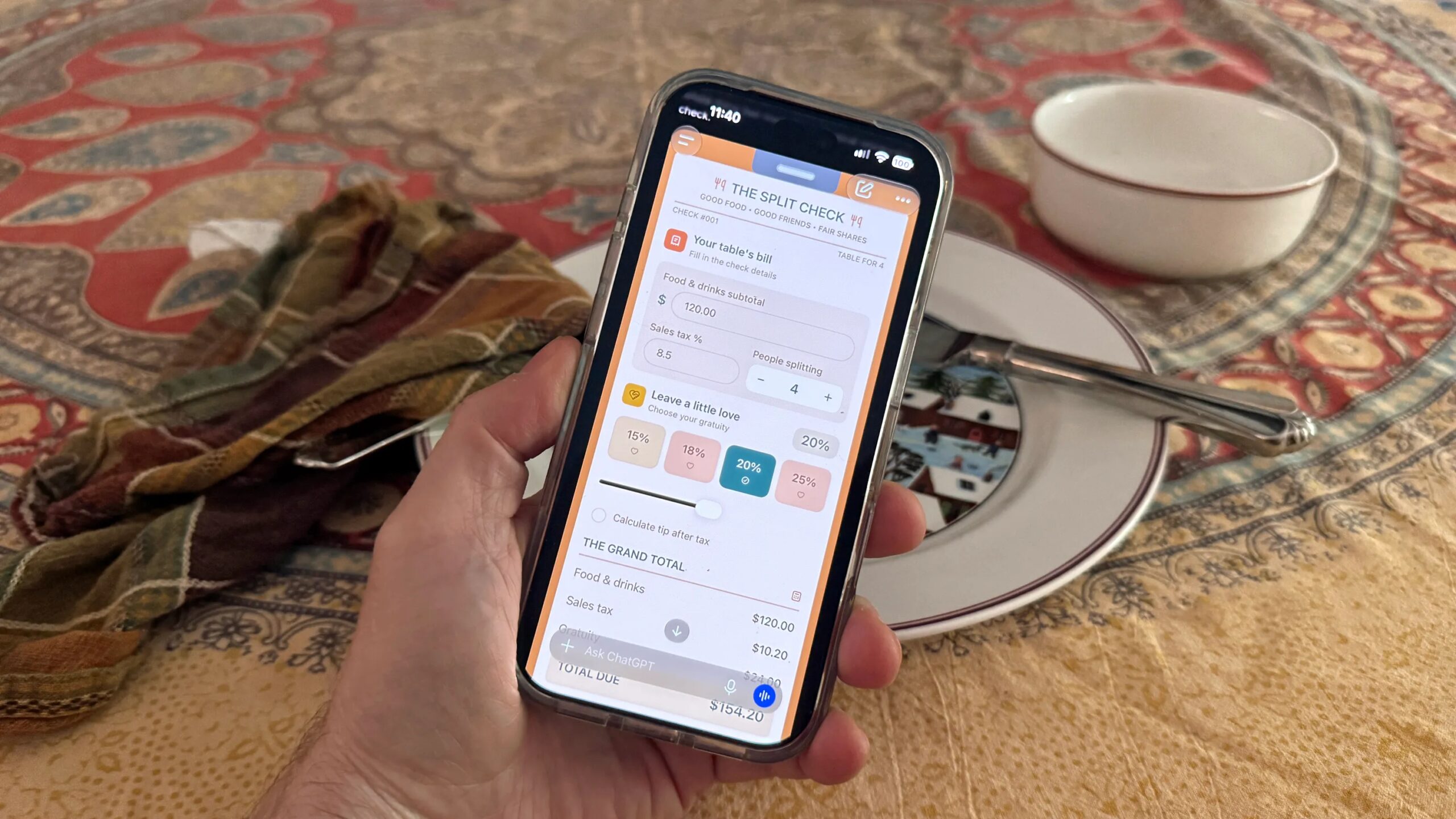
You are eating at a restaurant with a few other people when the check arrives. Assuming no one person pays the entire bill, you need to figure out how much each person owes. This was my second challenge to ChatGPT for the next time my wife and I dine with family or friends. Here I’m told to create an interactive clipboard for a restaurant bill splitter.
Also: How to use ChatGPT Work – and my top 10 tips for getting started with agent AI
The first attempt gave me an interactive tool that works perfectly. I was able to change all values including the total cost of the meal, sales tax, number of meals and tip. In return, the tool would show me the cost per person.
But I wanted something more visually appealing, so I asked ChatGPT to give it another try. The second attempt kept the same interactivity, but developed the tool as a virtual clipboard with different colors and a jazzier layout. With the ChatGPT mobile app on my iPhone, I can now use this tool when I eat.

3. Design an interactive diagram for a food recipe
One of my specialties in the kitchen is spaghetti and meatballs based on a recipe from the famous Italian restaurant Rao’s in Manhattan. I cook the meatballs and the sauce from scratch. With the holiday season, I plan to prepare this dish for the guests, but I don’t know yet how many people will be eating at our place. No problem: I asked ChatGPT to find the recipes online and create an interactive chart showing me how much to prepare for four to eight guests.
The AI responded by showing me the recipes for the meatballs and sauce along with step-by-step instructions on how to prepare everything. For the interactive element, the chart displayed two separate columns – one for the shopping list and another for preparing the meal. I could change the number of guests to any number from four to eight, and the chart would update to show the correct amount.
 Screenshot by Lance Whitney/ZDNET
4. Develop an interactive room designer
My wife and I are thinking of redoing our living room. But deciding what we want, figuring out what furniture we need and where to place it, and what color to paint the walls can be challenging, so I asked ChatGPT to create an interactive room designer.
Here, the AI created an interactive floor plan with adjustable dimensions, furniture and a palette of different colors. I was able to add, remove and change the position of each piece of furniture, as well as change the size of each piece. I was also able to choose the color for the wall by either selecting one of the predefined colors or selecting a custom color from a color bar. The end result helps us to better determine how to convert the room.
 Screenshot by Lance Whitney/ZDNET
5. Build an interactive timeline of American history
I am a huge history buff, especially when it comes to American history. For the fifth assignment, I asked ChatGPT to build an interactive timeline of American history. I have given it a specific timeline from 1620 to the present. I wanted to be able to drag a date slider to see different moments in history with the corresponding events or activities displayed.
Also: How I Used ChatGPT to Talk Me Through Fixing a Corrupt Gaming PC – Literally
Here, ChatGPT has provided an effective and useful timeline from 1620 to the present day. I could move the slider box to jump from one year to the next or select a specific category such as Colonial, Civil War, or World Wars. In response, the tool would show me the prominent events for that particular year. I was also able to explore the events through topics including politics and science, and look at historical milestones.
I asked ChatGPT to provide sources for information appearing in the timeline, which it did, so I could verify certain events. I wasn’t so worried about it for major historical events that are common knowledge, like the stock market crash of 1929 or the arrival of the pilgrims in 1620, but you should always check the accuracy of any information that chatbots give you.
 Screenshot by Lance Whitney/ZDNET
Overall, ChatGPT did a solid job of providing the interactive images and tools I requested. With GPT-6, I can now use AI to visually help me learn, understand and work with any topic or area that comes to mind.

See full bio