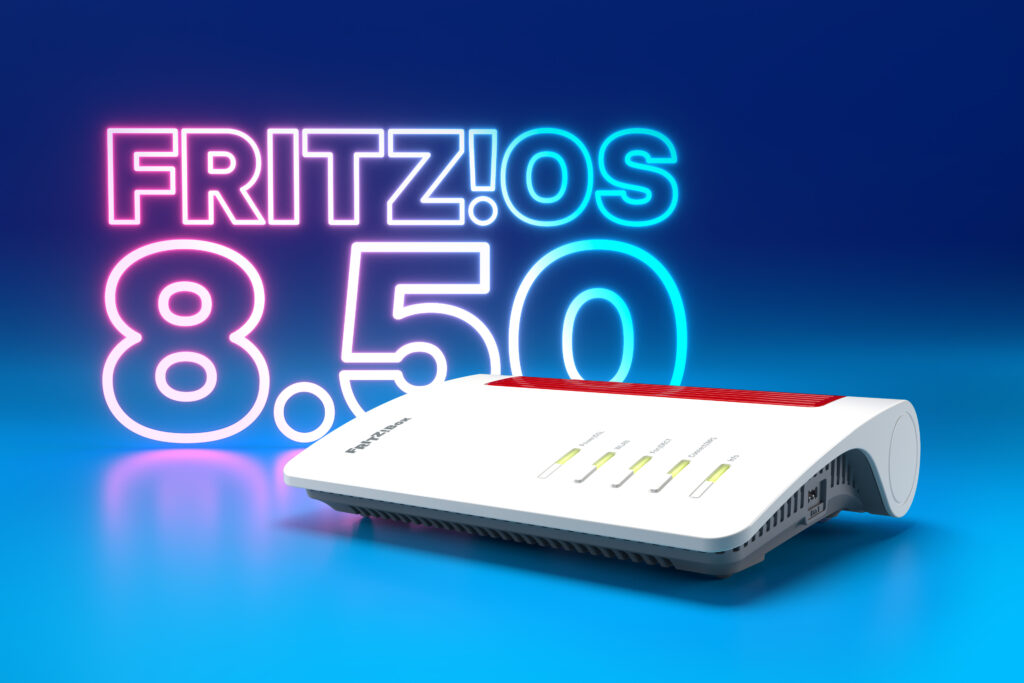
FRITZ!, the Berlin-based networking company formerly known as AVM, has begun rolling out FRITZ!OS 8.50, a major firmware update for its routers and mesh repeaters. The FRITZ!Box 7690 is the first model to receive the new software, with the update for all current FRITZ!Box and FRITZ!Repeater models in the coming weeks.
The release covers a wide range of areas, from improved diagnostic tools to additional smart home automations. According to the company, the main focus is on the stability and security of the home network. The most notable additions are a new DNS filter, extended failover protection and the automatic prioritization of real-time data streams, with the changes for home work, online gaming and smart home use.
Related reviews
How to install the update
Users who have activated the automatic update feature will have FRITZ!OS 8.50 installed without having to do anything. Alternatively, the update can be requested manually by logging into the router at fritz.box and selecting “Start Update” in the user interface. A full list of new features and changes is available at FRITZ! Website at fritz.com/fritzos.
It’s worth noting that not every feature comes to every model at the same time. Several of the new features, including DNS filtering and automatic prioritization, will be introduced first in the FRITZ!Box 7690 and will be extended to other selected models as the rollout continues.
New DNS filter to block unwanted content
The most significant security addition in FRITZ!OS 8.50 is a router-level DNS filter. Every time a phone, laptop or other connected device visits a website, it first asks a DNS server to translate a domain name into the numeric IP address needed to make the connection. By blocking these requests, the router can refuse to resolve domains that appear on a block list.
With the update, the FRITZ!Box 7690 can block devices in the home network from accessing specified domains. The router supports common standards for importing and processing lists of domain names, which means that users can use publicly available DNS filter lists instead of building their own. These lists can be used to filter a variety of content, including:
- Advertising and tracking services
- malware distribution sites
- phishing pages
- botnet infrastructure and other unwanted content
If a device on the network tries to access a blocked address, the FRITZ!Box automatically blocks the request. Since the filtering takes place on the router itself, it applies to every device on the network without having to install the software on each one. This approach is similar to that used by dedicated network-wide blockers such as Pi-hole and AdGuard Home, which typically run on separate hardware. FRITZ! says the feature will gradually become available to additional select models as part of the rollout.
Smart Check brings network diagnostics to the MyFRITZ!App
FRITZ!OS 8.50 also introduces Smart Check, a new diagnostic function in the MyFRITZ!App. It shows the current status of the FRITZ!Box directly on the start screen of the app and provides recommendations, notices and warnings about a number of technical areas. These include Internet connection, telephony, home network, Wi-Fi, LAN, USB, Smart Home and security.
Each item comes with specific guidelines on how to solve it. For example, Smart Check will flag when a mesh connection to a repeater is missing, and it can offer advice to block unwanted calls to premium-rate phone numbers. The overall status is visible at a glance on the home page, and a single tap on “Smart Check” opens a more detailed analysis.
Automatic priority for real-time applications
FRITZ!Box routers have long offered the option to prioritize individual devices on the network. FRITZ!OS 8.50 adds the ability to automatically prioritize specific applications that run in real time, such as video conferencing and online gaming.
The router recognizes these applications on its own and gives them priority in the home network without manual configuration, with the aim of keeping the connection stable when the network is under load. When a priority connection is active, this is displayed in the user interface against the relevant network device, and the activity can be reviewed up to 24 hours afterwards. As with DNS filters, automatic priority will be introduced for selected models in the coming weeks.
FRITZ! Failsafe extends to 4G and 5G models
FRITZ! Failsafe is the company’s failover protection feature that keeps a home network online when the primary Internet connection fails. With FRITZ!OS 8.50, it can now be used directly on FRITZ!Box models developed for 4G and 5G mobile broadband.
For the first time, these mobile broadband routers can also connect to the Internet via a LAN port. This allows them to be connected to an upstream device such as an optical network terminal (ONT) on a full fiber connection. In this arrangement, the cable connection acts as the main link, and FRITZ! Failsafe temporarily switches the internet supply to the mobile network if the landline or fiber connection fails.
Simple mode and SOS calls for FRITZ!Fon mobile phones
The update also makes changes to the FRITZ!Fon range of DECT cordless phones. A new easy mode reduces menu navigation to the essentials. Once activated, the softkeys can be used as quick-dial buttons, with each assigned to a phone number or function.
Simple mode also includes an integrated SOS call feature. Up to four emergency contacts can be stored, and the handset will automatically call them in sequence in an emergency. The interval between calls can be configured. FRITZ! says that the mod was designed specifically for users who prioritize accessibility and ease of use.
Smart home security features and new automations
On the smart home side, FRITZ!OS 8.50 adds a security feature to the FRITZ!Smart Energy 200 and 210 smart plugs, as well as the upcoming FRITZ!Smart Energy 201 indoor model. These plugs can now be automatically turned off when a specified current limit is exceeded for a defined time.
The update also adds preconfigured automations, including “Leaving the House,” “Coming Home,” and “Holidays.” These can be set up and triggered in a few steps with zones, or geofences, previously configured in the FRITZ!App Smart Home. With the next update, routines can combine multiple triggers, including geofences defined on each smartphone. For example, it becomes possible to set a routine that is only activated when all the residents have left the house.
FRITZ!Box 5690 Pro gets Matter Bridge support
Finally, the FRITZ!Box 5690 Pro can now act as a Matter bridge. Matter is an industry standard for smart home devices designed to allow products from different manufacturers to work across different platforms.
As a result of this change, all FRITZ! Smart home devices, together with compatible smart home devices from other manufacturers registered with the FRITZ!Box 5690 Pro, can be added to an existing Matter network managed by Apple Home, Google Home or Amazon Alexa. This also allows these devices to be controlled by voice through the respective assistants.
Availability and price
FRITZ!OS 8.50 is now available for the FRITZ!Box 7690 and is delivered as a free firmware update. It will be rolled out to all current FRITZ!Box and FRITZ!Repeater models in the coming weeks, while the DNS filter and automatic priority functions will reach additional selected models in stages. Multi-trigger routines for smart home automations are planned to come with the next update.