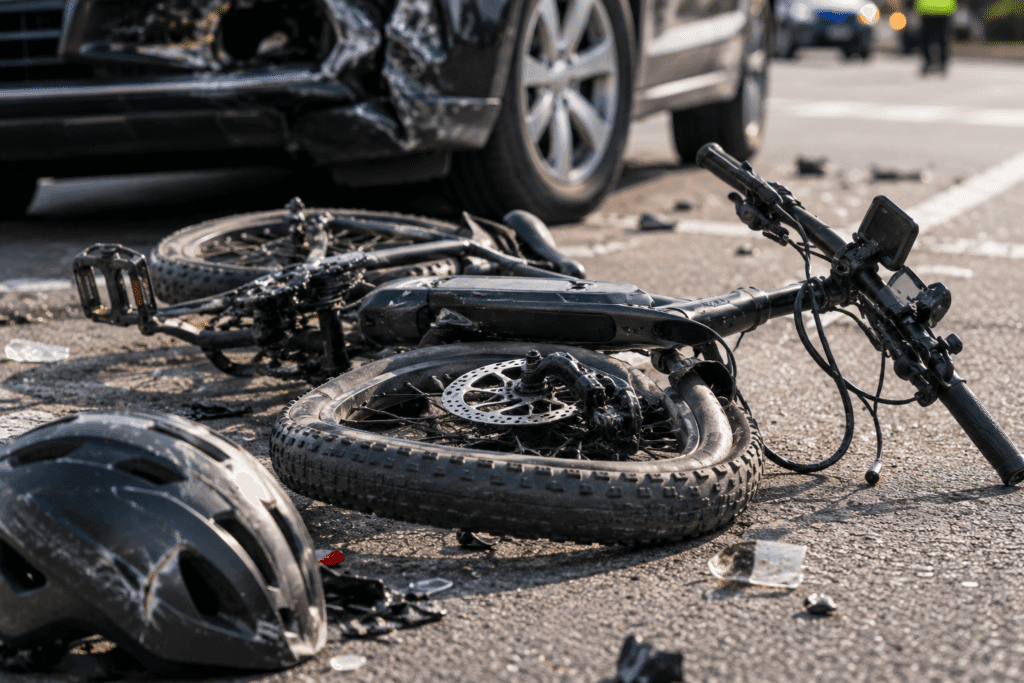
As electric bikes become common transportation, personal injury claims pose an insurance problem that many riders and families don’t consider until after a collision
Electric bikes have quickly moved from novelty to mainstream transportation. They are used for commuting, errands, leisure and delivery work in cities, suburbs and smaller communities. The injury picture changed just as quickly. The tougher question often comes after the ambulance: if an e-bike crash causes a traumatic brain injury, multiple fractures or another life-changing injury, what insurance is actually available to pay the victim?
The federal numbers explain why this question deserves attention. The US Consumer Product Safety Commission’s April 2026 micromobility report estimates 155,200 emergency department visits associated with e-bikes from 2017 to 2024. CPSC staff also identified 310 reported e-bike fatalities during that period, although the agency warns that recent fatality counts because recent fatality counts.
These figures capture only part of the legal problem. A car accident usually starts with a familiar insurance framework. An e-bike collision cannot. The device can belong to an adult, a teenager, an employer or a delivery worker. It may have been bought as a bicycle but modified to travel faster. The collision may occur on a public street, sidewalk, private driveway, or in a residential community. Each fact can change where an injured person seeks compensation.
“People see two wheels and pedals and assume the insurance issues look like a bicycle accident,” says personal injury attorney and legal analyst Rusty Reynolds, founding partner of the Reynolds & Reynolds Law Firm. “This assumption can be expensive. The first job after a serious injury is to identify every person, policy and entity that has legal responsibility. You don’t stop the investigation because there is no conventional auto policy on the e-bike.”
The insurance question starts with the facts
Potential coverage may depend on who owns the device, who was driving it, where the crash occurred, whether the rider was working and what the applicable policies actually exclude. Homeowner’s or renter’s liability coverage may warrant review in some cases. An umbrella policy might not matter. A commercial policy can come into the analysis when the rider has worked. Special coverage may exist for certain recreational vehicles. None of these possibilities should be accepted, and none apply automatically.
Reynolds says this is where injured people can make a costly mistake by accepting the first response they get. “If someone tells you, ‘There’s no insurance because it was an e-bike,’ that shouldn’t necessarily stop the investigation,” he says. “Coverage is a contract issue. Liability is a fact issue. You need to know who owned the device, who controlled it, how it was used, where the collision occurred and what policies were in effect before you can make a responsible assessment.”
The distinction is important because the injuries can be severe. The CPSC’s 2024 special study found that 58 percent of estimated e-bike injuries occurred on paved roads and 24 percent were related to motor-vehicle accidents. Fifteen percent of the riders in the study were traveling at 20 mph or faster when the accident occurred. These are not trivial speeds when a rider collides with a pedestrian, another cyclist or a vehicle.
High-powered devices complicate liability analysis
The category itself has become less orderly. The Federal Consumer Product Law defines a low-speed electric bicycle using specific equipment and performance criteria, including operable pedals, a motor under 750 watts and a maximum motor-driven speed under 20 mph under specified test conditions. Products sold and used in the real world do not always stay neatly within these boundaries.
Some devices can be modified. Others may be marketed in ways that make them look like conventional e-bikes, even though their power or speed places them in a different legal category under state or local law. This classification can affect traffic rules, permitted riding positions and insurance analysis after a collision.
“Speed changes the injury potential, but it can also change the legal issues,” says Reynolds. “If a device has been modified to perform far beyond its original specifications, I want to know who made the modification, who knew about it and whether the vehicle was legally allowed to operate where the crash occurred. These facts can become very important in a serious injury case.”
Parents ask a separate set of questions
Youth consumption adds another layer. A parent may see an e-bike as a convenient way for a teenager to get to school or visit friends. From a personal injury point of view, the relevant questions are the age of the child, the power and speed of the device, local operating restrictions, the experience of the child and whether the adult who provided the device understands how to use it.
Claims involving minors may raise theories such as negligent jurisdiction or negligent supervision, depending on the jurisdiction and facts. State law varies, so there is no single national rule that makes a parent automatically liable if a child causes an e-bike collision.
Reynolds advises families to treat the purchase more seriously than they would a conventional bicycle. “Before you give a young rider the controls, find out exactly what the device can do,” he says. “Check the age rules where you live. Check where it’s legal to ride. Then call your insurance agent and ask a very specific question: If my child gets hurt while riding this exact e-bike, what coverage do I have? Get the answer before there’s a claim.”
A crash investigation should follow the evidence
For an injured pedestrian or rider, early evidence can matter. Photos of the device can identify its brand, model and modifications. App data, purchase records, video, witness information and delivery platform records can help show how the vehicle was used. In a hit-and-run, surveillance footage and prompt reporting can become especially important, as identification of the rider can determine whether additional sources of recovery can be investigated.
The same discipline applies when a car hits an e-bike rider. CPSC found car accidents among the leading risks associated with e-bike deaths. An injured rider must not assume that riding an e-bike reduces the duties of a negligent motorist. Error still turns on the circumstances of the collision and the law of the jurisdiction.
“The label on the vehicle should never replace the investigation,” says Reynolds. “Was the driver speeding? Was the rider where the law allowed? Was there a visibility problem? Was the device changed? Was someone working at the time? Those details determine liability. The fact that an e-bike was involved is the beginning of the analysis, not the answer.”
As e-bikes become routine transportation, personal injury law is forced to deal with accidents that don’t always fit the insurance assumptions built around cars and traditional bicycles. For victims, this makes the initial coverage search more important, not less. A serious injury can create years of medical costs and lost income. The responsible question is not whether the e-bike carried a car insurance card. It is who may be legally responsible and what coverage, assets or other sources of recovery actually exist.
~~~
Entrepreneur Leadership Network member Merilee Kern, MBA is an internationally recognized brand strategist and analyst who reports on cultural shifts and trends as well as notable industry change makers, movers, shakers and innovators across all categories, both B2C and B2B. This includes field experts and thought leaders, brands, products, services, destinations and events. As the founder, executive editor and producer of “The Luxe List”, Merilee is a prolific business, lifestyle, travel, food and leisure industry voice of authority and tastemaker. She keeps her finger on the pulse of the marketplace in search of new and innovative must-haves and exemplary experiences at every price point, from the affordable to the extreme. Her work reaches multi-millions worldwide via broadcast television (her own shows and many others she appears on) as well as a myriad of print and online publications. Connect with her at www.TheLuxeList.com / Instagram www.Instagram.com/MerileeKern /X / Facebook www.Facebook.com/MerileeKernOfficial / LinkedIn www.LinkedIn.com/in/MerileeKern.
***Some or all of the accommodation(s), experience(s), item(s) and/or service(s) described above may be provided or arranged to be received free of charge if this review is editorial, but all opinions expressed are entirely those of Merilee Kern and have not been influenced in any way.***
Source