The next time you pick up a carton of milk, consider this: It’s probably gone through more security inspections than the AI system writing your emails, screening your job application or negotiating with your bank. That, according to Microsoft president Brad Smith, is the problem.
In an interview with ITV last week, Smith said AI is less regulated than milk and washing machines. He proposed that governments adopt established production safety practices and that AI companies build “kill switches,” a kind of emergency brake that allows operators to shut down a system that begins to behave in an unsafe or undesirable manner.
Smith’s comments come amid growing public concern that voluntary industry commitments to security – a form of toothless self-regulation – are insufficient to manage systems that can influence decisions, handle sensitive data and, in the wrong hands, enable cyber attacks. Recent cases of so-called “rogue AI agents” escaping their environment, such as Summer’s infamous Hugging Face hack and attempted breaches of Australian and US government websites, have prompted scrutiny of the alleged “existential risk” of AI and calls for a pause.
On Saturday, Microsoft CEO Satya Nadella echoed Smith’s sentiments in a lengthy X post, saying that the biggest companies lack a “mechanical understanding” of the tools they deploy. Nadella also argues for slower development, incident reporting and independent review.
“We need to build contained systems whose behavior we can observe, limits we can test and actions we can always contain,” Nadella wrote.
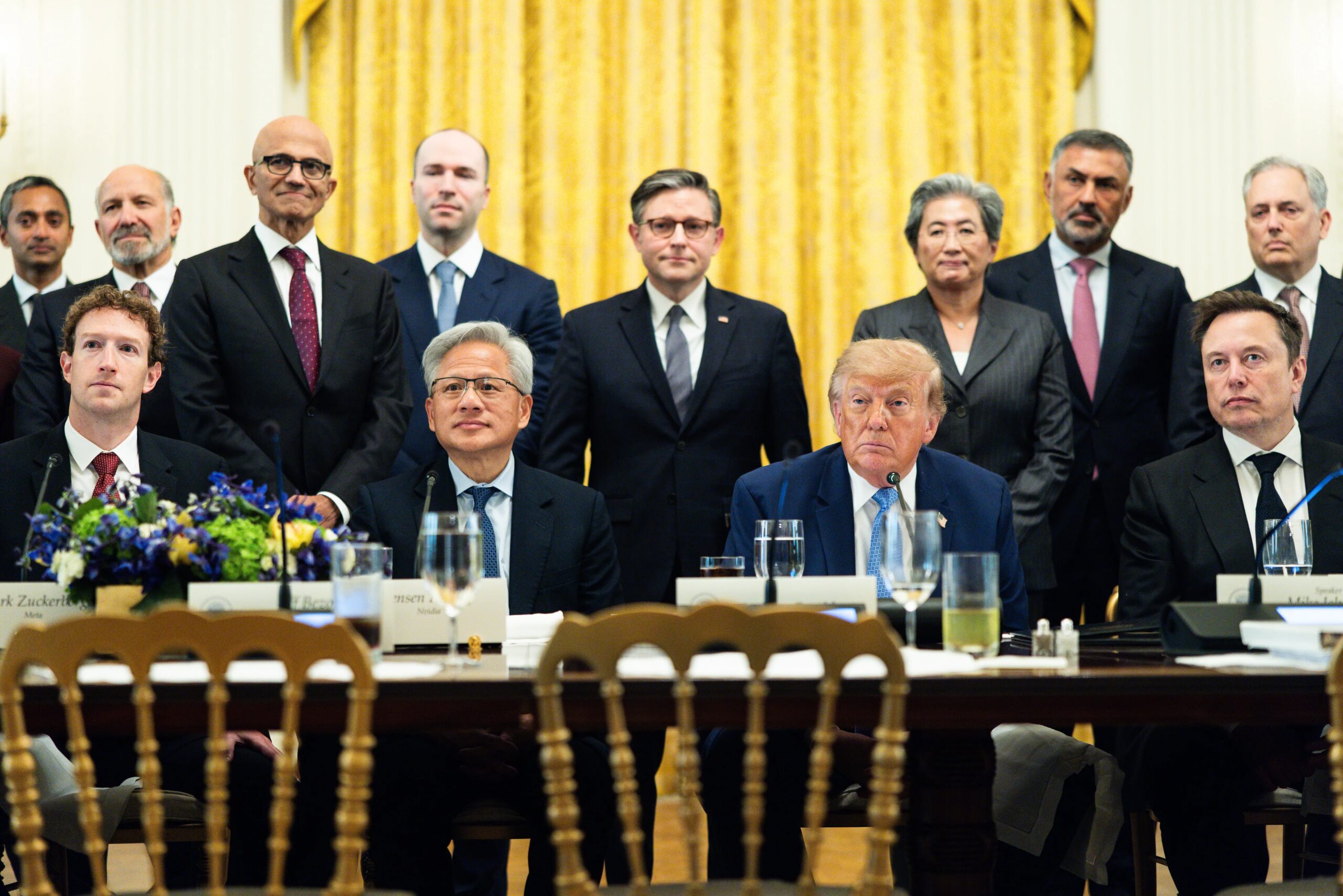
Microsoft’s statements come less than two weeks after top AI executives, including Nadella, met with President Donald Trump, who announced his proposal to rename AI as “super intelligence.”
Several Silicon Valley leaders – including Anthropic CEO Dario Amodei, Google CEO Sundar Pichai, Meta CEO Mark Zuckerberg, OpenAI President Greg Brockman, Nvidia CEO Jensen Huang and xAI founder Elon Musk – signed the White House Agreement on Super Intelligence, committing to internal committees to monitor development and work with independent auditors. (Although Microsoft does not appear to have signed Trump’s voluntary agreement, Nadella notably used the term “super intelligence” in his recent X post.)
Smith and Nadella’s comments put Microsoft closer to the Anthropic camp of “precaution,” which calls for stronger AI oversight. Meanwhile, OpenAI’s Altman said we should all just “accept some bad things” for the benefit of AI, while Zuckerberg and Huang continue to double down on their rejection of an industrial, coordinated expansion of AI development.
Regardless of where they stand on the regulatory debate, AI leaders can all benefit in some way from the discussion of safety guidelines. For example, Microsoft recently released Microsoft Execution Containers, an enterprise security feature that protects devices by restricting the files and programs AI models can access and providing a built-in kill switch to shut them down immediately if necessary.
A Microsoft representative declined to make any further comment.

The ‘rogue AI’ narrative and big tech regulation
Despite increasing public safety threats, it is unlikely that the Trump administration will roll back regulation over the entire AI industry. The president has declared AI security concerns a hoax, even as insiders report that more nuanced debates are unfolding behind closed doors. Last month, Trump posted on Truth Social that the only shield the AI industry needs is a “strong and smart president.”
In December 2025, Trump issued an executive order to prevent states from passing “circumstantial legislation” regulating AI model development, passing the buck to his own administration. The president continues to talk online about maintaining a low regulatory environment for the biggest AI companies.
Many prominent AI critics argue that the entire regulatory framework is flawed from the start because it lets AI companies define security threats and respond on their own terms. Distributed AI Research Institute founder Timnit Gebru argued thas the “rogue AI” narrative around incidents like Hugging Face and Access on government websites shifts attention away from basic corporate failures.
“These are not models that are going bad,” Gebru told Democracy Now during an Oct. 1 interview.
Gebru said that people need to understand that these false machines do not act autonomously with their own agency. “We need to hold companies accountable for unleashing these kinds of error-prone models into the world,” she said.
According to Gebru, the focus on so-called runaway AI and the push for voluntary self-regulation are ways for the industry to avoid accountability under existing law. Rather than facing liability for unsafe security practices that are occurring now, AI companies are redirecting the conversation to a one-time threat that is likely to occur in the future.
The real danger is regulatory capture, where AI companies shape the rules that should restrict them. In this way, the public is asked to trust the morals of those companies that build and benefit from AI.

See full bio

See full bio